The week ahead: A key moment for the global economy as threats rise
- UK diesel hits a record, as economic concerns rise.
- Labour’s ‘Your First Home’ scheme sets UK homebuilders alight.
- The market expects an aggressive Fed rate hiking cycle, but is it necessary?
- Oil supply concerns ease, even as oil prices rise.
- Does Scott Bessent have a point?
- What’s next for the AI trade.
- Micron results: a key test for AI trade.
- Nvidia tries to make AI safer.

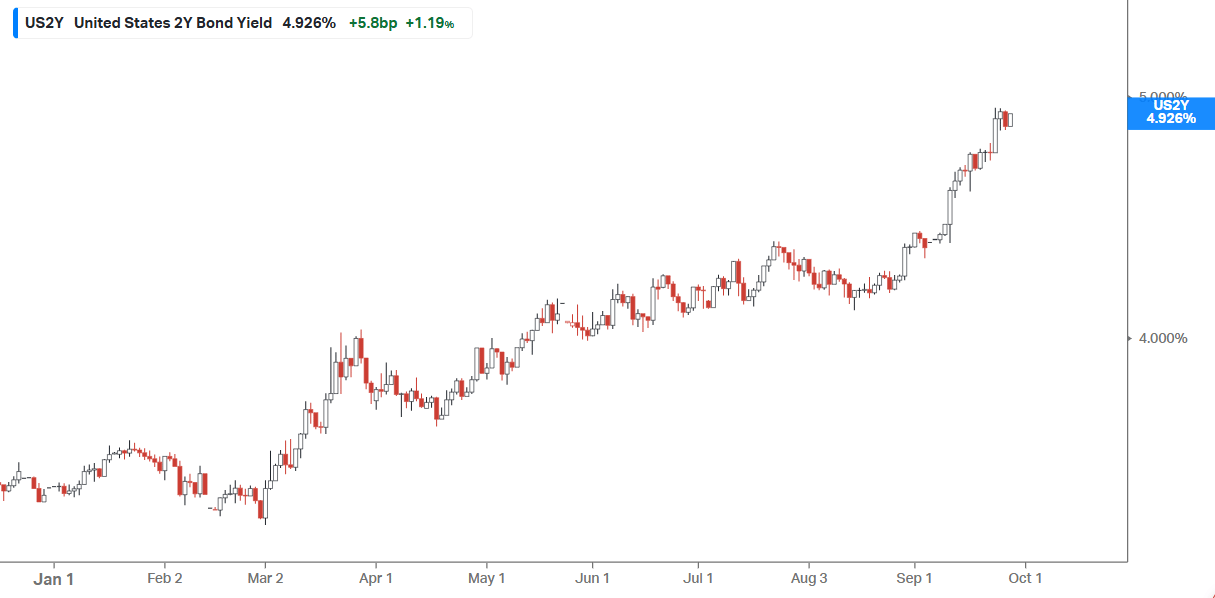
Oil prices are rising once more on Monday, and Brent crude is higher by more than 3% after last week’s hopes for a diplomatic solution to reopen the Strait of Hormuz have been dashed. The Brent crude continuous contract is back above $100 per barrel. This is also putting upward pressure on sovereign bond yields. US Treasury yields are rising once again, and European yields are now jumping sharply. The 2-year Treasury yield is marching towards 5%, and is currently trading at 4.92%.
UK diesel hits a record, as economic concerns rise
Diesel costs in the UK have hit a record high of 199.18p per litre, higher than the aftermath of Russia’s invasion of Ukraine. UK Fuel costs have now entered unchartered territory, and there will be rising concerns about the economic impact, and how the BOE will react.
Rising yields are weighing on stocks, and futures on US indices are under pressure on Monday, as the move higher in yields tests the resilience of the tech trade. Semiconductor stocks came under pressure during the Asian session, and Korea’s Kospi index fell 2% as volatility rose.
There is one pocket of support for the stock market, UK homebuilders are surging on Monday, after the government rebooted the Tories’ Help to Buy scheme. Persimmon and Barrett Redrow are higher by 14% and 13% respectively this morning, reversing a fairly torrid year for the homebuilding sector, which has been crushed under the weight of rising interest rate expectations.
Labour’s ‘Your First Home’ scheme sets UK homebuilders alight
This is boosting the FTSE 100, which is higher by 0.3% so far on Monday. There are also gains for the broader FTSE 350, as UK homebuilding suppliers also gain from this latest government announcement. Travis Perkins, Ibstock, the brick maker, and Topps Tilles are also rising this morning.
It is not broad-based euphoria,however. The government’s ‘Your First Home’ plan will slash the deposit required to 2.5% from 5%, which should help give access to lower income first time buyers. This is helpful for Persimmon, which builds homes at a relatively low price point, compared to other premium homebuilders like Berkely. There is also a stark difference between this scheme and the original scheme launched by George Osborne: a very different interest rate environment.
Back then, the base rate was 0.5%, compared to 3.75% now, and there are expectations that rates will have to rise further. Also, some participants of the original scheme have had trouble selling on their properties, particularly flats, with some properties falling into negative equity.
Although the government will face criticism as it launches this scheme, there is no doubt that the dial has shifted for UK homebuilders, and we could see the start of a new bull market for this sector, which is good news for the FTSE 100 in the short term.
Market expects an aggressive Fed rate hiking cycle, but is it necessary?
As we start a new week where there is still no resolution to the energy price crisis, sovereign bond yields are surging, and questions are rising about when rising interest rate risk will spill over into credit and economic risk? There is now a 70% chance of a rate hike from the Fed in October, and a near 60% chance of another hike in December.
As we move to the end of Q3, the market is pricing in an aggressive Fed rate hiking cycle. Sovereign yields are rising to multi-decade highs, led by the US, where yields on all maturities higher than 3-years are now above 5%. The diverging performance between stocks and bonds is worth noting, especially as hopes for a resolution to the blockade of the Strait of Hormuz remains elusive.
Oil supply concerns ease, even as Oil prices rise
However, while the oil price is rising at the start of the week, it is worth noting that oil tankers are getting through the Strait of Hormuz, Saudi oil exports rose to their highest level since the war began and exports through the Strait are averaging 14mn barrels per day. Added to this, Saudi Arabia’s East-West pipeline is operating at full capacity.
There is still a ‘war’ premium attached to the oil price, and that will stay until the conflict is resolved, but at some stage, the market is at risk of becoming detached from the fundamentals. Even the US Treasury Secretary said at the weekend that the Federal Reserve should keep an open mind about interest rates since productivity gains from AI will keep inflation in check.
Does Scott Bessent have a point?
While the Fed is likely to ignore his words, Bessent does highlight how the shift in rate hike expectations in the US is causing concern right at the top of politics.
The question now is, will this week’s key US economic data releases shift US interest rate expectations once again? US PCE and Payrolls on Friday could trigger another recalibration in US rate expectations. If payrolls or inflation data are softer than expected, we could see rate hike expectations get scaled back sharply.
What’s next for the AI trade
The AI trade is also in focus this week. It is set to slide on Monday, but it is worth noting that stocks linked to the AI trade have been swinging between two extremes in recent weeks, with money quickly moving out of and then back into the AI trade as the newsflow shifts. Concerns about a slowdown in the development of AI technology triggered a major downturn in the AI trade earlier in September, but now excitement about Meta’s new Muse AI agent, has reignited enthusiasm for the trade.
This is a narrative market, and when the narrative changes, so does the trade. For example, $3 trillion has been added to the Nasdaq since its September 15th low, and moves have been staggering in both directions.
Although Meta is expected to slide today, in the pre-market its share price is lower by more than 2%, Meta’s shares are on track for their best monthly performance for more than a decade and are currently higher by 27% in 4 weeks.
Every time there is an AI sell off, the market finds an excuse to jump back in, and the decline in the AI trade earlier in September helped remove some of the froth from the market. Some AI names now trade at attractive valuations, for example, Nvidia now trades at a forward P/E ratio of 25 times future earnings, which is nearly 50% below its 10-year average.
Micron results: A key test for AI trade
This week, a key driver for the AI trade could be Micron’s earnings on Wednesday night. Investors will be watching margins, revenue, projected demand and earnings. Margins are particularly in focus due to surging memory costs
Micron has projected revenues of $50bn and gross margins of 86%, so any deviation from this guidance may trigger stock market volatility, and the options market is currently projecting a move of 8% in either direction. Attention will also shift to the revenue outlook and capex spending, which is expected to be $10bn for next quarter. Some analysts are concerned about the longer term outlook, and the stock price is already higher by 266% YTD, so there is not much room for error.
Nvidia tries to make AI safer
Nvidia is also in focus after it announced a software platform that controls AI agents and stops them from going rogue. This could target some concerns about rogue agents that have escaped their ‘sandbox’ test labs, for example the incident where 17,000 agents attacked Hugging Face’s infrastructure. So far, this is not halting an expected slide in US AI stocks later on Monday, however, anything that makes AI safer is likely to be looked on warmly by investors.
Chart 1: US 2-year Treasury yield
Author

Kathleen Brooks
XTB UK
Kathleen has nearly 15 years’ experience working with some of the leading retail trading and investment companies in the City of London.