Fed vs BoJ: Both hiked. The market only believes one of them – and the chart shows which

The Federal Reserve (Fed) and the Bank of Japan (BoJ) have just done something remarkably similar. Both central banks raised interest rates by 25 basis points (bps) last week, both are confronting inflation risks, and both signal that future decisions will depend on incoming economic data.
On paper, the two decisions appear to tell the same story: Monetary policy is becoming tighter on both sides of the Pacific. Markets, however, rarely trade on the headline alone.
What investors believe will happen next can matter much more than what a central bank has just done. And once the market reaction following the two decisions is brought into the picture, the apparent similarity between the Fed and the BoJ begins to disappear.
The USD/JPY chart makes that divergence difficult to miss.
The USD/JPY chart reveals which rate hike markets believe
The Fed raised interest rates by 25 bps on Wednesday, September 16, taking its target range to 3.75%-4.00%. Two days later, on Friday, September 18, the BoJ followed with its own 25-basis-point increase, lifting its policy rate to 1.25%, the highest level in 31 years.
However, USD/JPY rose after the two central-bank decisions, clearly indicating how investors interpreted them.
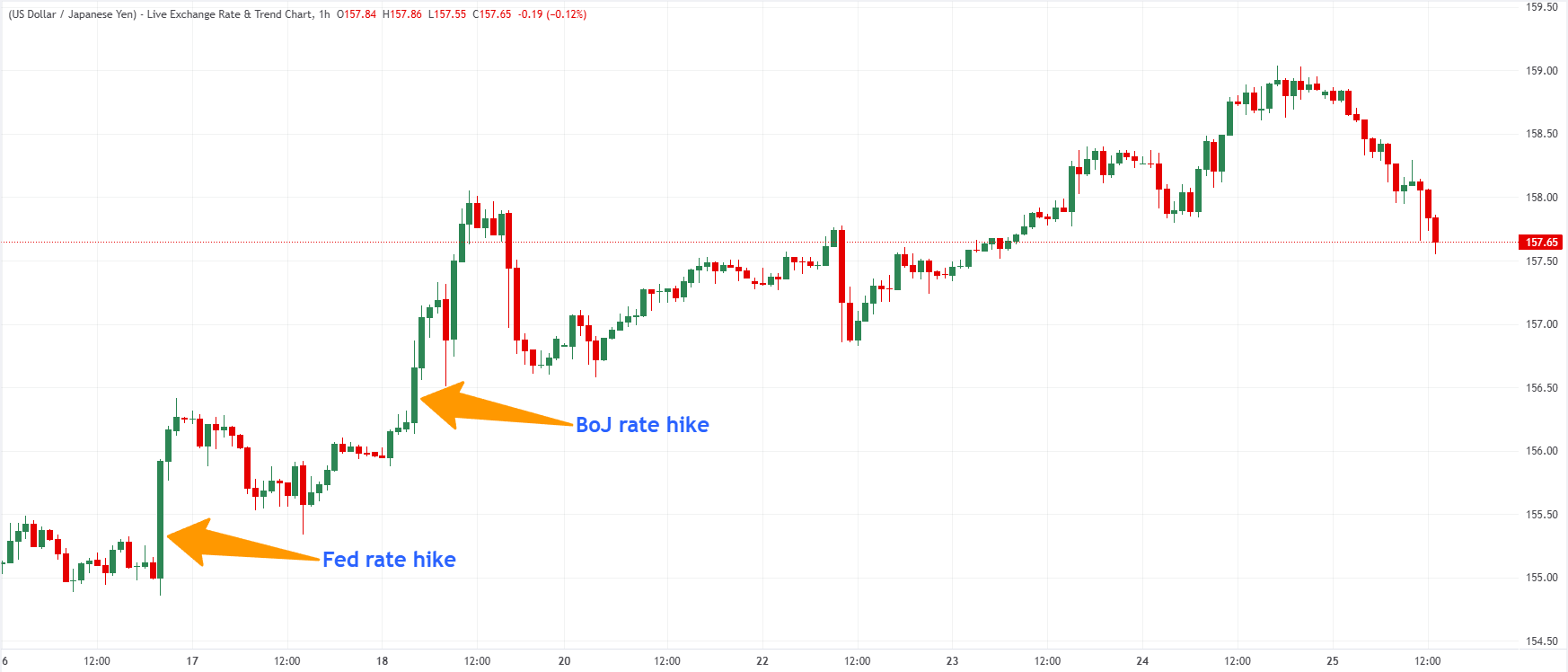
A rising USD/JPY means that the US Dollar (USD) is appreciating against the Japanese Yen (JPY), and that the JPY is weakening. In other words, even though both central banks tightened policy by the same 25 bps, the currency market treated the two decisions very differently.
That reaction is particularly striking on the Japanese side. The BoJ raised its policy rate to 1.25%, its highest level in 31 years. Higher interest rates would normally be expected to make a currency more attractive by increasing returns on assets denominated in that currency. Yet the Japanese Yen weakened after the decision.
The explanation lies less in the rate hike itself than in what accompanied it.
The BoJ approved the increase by a 7-2 vote, with board members Toichiro Asada and Ayano Sato opposing the move. Governor Kazuo Ueda also provided no clear timetable for another increase, leaving investors uncertain about how quickly the central bank is prepared to continue normalizing monetary policy.
Ray Attrill, head of FX strategy at National Australia Bank, told Reuters that the BoJ had “clearly underwhelmed versus expectations,” noting that the two dissenting votes raised additional questions about the strength of the central bank's tightening consensus.
The market, therefore, received a rate hike, but not necessarily the promise of a forceful hiking cycle.
The Fed delivered the same hike but a very different signal
The Fed also raised interest rates by 25 bps, taking the fed funds rate target range to 3.75%-4.00%. The size of the move was identical to the BoJ's. The message surrounding it was not.
Sixteen of the Fed's 18 policymakers expect at least one additional 25 bps increase before the end of the year. Updated projections put the policy rate at 4.10% at the end of 2026, compared with 3.80% in the previous projections. For investors, that changed the meaning of the hike.
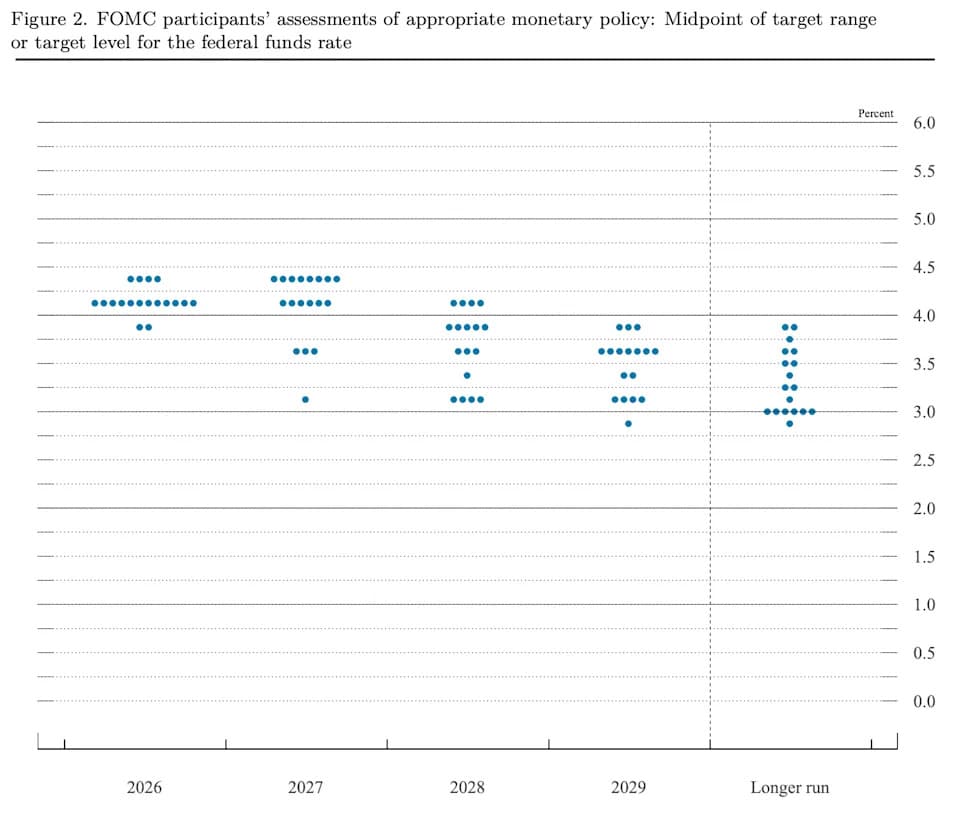
Rather than being interpreted as an isolated increase followed by an uncertain path, the decision reinforced expectations that US monetary policy could remain restrictive and that further tightening is possible.
Karl Schamotta, Chief Market Strategist at Corpay, said the unanimous Fed hike and the upward revision to policymakers' rate projections should help “restore confidence in the Fed's commitment to fighting inflation.”
That is where the contrast with the BoJ becomes clearer. Markets are not simply comparing two 25 bps hikes. They are comparing what each increase implies about the next one.
The rate gap explains why the two hikes are not equal
There is another reason why identical rate moves produce very different currency reactions: The two central banks are starting from very different places. After the latest decisions, the Fed's target range stands at 3.75%-4.00%, compared with just 1.25% for the BoJ. The gap, therefore, remains around 250-275 bps.
Because both central banks raise rates by the same amount, neither decision materially narrows that policy differential. Japan's borrowing costs rise, but so do those in the United States.
The same dynamic can be seen in government bond markets. The benchmark 10-year US Treasury yield trades around 5.17%, its highest level since 2006, while the Japanese 10-year government bond yield reaches around 3.08%, its highest level since 1996.
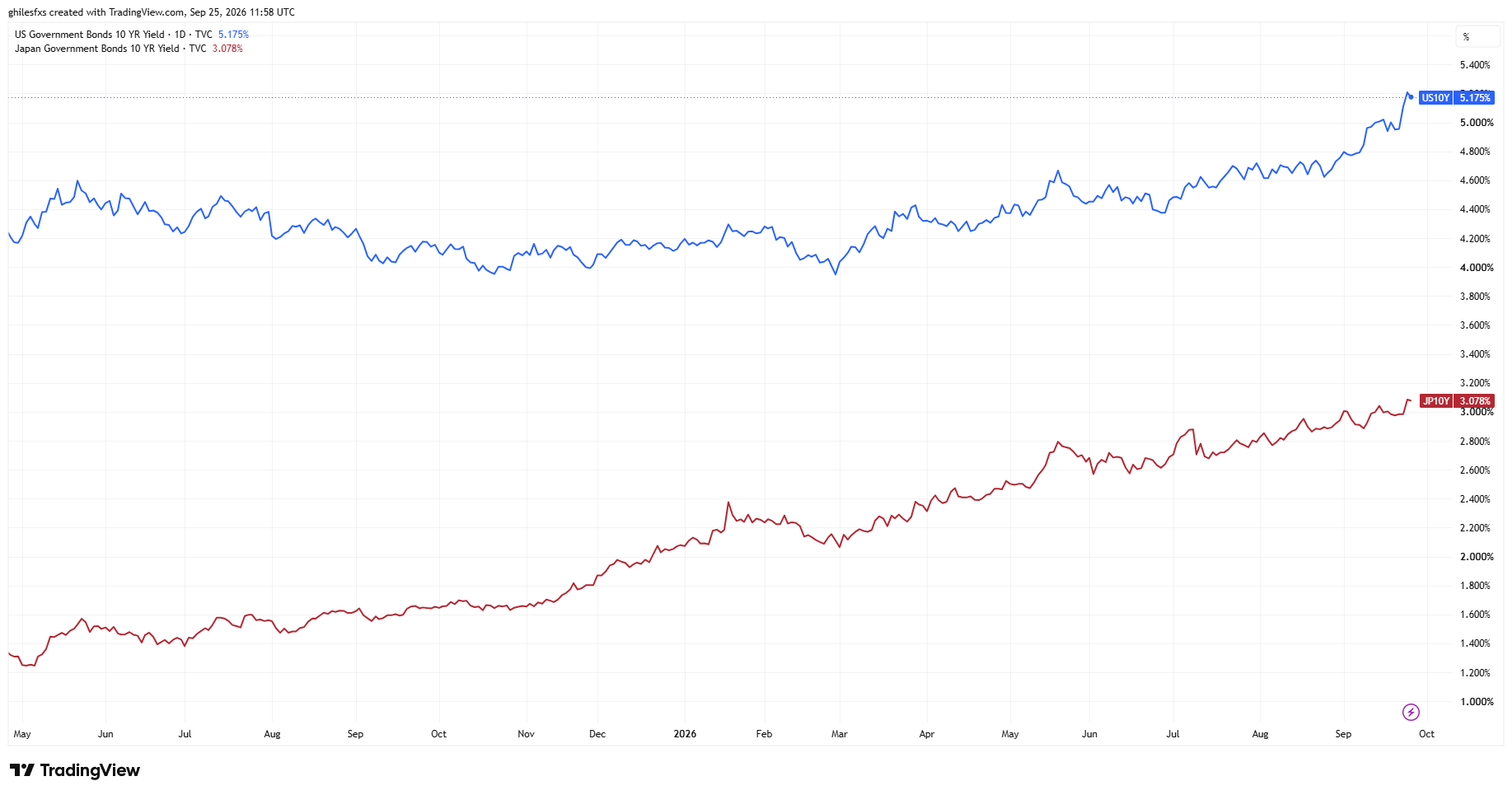
Japanese yields are clearly moving higher. They simply remain well below their US equivalents. That difference continues to matter for the carry trade, where investors borrow in a relatively low-yielding currency to invest in higher-yielding assets elsewhere.
The BoJ's normalization process makes borrowing in Japanese Yen more expensive than it was before, but the positive yield differential available in US assets remains substantial.
The result is visible in the USD/JPY chart as the two central banks are moving rates in the same direction, but they have not changed the relative equation enough to produce the same level of conviction in currency markets.
The market is trading the next hike, not the last one
The divergence also highlights a broader principle of foreign exchange markets: Currencies are forward-looking.
A central bank can raise interest rates and still see its currency fall if investors expected an even more hawkish decision. Conversely, a widely anticipated hike can support a currency if the accompanying projections suggest that additional tightening is coming.
This helps explain why the BoJ's 31-year-high policy rate has failed to generate a sustained Yen rally. The absolute number sounds significant in a Japanese context, but investors are comparing Japan not only with its own monetary history, but also with the returns available elsewhere.
The Fed currently combines a higher policy rate with a clearer signal that another increase could follow. The BoJ is tightening from an exceptionally low starting point while facing visible disagreement within its own policy board.
The two 25 bps increases are, therefore, mathematically identical but financially very different.
Japan's intervention threat tests how far the market will push the Yen
There is one force capable of complicating this divergence: Japanese authorities. After USD/JPY climbed above 158 following the BoJ decision, Japanese authorities conducted a rate check, according to the Nikkei. The procedure involves contacting currency dealers to obtain current exchange-rate quotations and is closely watched because it can precede direct foreign-exchange intervention.
The rate check was enough to trigger a sharp Japanese Yen rebound. Japan's Ministry of Finance (MoF) decides whether to intervene in the currency market, while the BoJ typically executes the operation. Finance Minister Satsuki Katayama has also indicated that Tokyo is prepared to take further coordinated action if necessary.
Kevin Ford, FX and macro strategist at Convera, told Reuters that “a hike that weakens the currency is an uncomfortable outcome for policymakers,” giving Japanese authorities a stronger case to respond to one-sided price action.
That makes the area around 160 increasingly important for traders, although Japanese officials do not identify a specific exchange rate as an automatic intervention threshold. The speed and disorderly nature of currency moves can matter as much as the level itself.
Hence, intervention risk can slow the move shown in the USD/JPY chart or trigger abrupt reversals. What it does not automatically change is the monetary-policy divergence behind it.
And that brings the story back to the original paradox. The Fed and the BoJ both raised rates by 25 bps. But markets are not voting on what the central banks have already done. They are positioning for what they believe each central bank can credibly do next.
For now, the USD/JPY chart is their ballot.
Author

Ghiles Guezout
FXStreet
Ghiles Guezout is a Market Analyst with a strong background in stock market investments, trading, and cryptocurrencies. He combines fundamental and technical analysis skills to identify market opportunities.














