The debasement trade: Could the US Dollar become the next casualty?
The US Dollar has spent much of 2026 fighting familiar enemies. Federal Reserve (Fed) expectations, stubborn inflation, geopolitical uncertainty and doubts about the sustainability of US fiscal policy have all taken their turn driving the world's reserve currency.
Now there is another phrase creeping into market conversations: the debasement trade.
It sounds dramatic. Perhaps deliberately so. Yet behind the catchy label sits a considerably more important question for financial markets: what happens when investors demand increasingly higher returns to finance the US government, but policymakers become increasingly uncomfortable paying them?
That question moved closer to centre stage in August after the US Treasury announced that it would at least double the size of its liquidity-support buybacks of longer-dated Treasury securities. From September 9, the maximum purchase size will rise from $2 billion to at least $4 billion per operation in the 10-to-20-year and 20-to-30-year sectors. The increased purchases will run through the current refunding quarter, ending November 4.
The amounts themselves are hardly enough to overwhelm the world's largest government bond market. But markets trade narratives as much as numbers, and the message investors heard was potentially more important than the dollars involved.
Washington appears increasingly uncomfortable with rising long-term borrowing costs.
And if the bond market is no longer allowed to provide the release valve, investors are beginning to wonder whether the US Dollar eventually will.
The debasement trade enters Wall Street
Currency debasement is hardly a new concept.
Historically, governments reduced the precious-metal content of their coins while maintaining their nominal value. Today's version is considerably more sophisticated, but the underlying fear is similar: governments carrying very large debt burdens have an incentive to reduce the real value of those liabilities over time.
That does not necessarily require runaway inflation or money printing.
Financial repression can take subtler forms: keeping borrowing costs below where markets would otherwise set them, allowing inflation to run somewhat hotter, encouraging domestic institutions to absorb government debt or using balance-sheet and debt-management policies to influence yields.
For investors, the response is the so-called debasement trade.
Rather than holding assets whose value depends directly on the purchasing power and credibility of fiat currencies, investors move towards scarce or real assets. Gold is the classic example, while Bitcoin has increasingly joined the conversation.
The trade therefore tends to look something like this:
Government debt concerns rise → confidence in fiat assets falls → Gold and other scarce assets gain → government bonds and the currency come under pressure.
The US Treasury's latest move has given that argument fresh oxygen.
When 5% becomes uncomfortable
The backdrop matters.
US public debt has moved beyond $40 trillion, while long-term Treasury yields have climbed as investors demand compensation for inflation, enormous financing requirements and fiscal uncertainty. The 30-year Treasury yield recently reached its highest level since 2007.
Higher yields are not inherently a problem.
They are the price mechanism through which the bond market balances supply and demand. If Washington needs to borrow more money and investors become less enthusiastic about providing it, yields rise until buyers return.
The difficulty is that the same mechanism dramatically increases the government's borrowing costs.
And that is where the debasement argument becomes interesting.
Treasury Secretary Scott Bessent has pushed back against some of the rise in long-term borrowing costs, while the Treasury's decision to increase long-end buybacks has reinforced the perception that Washington is becoming increasingly sensitive to where long-term yields trade.
That raises an uncomfortable question.
Has the US government revealed that there is a level of long-term interest rates it is unwilling to tolerate?
If the answer ultimately proves to be yes, the consequences could stretch well beyond Treasuries.
This isn't QE… at least not yet
There is an important distinction to make.
Treasury buybacks are not quantitative easing.
The Fed creates central-bank reserves when it purchases securities under QE. Treasury buybacks instead form part of the government's debt-management operations. Treasury says the current programme is designed to improve liquidity in older, less actively traded securities rather than impose a ceiling on long-term borrowing costs.
The scale also matters.
Treasury had already planned purchases of up to $38 billion of off-the-run securities for liquidity support during the current quarter, alongside as much as $25 billion in shorter maturities for cash-management purposes.
That is a long way from the trillions of dollars associated with previous asset-purchase programmes ran by the Fed.
For now, therefore, describing Treasury's actions as outright yield-curve control would be an exaggeration.
But markets are looking beyond the current programme.
The more important issue is precedent.
If long yields rise again, will Treasury increase purchases again? Will issuance increasingly migrate to shorter maturities? And if financial conditions tighten because investors demand a greater fiscal risk premium, how aggressively will policymakers respond?
Those questions are precisely why a relatively modest technical adjustment has generated such an outsized market debate.
When higher yields stop helping the US Dollar
In the FX galaxy, this scenario is where things get particularly interesting.
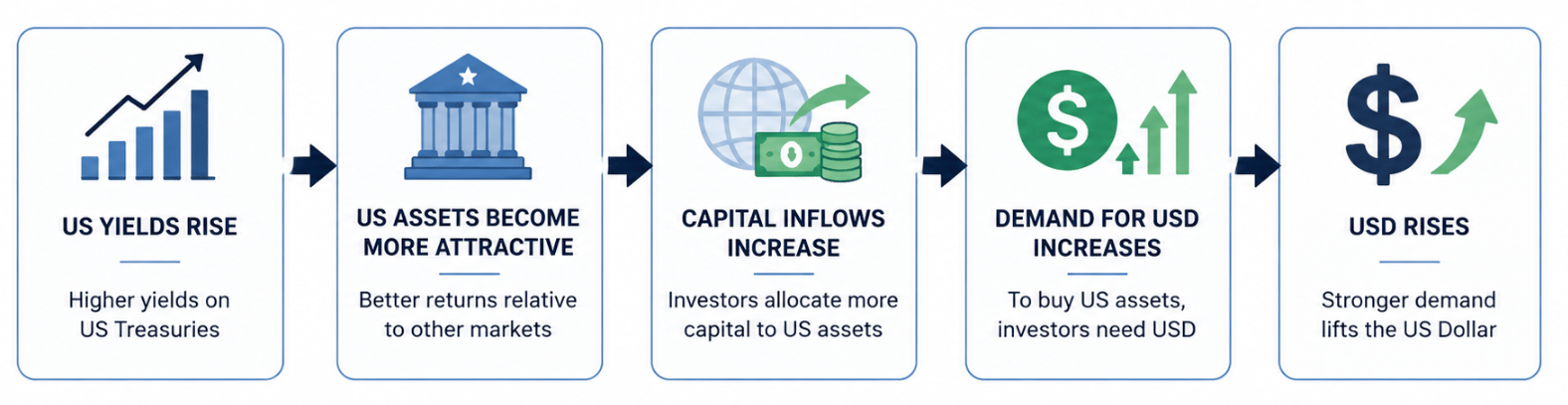
For decades, one of the most reliable relationships supporting the US Dollar has been America's interest-rate advantage.
The higher yields on Treasuries attract foreign investors to US assets. Capital flows to those assets. Demand for dollars increases.
Simply put:
But not every increase in yields means the same thing.
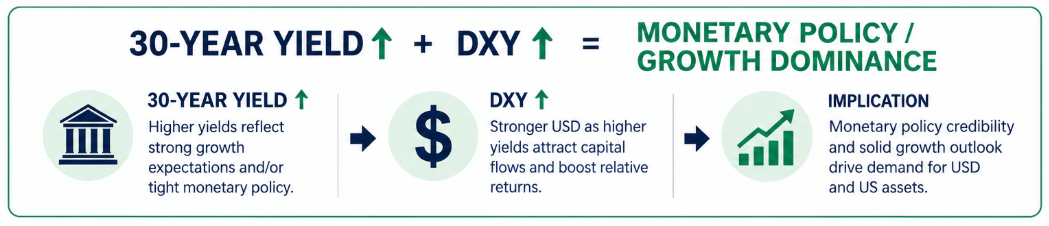
A Treasury yield rising because the US economy is outperforming or because markets expect tighter Fed policy can be positive for the Dollar.
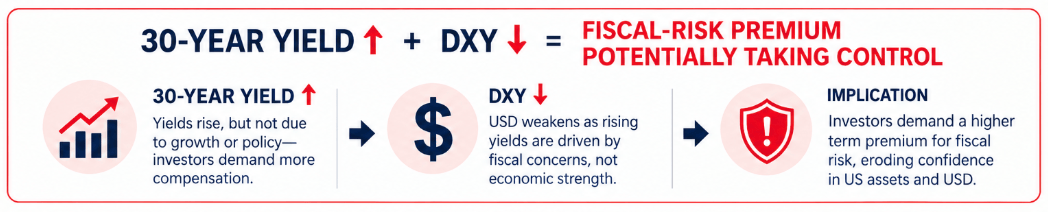
A yield rising because investors are increasingly worried about government finances is a very different animal.
In that environment:
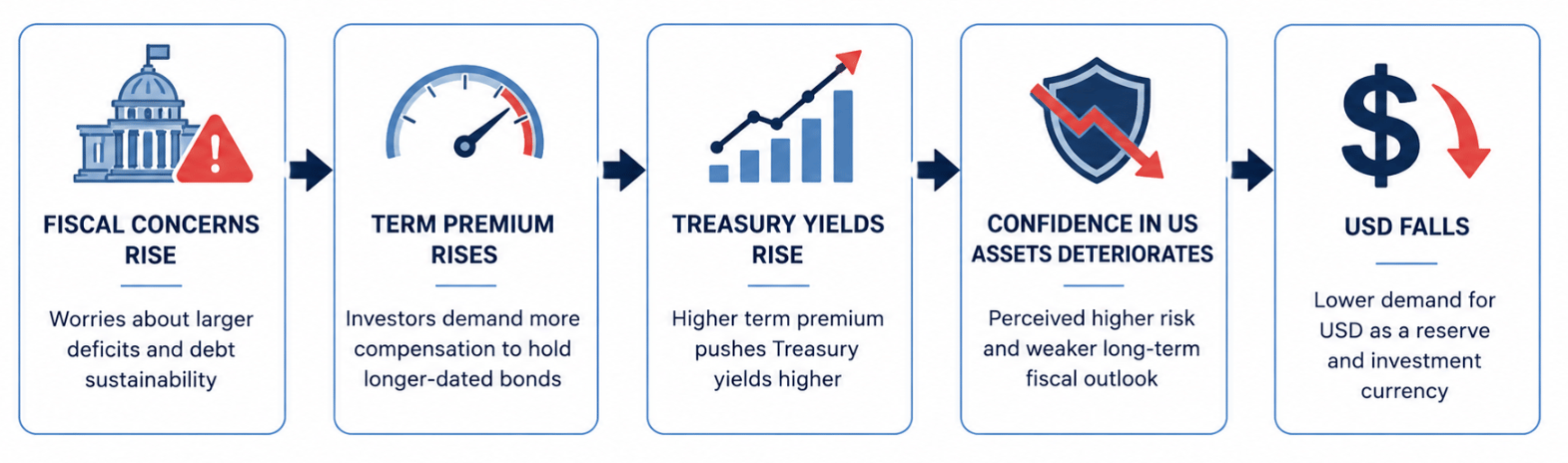
The yield is higher, but investors are demanding that additional yield because they perceive greater risk.
That would represent an important change in the US Dollar's market regime.
And it gives us one of the most useful indicators for judging whether the debasement trade is genuinely taking hold.
The chart that could tell us who is winning
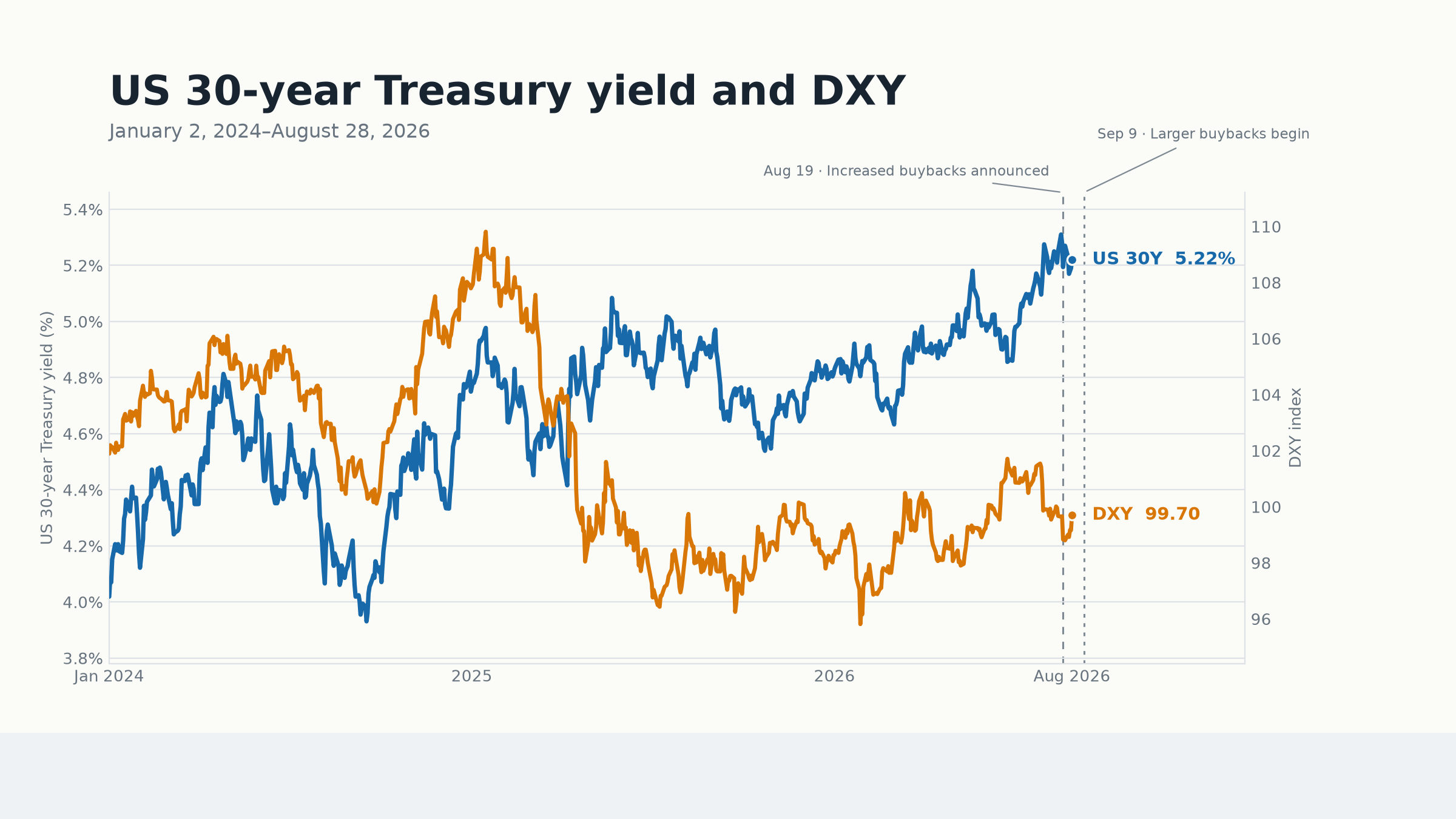
Watch the relationship between the 30-year Treasury yield and the US Dollar Index (DXY).
If long-term yields rise alongside the US Dollar, the traditional interest-rate story is probably still dominant.
If long-term yields rise while the Dollar falls, however, the message becomes considerably more uncomfortable.
There is then a third combination worth watching.
If Treasury intervention pushes long yields lower while the Dollar also falls and Gold rises:

Some of those relationships have already appeared.
The US Dollar fell towards three-month lows following the Treasury announcement, while the precious metal and Bitcoin advanced, as investors debated whether efforts to contain borrowing costs could ultimately weaken the currency.
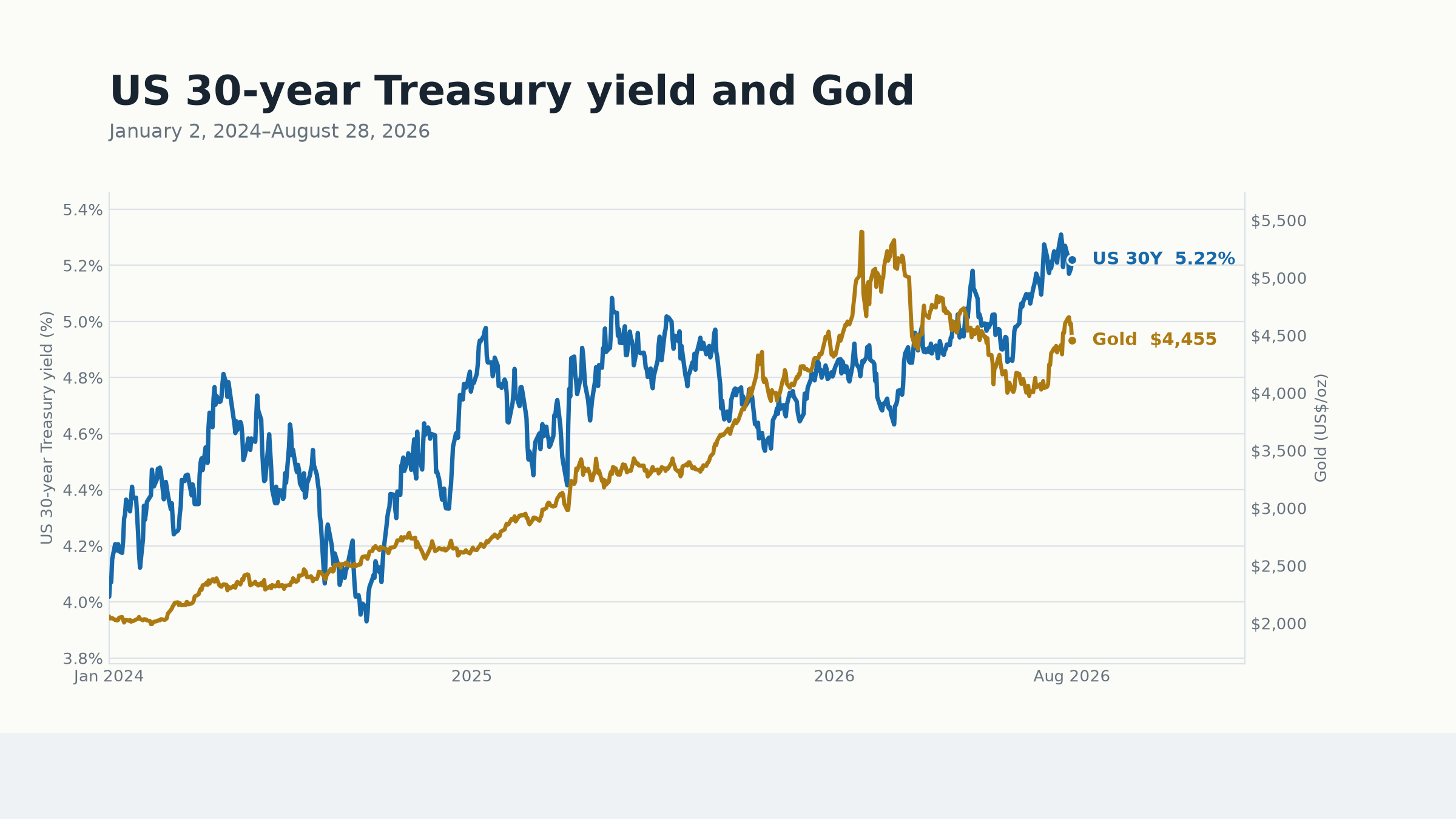
That does not prove the debasement thesis.
But it tells us markets are beginning to test it.
Gold is already paying attention
Gold becomes particularly important in this story because it sits outside both sides of the traditional government balance sheet.
It is neither somebody else's fiat currency nor somebody else's government liability.
When investors worry about inflation, fiscal sustainability or the credibility of monetary institutions, that scarcity becomes valuable.
Bitcoin increasingly performs a similar role for some investors, although its volatility and much shorter history make the comparison imperfect.
The key signal, therefore, may not be US Dollar weakness alone.
It could be the combination of a weakening USD, elevated fiscal risk and persistent demand for scarce assets such as Gold.
That would suggest investors are not simply rotating between currencies based on relative interest rates. They are questioning the assets against which those currencies themselves should be valued.
The US Dollar's H2 2026 roadmap
None of this means the US Dollar is destined to collapse during the remainder of the year.
In fact, there are powerful forces pulling in the opposite direction.
Fed Chair Kevin Warsh continues to signal concern about inflation and has left the door open to higher interest rates should underlying price pressures fail to return towards the Fed's objective.
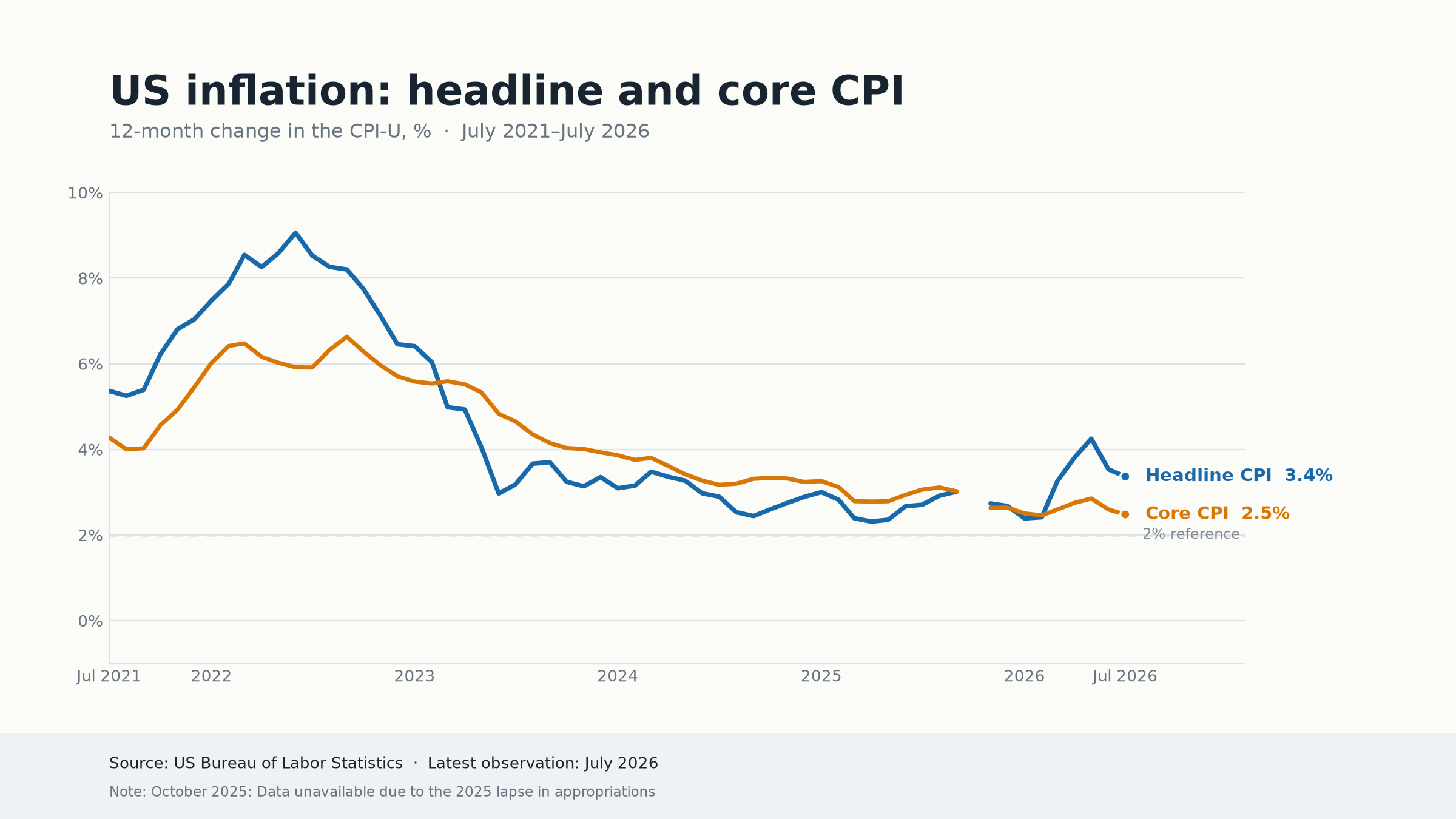
That creates a potentially important monetary-policy counterweight.
Sticky inflation, higher policy rates and strong US economic activity could restore the US Dollar's rate advantage and trigger another rebound.
Geopolitics also matters. Despite growing questions surrounding America's fiscal position, the Dollar remains deeply embedded in global trade and finance and can still benefit from episodes of extreme risk aversion.
That leaves three broad scenarios for the second half of 2026.
Base case: Gradual US Dollar depreciation
Fiscal concerns remain elevated, and the Treasury continues trying to limit disorderly moves at the long end, but without moving towards outright yield-curve control. The Fed remains cautious because inflation is still too high, limiting the scale of USD weakness.
Under this scenario, the USD does not collapse. Instead, rallies increasingly struggle for sustainability as investors demand greater compensation for US fiscal risk.
Bullish USD case: The Fed takes control
Inflation proves considerably stickier than expected, forcing the Fed to tighten further. Treasury yields rise primarily because markets price a higher policy-rate path rather than because of fiscal stress.
The traditional yield advantage returns, and the Greenback rebounds.
This would be the scenario in which 30-year yields and the DXY rise together.
Debasement case: The US Dollar becomes the release valve
Long-term yields again move sharply higher, the Treasury responds with increasingly aggressive intervention, and markets conclude that Washington is unwilling to tolerate the borrowing costs implied by its fiscal position.
Yields are constrained, but the underlying fiscal problem remains.
The adjustment therefore migrates elsewhere.
The US Dollar weakens, Gold outperforms, and the debasement trade becomes considerably more than the latest Wall Street buzzword.
November 4 could matter more than it looks
Markets will not have to wait indefinitely for another test.
Treasury says the increased long-end buyback sizes will remain in place through November 4, when the next Quarterly Refunding announcement is scheduled. Officials have explicitly said they will provide further information about future buyback sizes at that time.
That makes November's announcement a potentially important checkpoint.
A return to previous purchase sizes would reinforce the Treasury's argument that these operations are primarily technical liquidity management.
Another expansion would invite considerably more questions.
Between now and then, the market reaction to episodes of rising long-term yields may tell us even more.
The US Dollar does not need to crash for the debasement trade to matter.
The more important change would be investors gradually questioning a relationship they have relied upon for decades: that higher US yields are inherently good news for the buck.
All in all
The debasement trade does not require America to print trillions of dollars tomorrow, abandon inflation targeting or formally cap Treasury yields.
It requires something subtler.
Investors need to demand progressively more compensation for financing America's growing debt burden while policymakers become increasingly less willing to pay that price.
For now, the Treasury's expanded buybacks are too small to establish that regime by themselves. Strong US growth (“exceptionalism”?), sticky inflation and a hawkish Fed could still produce a powerful recovery in the Greenback during the second half of 2026.
But the balance of risks has changed.
If rising long-term yields increasingly coincide with US Dollar weakness rather than strength, markets may be telling us that America's interest-rate advantage is slowly being replaced by an American fiscal-risk premium.
And if Washington responds to those higher yields with progressively larger interventions, the ultimate release valve may no longer be the Treasury market.
It may be the US Dollar itself.
Author

Pablo Piovano
FXStreet
Born and bred in Argentina, Pablo has been carrying on with his passion for FX markets and trading since his first college years.
















