Everyone's dumping Gold after hot US inflation. Here's why $4,100 could be a floor, not a cliff

Gold (XAU/USD) is recovering from a sharp sell-off triggered by hotter-than-expected United States (US) inflation data released on Wednesday. The precious metal briefly plunged toward $4,073 as investors increased their bets on further Federal Reserve (Fed) interest rate hikes before recovering as US Treasury yields and the US Dollar (USD) reversed their initial gains.
At first glance, the inflation report delivered almost everything Gold bears wanted. Consumer prices accelerated, underlying inflation proved more persistent than expected, and traders rapidly reassessed the likelihood of additional monetary tightening.
Yet the most revealing development may not be the initial decline. It is how quickly buyers returned. Despite renewed pressure from systematic trading strategies and a more hawkish outlook for US monetary policy, Gold continues to attract demand around a price region that has repeatedly contained declines since the summer.
That resilience raises an important question: is the latest sell-off the beginning of a deeper breakdown, or another episode in which speculative investors are selling into demand from buyers with longer investment horizons?
Hot inflation gave Gold bears exactly what they needed
The September Consumer Price Index (CPI) showed that headline inflation accelerated to 3.7% YoY, compared with 3.4% in August and market expectations of 3.6%. Core inflation, which excludes volatile food and energy prices, also accelerated to 2.6% from 2.4%, exceeding the 2.5% consensus.

The figures reinforced concerns that inflationary pressures are spreading beyond energy and that the Fed may need to maintain restrictive monetary policy for longer than previously anticipated. Markets reacted accordingly. The probability of an October interest rate hike increased sharply immediately after the report, while expectations for another increase in December strengthened.
The initial reaction was particularly unfavorable for Gold. Higher interest rates increase the opportunity cost of holding a non-yielding asset, while rising Treasury yields and a stronger US Dollar generally reduce its attractiveness.
The combination initially brought prices to the support area that had already attracted buyers during previous corrections. However, the selling pressure was not exclusively driven by investors reassessing inflation expectations. Another group of market participants appears to have played an important role.
The real selling pressure is coming from systematic traders
According to TD Securities, the stronger inflation report triggered significant selling from Commodity Trading Advisors (CTAs), investment strategies that frequently rely on price trends and systematic trading signals. The bank explains that "CTAs have turned heavy sellers of gold amid a higher than expected inflation print and as prices have found heavy resistance near the $4,200/oz level."
The latest episode follows several weeks of speculative repositioning. In its earlier analysis of Gold futures positioning, TD Securities reported that speculative investors had reduced long exposure while increasing short positions for three consecutive weeks. The bank also identified approximately $4,300 as an important threshold for triggering short covering from systematic strategies.
The latest inflation surprise therefore arrived in a market where speculative investors were already positioned defensively. But selling pressure from CTAs does not necessarily mean that all investors are abandoning Gold. Indeed, the bank identified another category of flows moving in the opposite direction.
The buyers aren't disappearing. They're waiting lower
One of the most important observations in TD Securities' latest research concerns the demand that continues to absorb speculative selling. While systematic traders have increased their bearish exposure, the bank noted that offsetting flows "have ultimately offered strong support for gold," adding that "we expect these flows will remain robust, especially in the $4,000-4,100/oz region."
This assessment supports the idea that the latest decline may represent a confrontation between different groups of investors rather than a broad liquidation of Gold holdings. Short-term traders are reacting to higher inflation, changing interest rate expectations and deteriorating price momentum. Meanwhile, other investors appear willing to accumulate Gold at lower valuations.
The distinction is consistent with the positioning divergence highlighted before the CPI release, when TD Securities identified continued buying interest from discretionary investors and Exchange-Traded Funds (ETFs), despite bearish positioning among systematic strategies.
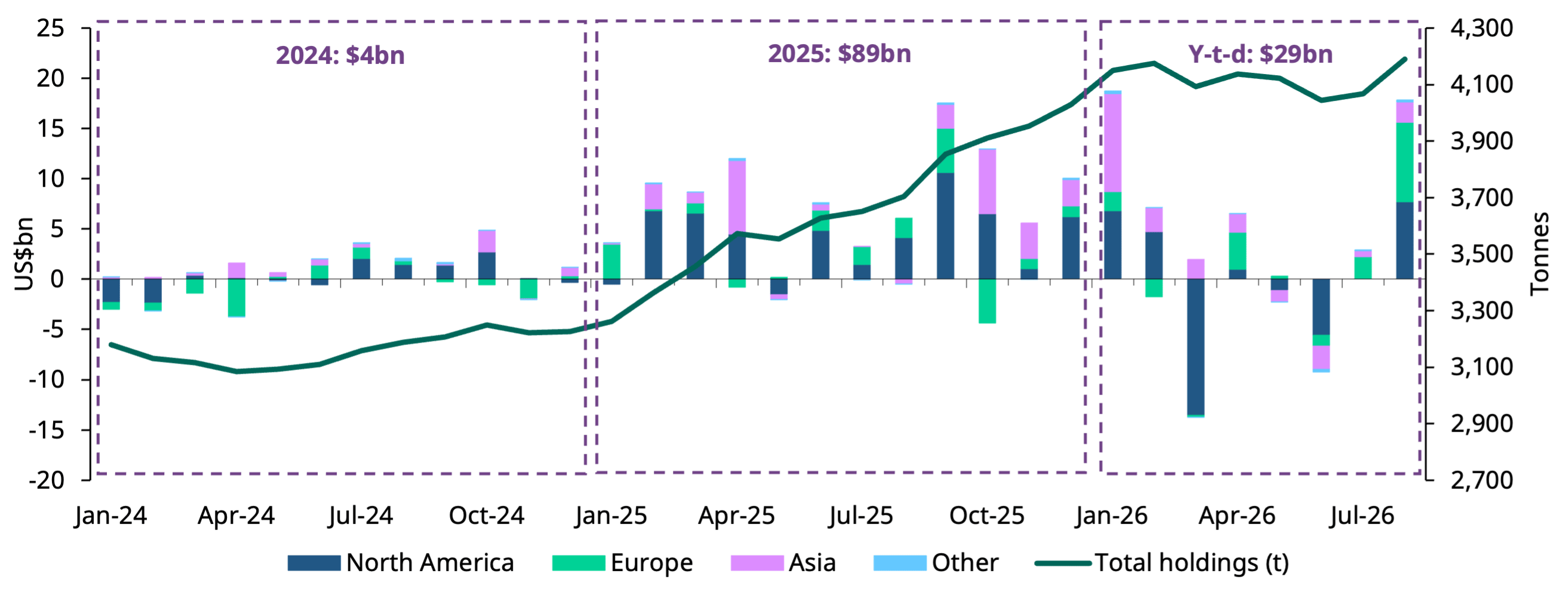
This creates a potentially important market dynamic. As speculative traders liquidate long positions or establish new shorts, they generate immediate selling pressure. But if other investors absorb that supply, the market can stabilize without requiring a significant improvement in the macroeconomic environment.
Moreover, the reduction of speculative long exposure can eventually diminish the pool of investors vulnerable to forced liquidation. That does not automatically establish a market bottom. However, it means that the relationship between negative news and falling prices can weaken as positioning becomes increasingly defensive.
The latest rebound suggests that this mechanism may already be operating around $4,100.
The bond market just challenged the bearish Gold narrative
Perhaps the most surprising development following the inflation report occurred in the US Treasury market. Bond yields initially increased as traders priced in a greater probability of additional Fed tightening. However, the move subsequently reversed, with the benchmark 10-year Treasury yield falling to a three-week low on Thursday.
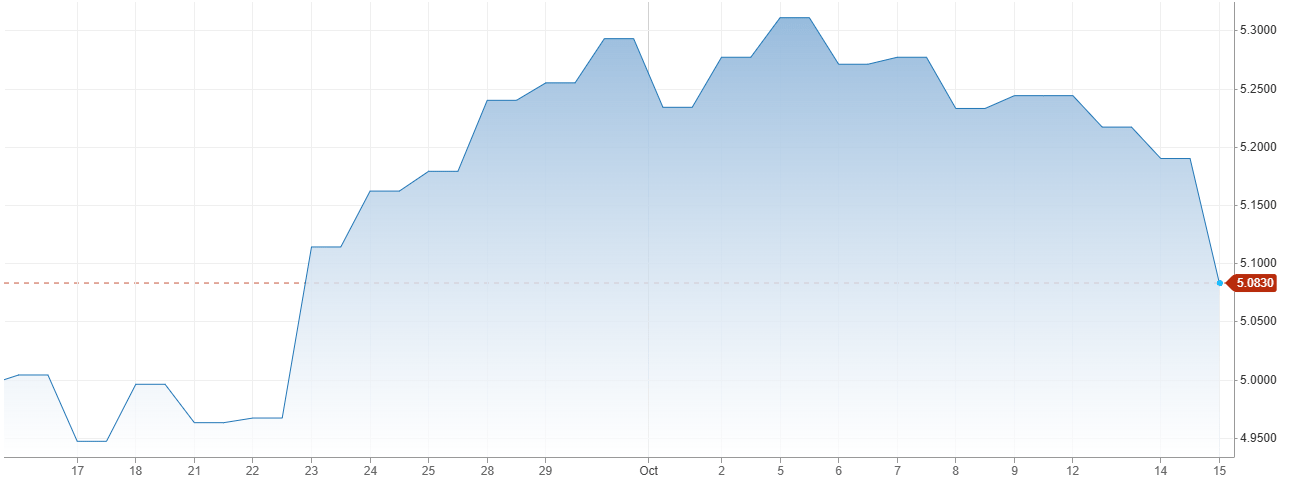
One possible catalyst behind this reversal emerged from China. According to a Bloomberg report, China has been quietly accumulating US Treasury securities through custodians outside the United States.
The revelation provided a possible explanation for renewed demand for US government debt. When investors purchase Treasuries, bond prices rise and yields decline. This mechanism can provide relief to Gold by reducing the opportunity cost of holding a non-yielding asset. The US Dollar (USD) also retreated from its highest level in approximately 18 months, reinforcing the precious metal's recovery.
Saxo Bank Head of Commodity Strategy Ole Hansen highlighted the importance of this development in comments reported by Reuters: "Falling real yields and resilient investment demand help gold recover from its post-CPI selloff, but the technical outlook remains fragile."
For Gold, the key question is whether bond demand can contribute to a sustained decline in Treasury yields, even as inflation remains elevated and the Fed maintains a tightening bias. If yields continue retreating while investment demand remains resilient, Gold could find additional support despite the unfavorable inflation backdrop.
The latest rebound therefore highlights an important contradiction: the inflation report gave Gold sellers a reason to push prices lower, but the bond market's response may have removed part of the pressure needed to sustain that decline.
$4,100 is becoming a floor candidate, but $3,940 remains the real test
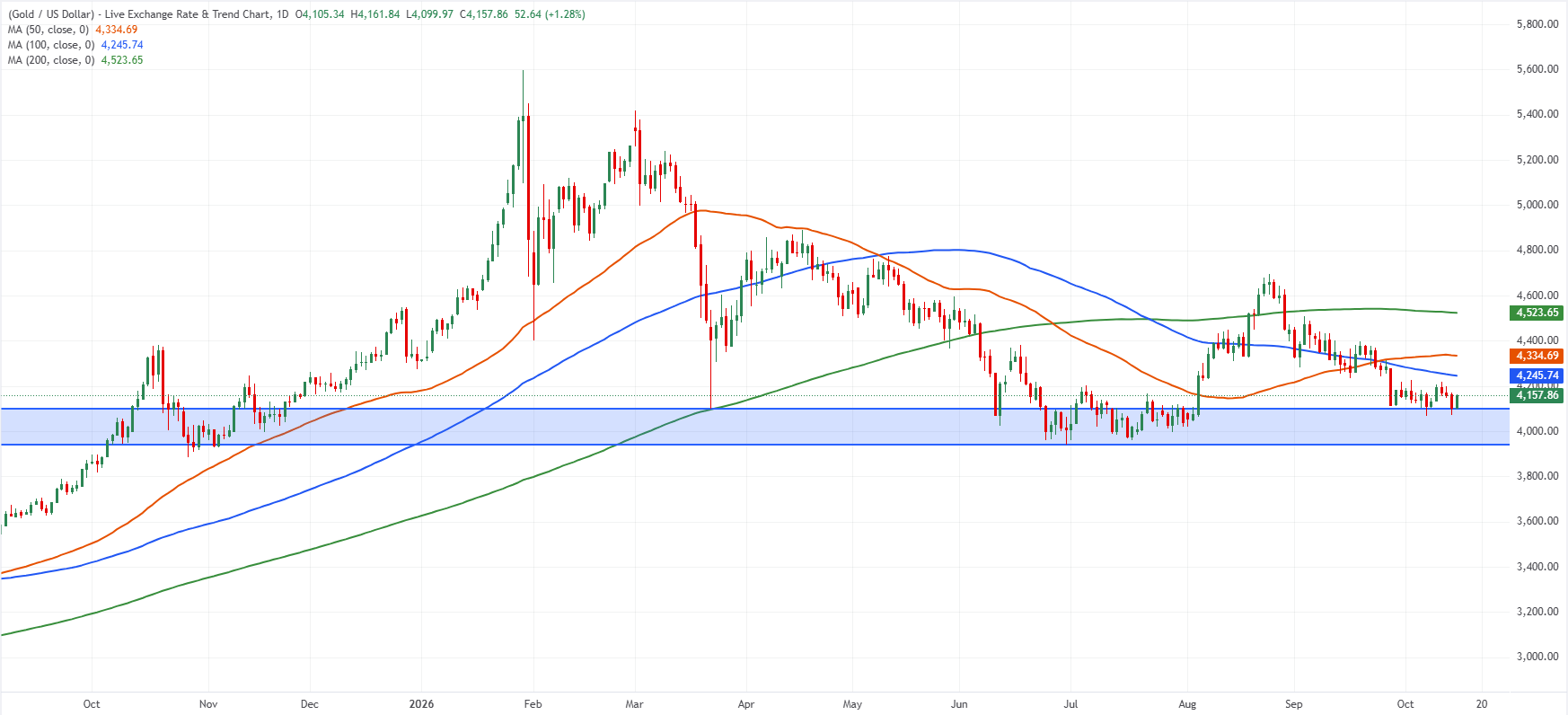
The daily chart reinforces the importance of the broader support region identified during previous corrections. Gold trades below its 50-day, 100-day and 200-day Simple Moving Averages (SMAs), currently near $4,335, $4,246 and $4,524, respectively. This configuration indicates that the broader trend remains under pressure despite Thursday's recovery.
However, the $4,100 region continues to attract buyers, following several successful defenses of the area since late September. Wednesday's decline toward $4,073 briefly pushed prices below this level without producing a sustained breakdown.
The importance of this support extends beyond the immediate $4,100 level. Gold repeatedly found demand around $4,000 during the summer, with the broader $4,100-$3,940 region representing a critical area for assessing whether longer-term buyers remain willing to absorb speculative selling.
A decisive break below $3,940 would weaken the argument that the recent consolidation represents a durable accumulation phase. It could also open the door to a deeper correction. Conversely, maintaining this broader support region would suggest that the market continues to absorb selling pressure despite an unfavorable interest rate environment.
On the upside, the $4,200-$4,225 area remains the first significant obstacle, having repeatedly limited recovery attempts in recent weeks. A sustained break above this region would expose the 100-day SMA near $4,246, followed by the $4,300-$4,335 area, where the 50-day SMA and an important systematic positioning threshold converge.
This latter region is particularly relevant because TD Securities previously identified $4,300 as a level capable of encouraging additional short covering among CTAs. A recovery above that threshold could therefore generate incremental buying pressure as systematic strategies adjust their positions. Further upside would bring the 200-day SMA near $4,524 into focus, although such a recovery would require a more convincing improvement in market conditions.
For now, the daily chart suggests that Gold is attempting to establish a base rather than confirming a bullish reversal.
The next Gold move may depend on who runs out of conviction first
The latest inflation report appears to strengthen the bearish case for Gold. Consumer prices are accelerating, the Fed is considering additional tightening, and systematic traders are increasing their selling pressure.
Yet the market's response reveals a more complicated picture. Gold has recovered from its post-CPI decline, Treasury yields have reversed their initial increase, and buyers continue to emerge around a support region that has repeatedly contained losses.
The contrast between speculative selling and persistent underlying demand is becoming increasingly important. If inflation remains elevated and long-term Treasury yields resume their advance, systematic selling could intensify and eventually overwhelm the demand supporting Gold around $4,100.
But if Treasury yields continue retreating while Gold maintains its broader $4,100-$3,940 support region, bearish positioning could become a source of future buying pressure rather than a permanent obstacle.
The most important signal may therefore be not how aggressively investors sell Gold after unfavorable economic news, but how little additional downside that selling ultimately produces.
For now, $4,100 is not a confirmed bottom. But the repeated willingness of buyers to defend the area suggests that the market is not yet ready to treat it as the edge of a cliff.
Author

Ghiles Guezout
FXStreet
Ghiles Guezout is a Market Analyst with a strong background in stock market investments, trading, and cryptocurrencies. He combines fundamental and technical analysis skills to identify market opportunities.
















