The US consumer isn't facing one squeeze. It's four at once
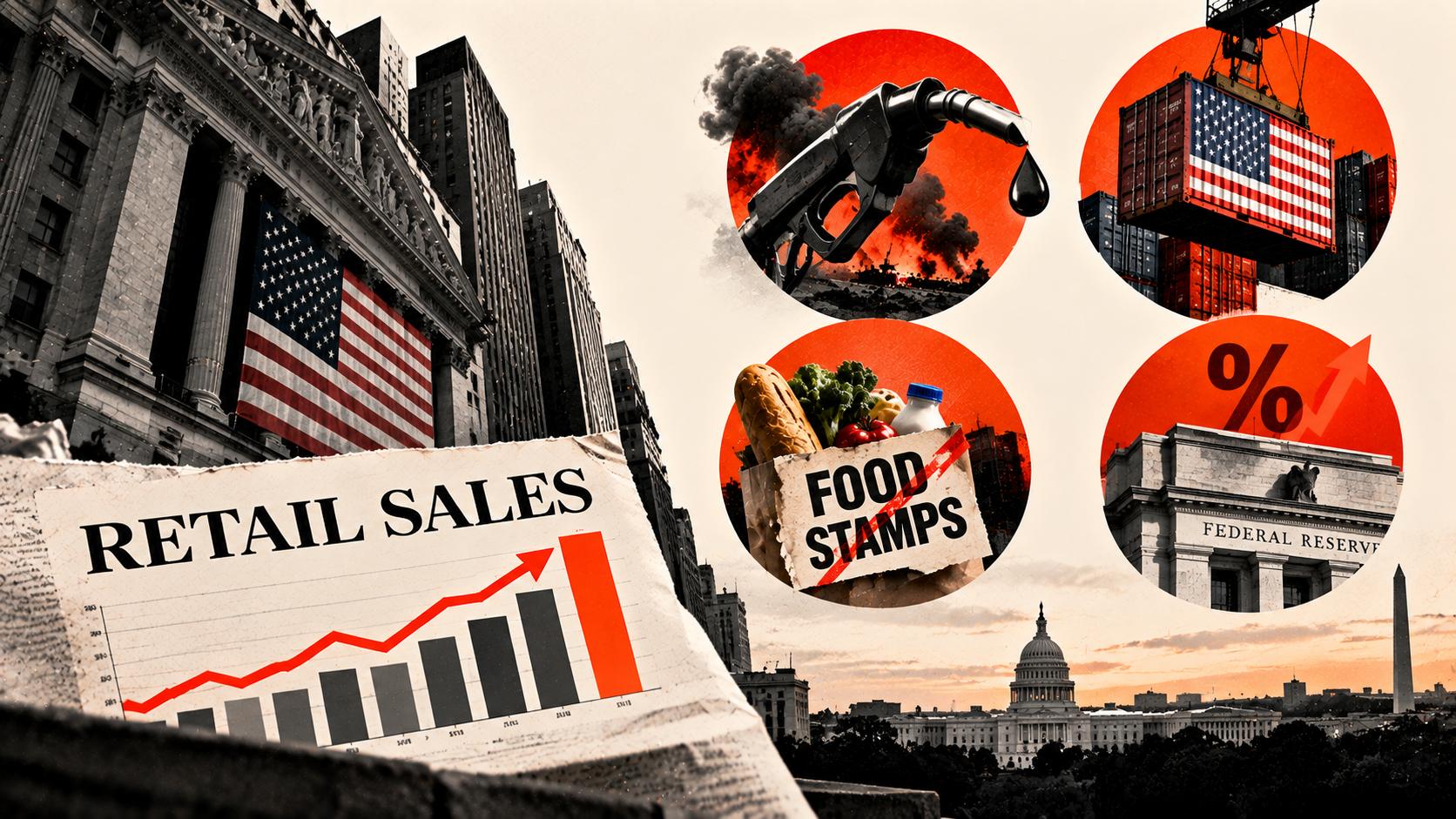
US Retail Sales rose 0.8% in September against a 0.3% forecast, and the squeeze is inside the beat. Four policy decisions taken since February each have a line in Thursday's table from the US Census Bureau: the war with Iran at the gasoline pump, tariffs in the clothing aisle, the food-stamp cuts in the grocery aisle and the Federal Reserve's September rate rise in the furniture store. While sales are 6.3% higher than a year ago in US Dollar terms, those dollars buy far less, and households have paid the gap out of savings.
The Census counts raw headline dollar spending, not gallons, shirts, or groceries, so a higher price and a bigger purchase look identical in the table. Every piece of good news in the report comes from that identity.
Same gallons, 28% more money
Gasoline stations supplied $4.07 billion of September's $5.70 billion gain, 71% of the month on 9.1% of the base. Station receipts rose 6.4% on the month and 28.1% on the year. The gasoline line in the Consumer Price Index (CPI) rose 9.1% in September and 34.2% on the year, so the receipts grew more slowly than the price of what they sell. The Energy Information Administration (EIA) has gasoline supplied to the US market in September 0.7% below a year earlier, with the normal step-down from August. Americans bought slightly less gasoline than in September 2025 and paid 28% more for it.
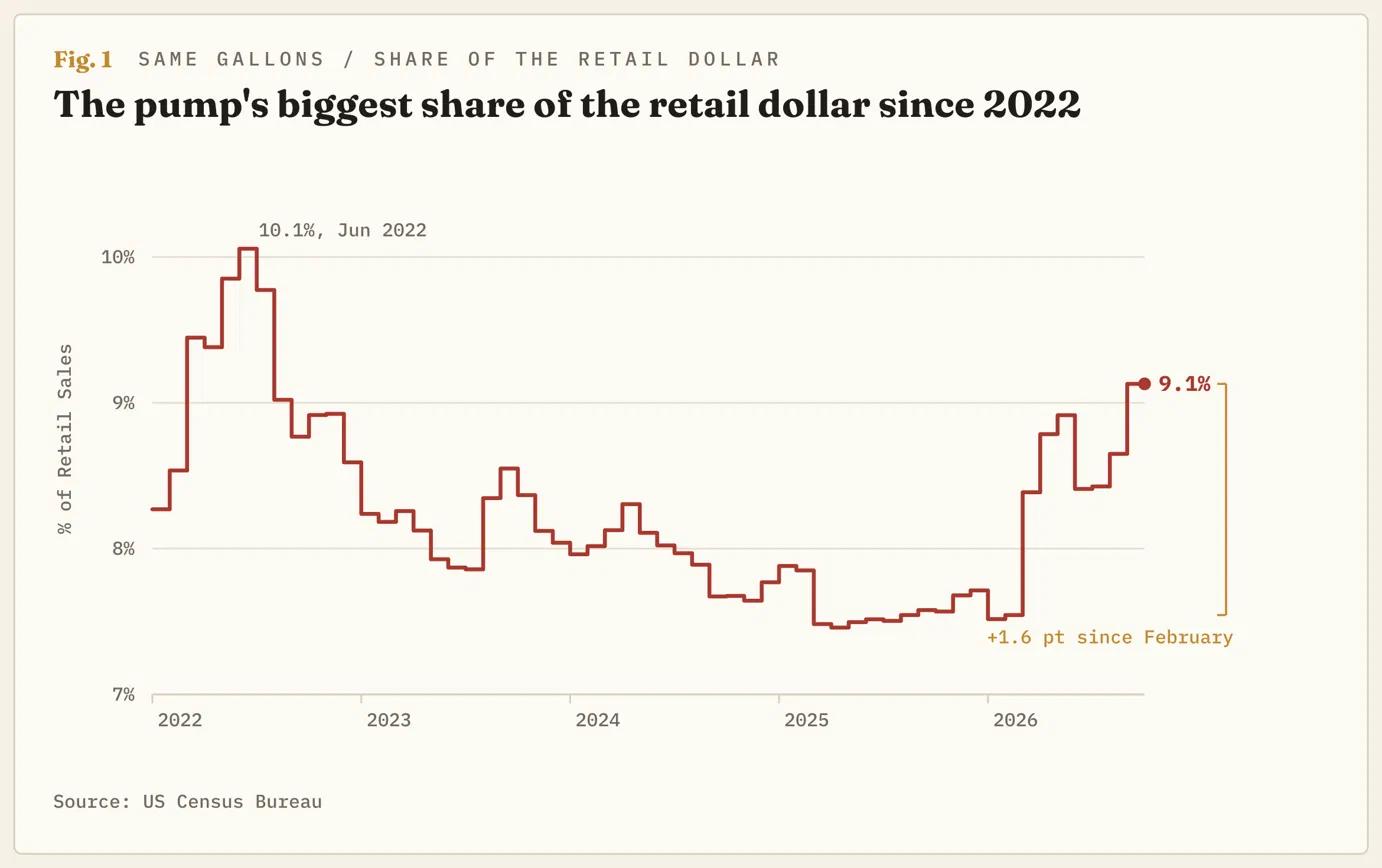
That 9.1% share of the retail dollar is the highest since July 2022, up from 7.5% in February, the last month before the war. At September's pace, stations are taking $175 billion a year more than they took in February, about $110 a month for every household in the country, and the money comes out of the other lines in the same table. Gasoline stations contributed 0.55 points to a month that beat its forecast by 0.5.
The pump is a policy price. Iran offered on September 25 at the United Nations to reopen the Strait of Hormuz in exchange for its frozen funds, an end to sanctions and an end to the naval blockade of its ports, and the offer was rejected on September 26. Brent crude averaged $114 in September and about $127 so far in October. The AAA national average for regular gasoline was $4.37 on October 9, 40% higher than a year earlier and under $3 in February, and pump prices have not yet followed October's crude. In the week to September 27, 132 ships crossed the strait, a figure that before the war was a daily count.
Prices rose and shopping didn't
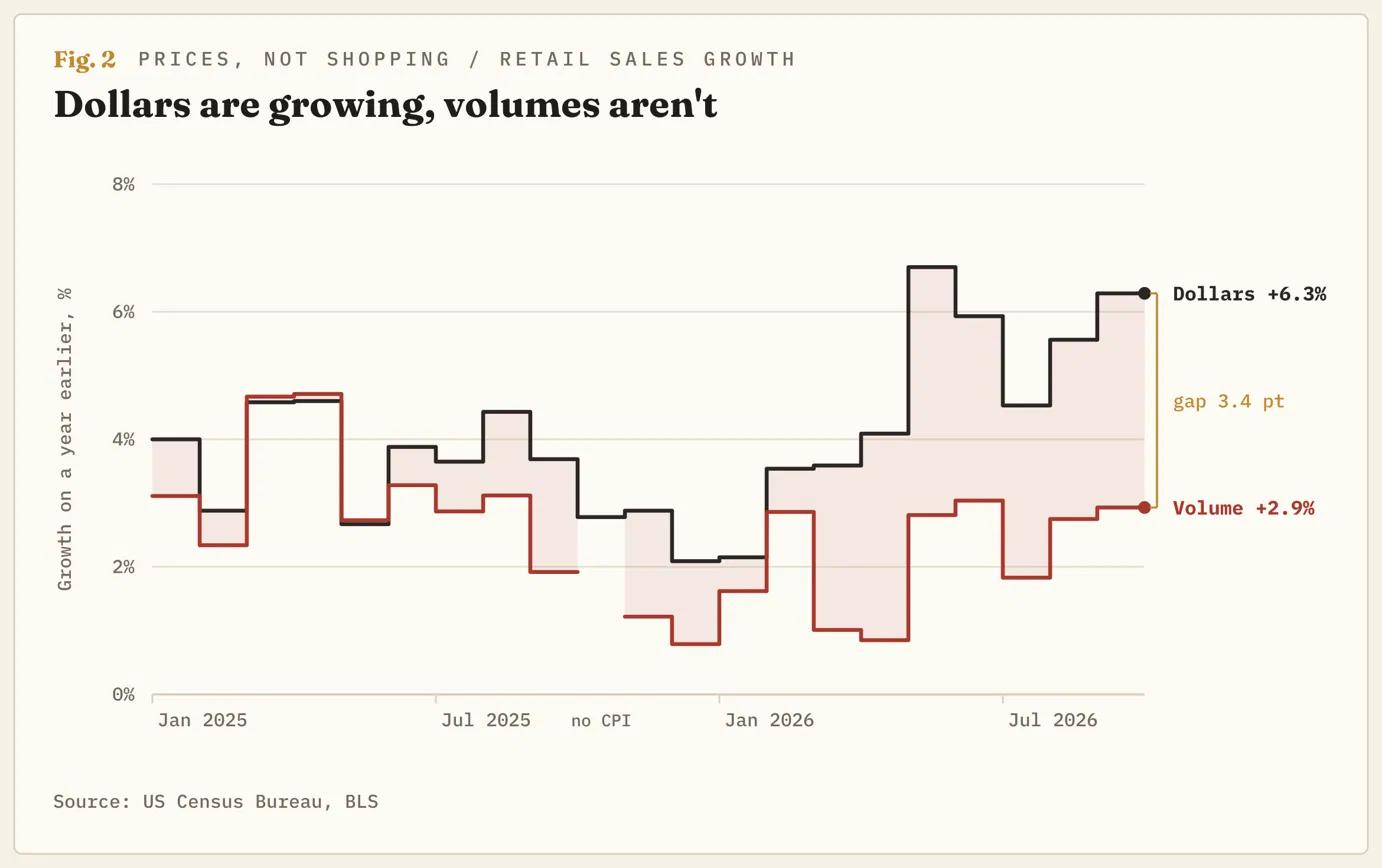
Take the pump out and sales rose 0.2% in September. Goods prices excluding food and fuel rose 0.3% in the same month, so the volume of everything else sold in American stores was flat. Put the pump back in and deflate every store type by its own price index, and the volume of Retail Sales fell 0.1% in the month the headline beat. The control group, which strips out fuel, cars, building materials and restaurants and feeds the goods line in Gross Domestic Product (GDP), rose 0.14% against a 0.3% forecast. The Atlanta Fed's GDP tracker uses a control group, which is why the beat didn't move it.
The year is a different number from the month. Sales are up 6.3% on the year in dollars and about 2.9% in volume once each store type is deflated, and goods spending in the third quarter grew close to 4% annualised in real terms. The squeeze is not in the aggregate yet, and it showed up in the month volume stopped growing while prices kept rising.
The electronics line shows how a price rise reads as a boom. Sales at electronics and appliance stores are up 9.4% on the year, and the CPI for computers is up 9.7% over the same period, because the data centres are buying the memory chips that used to go into laptops. The AI build-out's contribution to the American consumer is a price index. Bank of America's card data makes the same point from the other side: in dollars, 86% of discretionary retail categories are growing, and by transaction count, 71%. Census revised the level of Retail Sales down 4.4% on September 28 in a benchmark release nobody traded, and reported a beat 17 days later that everyone did.
The grocery aisle lost five million customers
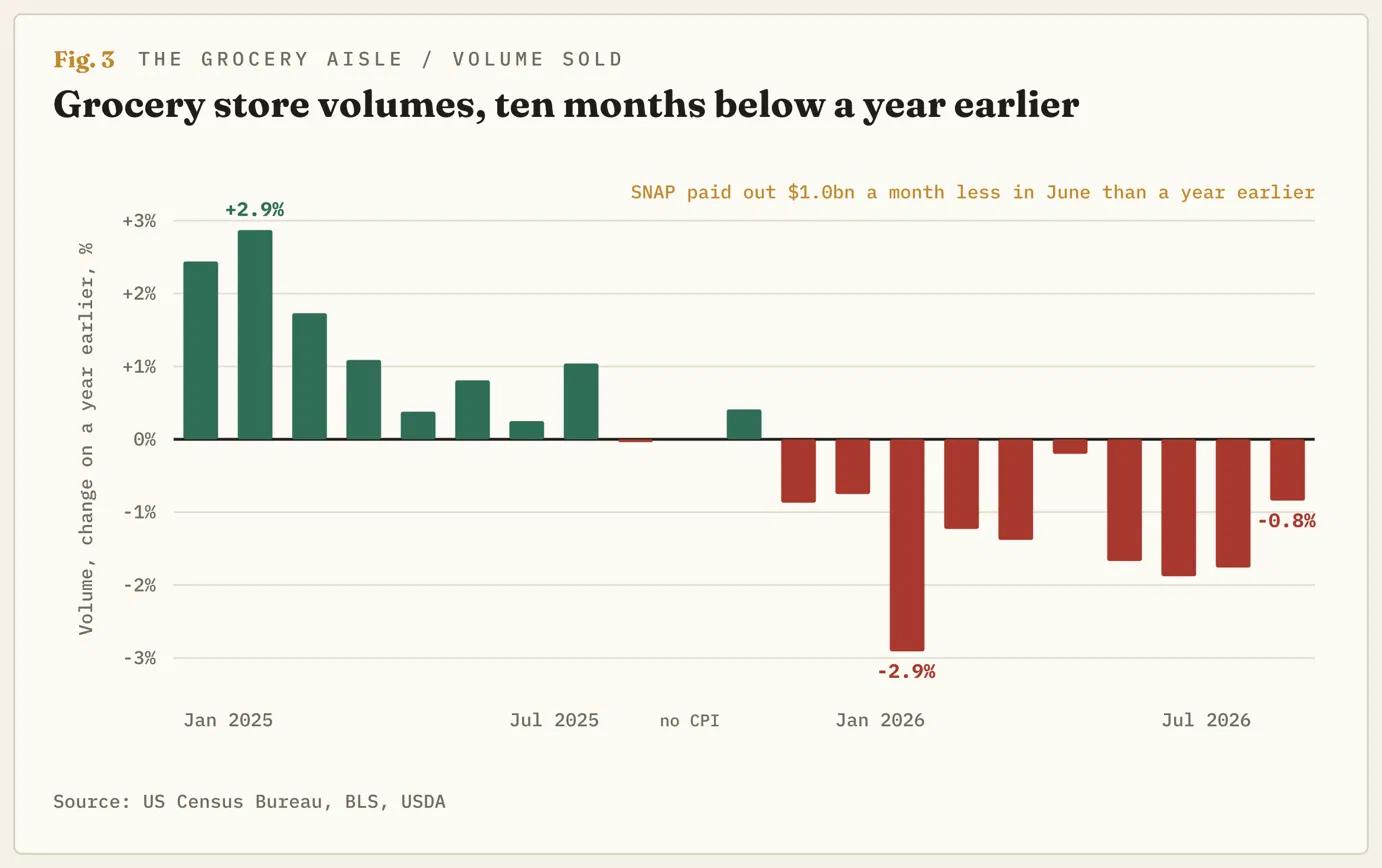
Grocery store sales are 0.9% higher than a year ago in dollars. Food-at-home prices are 1.8% higher, so the volume sold at grocery stores is 0.8% lower, and it has been lower than a year earlier in every month since December, ten in a row. Part of that is shoppers moving to Walmart (WMT) and Costco (COST), which Census files under warehouse clubs and supercenters, up 2.9% on the year before seasonal adjustment. The part that cannot be a change of store is the Supplemental Nutrition Assistance Program (SNAP).
SNAP paid 36.4 million people in June, the latest month the Department of Agriculture (USDA) has published, against 41.7 million in June 2025. Monthly benefits fell from $7.8 billion to $6.8 billion, a $1 billion monthly withdrawal from the grocery aisle. The July 4, 2025 reconciliation law extended work requirements to age 65 and to parents of children aged 14 and over, removed the exemptions for veterans, the homeless and former foster youth, and ended eligibility for many lawful immigrants. Participation is at a 17-year low and has fallen in every state except Alaska. Grocery store sales grew by $700 million a month over the year, which is less than what the government stopped paying into them.
Restaurant sales are up 7% on the year in dollars and 3.4% in volume, so eating out grew while eating in shrank. Food and beverage stores are 11% of Retail Sales and restaurants are 12%, and the two lines have been moving in opposite directions all year. That split runs through the rest of the table.
A tariff refund for everyone except the shopper
Clothing prices were 0.1% lower than a year earlier in September 2025. They are now 3.4% higher, after peaking at 4.8% in May, and clothing store sales are up 5% in dollars and 1.6% in volume. Inside the category, women's clothing stores are 9% lower on the year before seasonal adjustment, shoe stores 1.8% lower and family clothing stores, the value chains, 8.9% higher. Tariffs collected as a share of import value were 7.1% in August, up from 2.3% in January 2025, per the Penn Wharton Budget Model. Shoppers paid that at the register and traded down in the aisle.
The Supreme Court ruled on February 20, six to three, that the International Emergency Economic Powers Act (IEEPA) does not authorise duties, and the tariffs built on it were terminated. A 10% global tariff under Section 122 ran from February 24 to July 23, and tariffs of 10% or 12.5% under Section 301 now apply to imports from 60 economies. Some $166 billion collected under IEEPA is subject to refund, and $126 billion had been certified by October 2. The refund goes to the importer of record, which is the customs term for the company that paid the duty at the port rather than the person who paid it at the register. The shopper got Section 301 instead.
Fixing the old car
The Fed raised its rate to 3.75%-4.00% on September 16, the first increase since 2023, and Fed Chair Warsh said the move removed "a dose of accommodation". Average hourly earnings are 3% higher than a year ago, while CPI rose 3.7%, so pay fell 0.7% after inflation. Employers added 29K jobs in September, July was revised to a 10K loss, and unemployment is 4.2%. A dose of accommodation is Fed language for the interest rate on a car loan, and it was removed from households whose pay was already falling.
The Retail Sales table shows where that landed. Furniture stores are 5.9% lower on the year before seasonal adjustment. New car dealers are 0.9% higher, and auto parts and tyre stores are 9.9% higher, which is what fixing the old car instead of replacing it looks like in a Census release. The University of Michigan (UoM) survey for October has buying conditions for durable goods at a record low, with high prices and borrowing costs the reasons given, and in September 62% of consumers expected rates to rise further. The Fed meets October 27-28, six days before the midterm election. After Wednesday's CPI, the futures market put the odds of an October rise near even, and by Thursday under a third, with December near 90%.
The wealthy are carrying the number
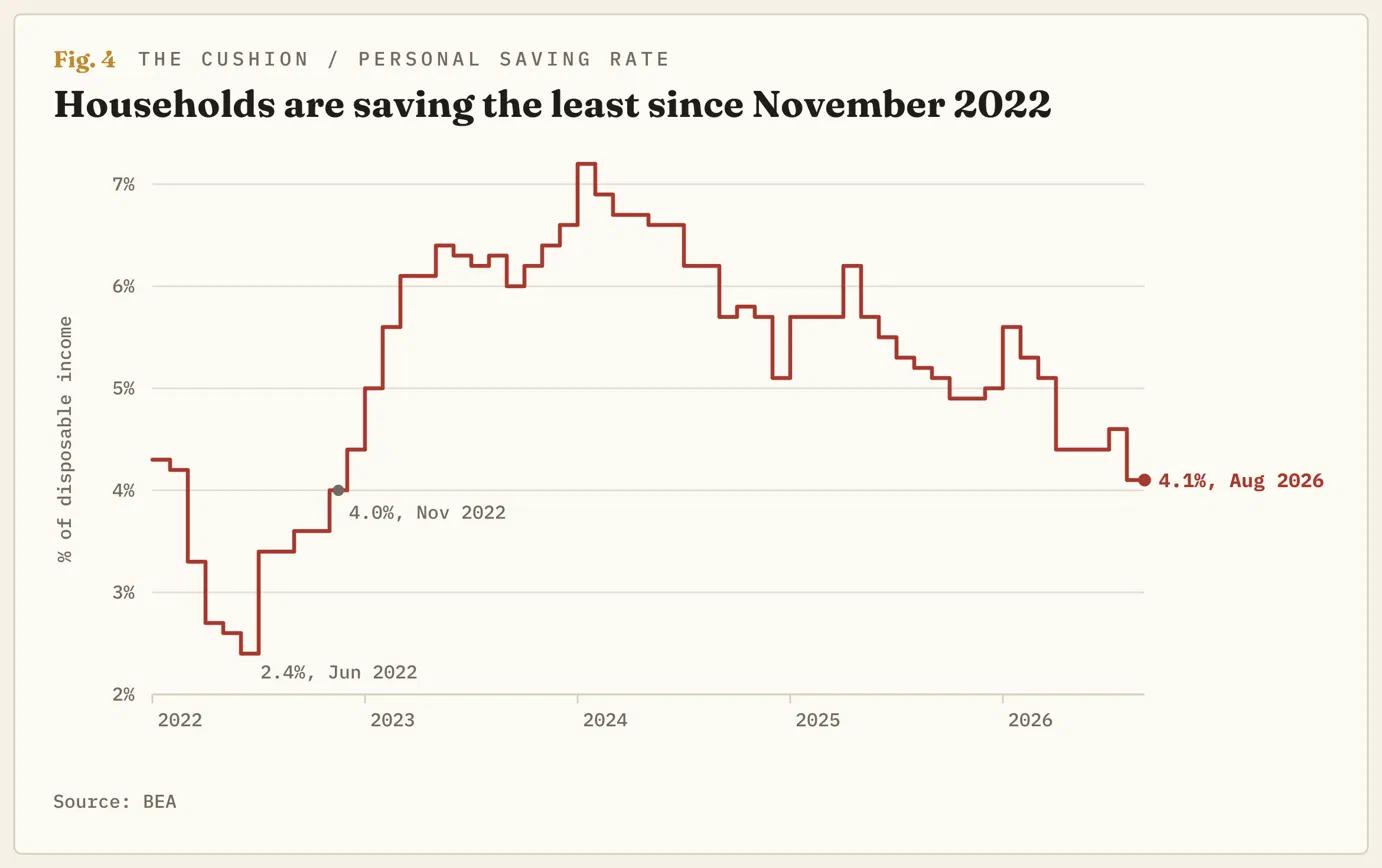
The personal saving rate was 4.1% in August, the lowest since November 2022. Real disposable income is 1.3% higher than a year ago and real spending is 2.6% higher, and the difference between those two figures is the fall in the saving rate. The last time it was this low, in November 2022, was the ninth month of a fuel shock and the ninth month of a hiking cycle. Bank balances aren't the only cushion: the New York Fed has card balances flowing into serious delinquency at close to 7% a year, elevated and flat, and 8.3% of Bank of America households made a buy-now-pay-later payment in September, with one in five above $500.
Michigan's October reading fell to 46.3, the second-lowest in the survey's history after May, and its current-conditions index fell to a record 44.7. Since January, sentiment is down 25% among households that own no stocks and 7% among the third of households that own the most. Half of the biggest stockholders plan to keep spending as usual, and 18% of households with no stocks do. Overall, 54% plan to cut back on items whose prices have risen the most. Bank of America's card data shows the top 5% of households by income spending on the strength of their portfolios and taking an outsized share of restaurants, furniture, electronics and department stores, and the S&P 500 is up roughly a sixth on the year.
The card data may be right that every income group is spending more, since lower-income households' card spending is up 5.5% on the year. They are spending more dollars, and the dollars are the squeeze. The Retail Sales volume growth is in the categories the top 5% dominate, and the volume declines are in groceries, furniture, and women's clothing. Fewer households are buying more things, and the rest are paying more for fewer.
Four bills, one calendar
None of the four bills has a reversal scheduled except the Fed's. Brent at $127 means the fuel line in October's Retail Sales report, due November 17, is larger again, and the headline rises with it whether or not anyone buys anything else. The tariff refund has reached importers and not prices. The SNAP changes have no sunset, and the state cost-share they contain does not even begin until October 2027. The Fed has raised rates within a week of an election once since 1990, on November 2, 2022.
The fork is whether the aggregate cracks before any of the four turns. If it holds, the wealthy keep buying, the saving rate goes under 4%, Retail Sales beats on fuel again in November, the Fed raises in December, and two-year yields rise with it. If it cracks, the control group falls two months running, the Fed skips, two-year yields fall, and the Retail Sales headline keeps rising on gasoline while every other line falls. The reading resolves on three dates: the September savings rate on October 30, the October CPI on November 10, and the October Retail Sales report on November 17.
The position is to lean toward companies paid in dollars rather than volumes, value chains, and warehouse clubs, and against those that need furniture, specialty clothing, and new car lines to grow. The case is wrong if the September savings rate comes in above 4.6% with sales ex-gasoline rising faster than prices, because then the four bills are being paid out of income and this is a story about composition rather than a crunch. It is also wrong if Brent is back under $90 with the strait open, because the largest of the four bills goes with it. It is possible all four reverse together: the war ends, the refund reaches the register, the food stamps come back, and the Fed cuts. One of the four has a meeting scheduled, and the agenda is a rise.
Author

Joshua Gibson
FXStreet
Joshua joins the FXStreet team as an Economics and Finance double major from Vancouver Island University with twelve years' experience as an independent trader focusing on technical analysis.

















