The US is importing inflation, not just goods. Here's what that does to the CPI
The Bureau of Labor Statistics (BLS) import price index rose 1.1% in September and 8.1% on the year, the most since July 2022, and it is collected at the foreign port before any duty is paid. That makes it the only series in the government's price statistics that records who pays the tariff, because if a supplier eats it, the dock price would appear to fall. The dock price hasn't fallen in a single month since August 2025, and the Dollar is where it was a year ago. Foreign suppliers were supposed to pay the tariff, but the index built to record it shows them raising prices by 6% instead.
The Consumer Price Index (CPI) then adds the duty, the freight, and the shop's margin, and the September CPI shows the result in three shapes. The fuel bill reached the pump in full and in the same month. The toy and clothing bills reached the shelf with the duty on top, and the bills for sofas and cars never reached anyone because nobody is buying one. Every link above the shopper is raising its price. Households at the end of the chain saved 4.1% of their income in August, the least since November 2022, and the households with the least to absorb are absorbing the most.
The index that leaves the tariff out
BLS asks importers for the price they pay as close to the first of the month as possible, quoted at the foreign port, with duties excluded. September's number is therefore the price of a container before the government touches it, at the start of the month. Prices for nonfuel imports rose 0.7% in September and 6% on the year, the most since April 2022, and have now gone twelve months without a monthly decline. The broad Dollar index was 0.7% weaker than a year earlier in September, so the currency explains at most 0.7 of the 8.1 points and the suppliers the other 7.4.
Fuel is 8.9% of the import basket, so its 34.5% rise contributes roughly three of those 8.1 points and goods with no war attached contribute the rest. The Kiel Institute traced 25 million shipment records through 2025 and found 96% of the tariff cost landing on the American side, with foreign exporters absorbing about 4%. An index designed to leave the tariff out is rising at the fastest pace in four years, which is what it looks like when the people who were supposed to pay it don't.
China gave the discount back
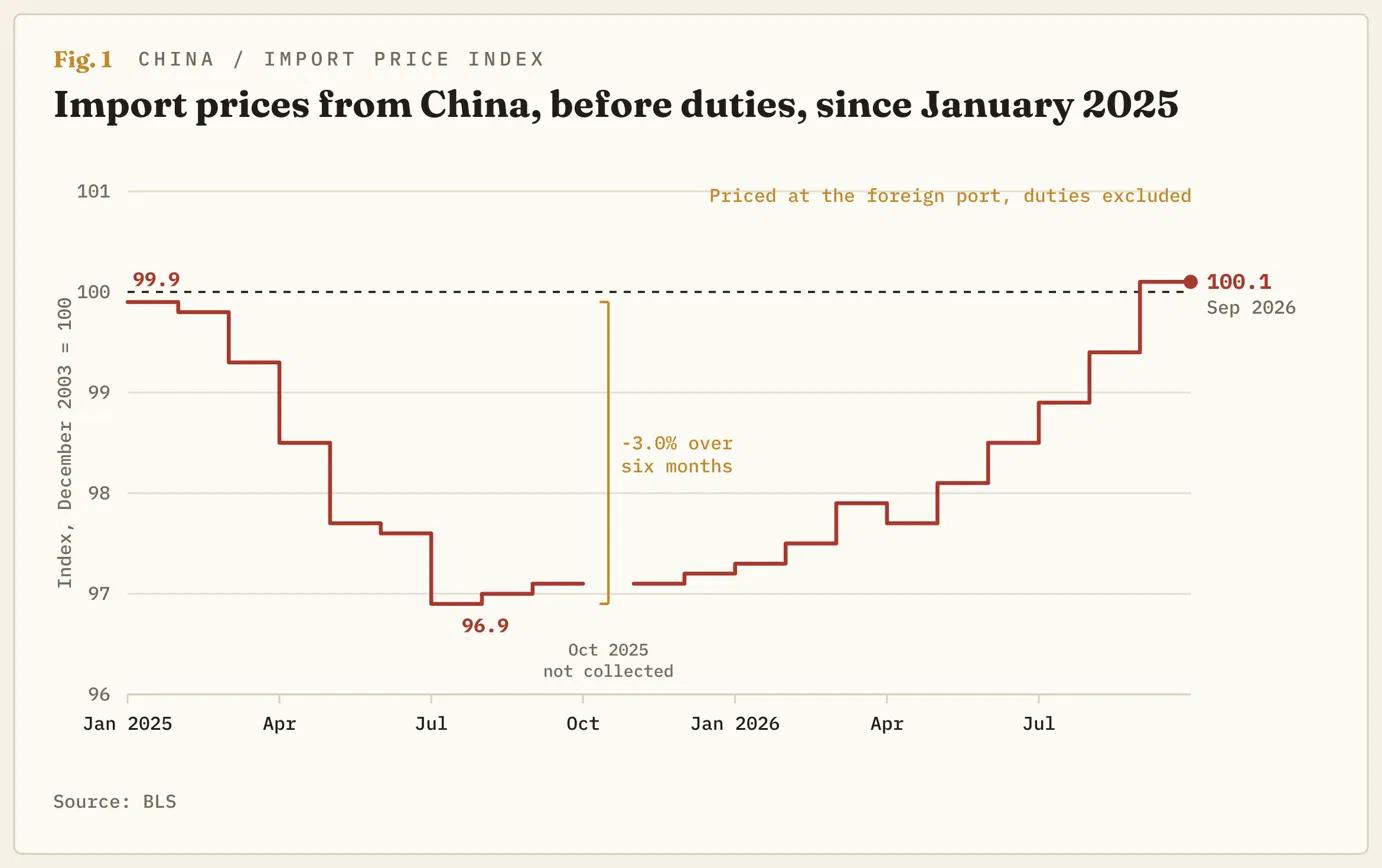
The index for imports from China was set at 100 in December 2003. It fell from 99.9 in January 2025 to 96.9 in July 2025, the year the tariff on Chinese goods peaked. It rose each of the last five months to 100.1, and September's 0.7% was the largest monthly rise since December 2021. The annual rate went from 2.6% below a year earlier in January to 3.1% above in September, climbing every month in between. Twenty-two years and two trade wars later, a Chinese good at the dock costs 0.1% more than it did when the counting began.
Tariffs on Chinese imports were 24.3% of their value in August, per the Penn Wharton Budget Model, well below the rate in 2025. Chinese exporters cut their prices 3% in the year the rate went up and raised them 3% in the year it came down. The shopper gets the second of those with the 24.3% on top of it.
The holiday aisles are priced before the duty
The pattern repeats in the aisles that fill in December. The dock price of clothing was 3.5% below a year earlier in January and 1.3% above in September, with the annual rate rising in every month between, and knitted apparel rose 1.5% in September alone. Toys at the dock cost 3% more than a year ago after a 2.6% jump in July, and footwear costs 2.2% more. Imported Copper costs 37.9% more than a year ago, Aluminium 28.2% more and Tin 59.5% more, and those are the prices before a metals tariff that runs to 50% is applied. A metal good made in America starts with the world's most expensive metal.
The duty goes on top and the refund goes elsewhere
Tariffs collected as a share of import value were 7.1% in August, up from 2.3% in January 2025. They would have been 10.1% if imports had followed their old trend, so three tariff points went uncollected because the goods stopped coming. Gross customs revenue from January 2025 through August is $314.8 billion. The Supreme Court ruled on February 20, six to three, that the International Emergency Economic Powers Act (IEEPA) does not authorise duties. A 10% global tariff under Section 122 ran from February 24 to July 23. Tariffs of 10% or 12.5% under Section 301 have applied to imports from 60 economies since July 24, beginning the minute Section 122 expired.
The Section 301 action rests on a finding that the 60 countries do too little to block goods made with forced labour. The Office of the United States Trade Representative (USTR) made that finding against all 60 on the same day, June 2. Plaintiffs at the Court of International Trade argue the finding was meant to replace the revenue the Supreme Court removed. A labour-rights determination and a budget line rarely share a start time to the minute.
Some $166 billion collected under IEEPA is subject to refund and $126 billion of it had been certified by October 2, payable to the importer of record, the company that paid the duty at the port. Whether any of it reaches a shelf is that company's decision, and the Section 301 bill at the register is not. The Budget Lab at Yale puts the average statutory rate at 11% and the rate scheduled under current law at 11.8% by the end of the year, at a cost near $92 a month for the average household.
The pump gets the war's bill the same month
Import fuel prices rose 4.8% in September and 34.5% on the year, with crude 29.8% higher and natural gas 96.5% higher, the largest annual rise in the gas index since June 2022. Brent averaged $114 in September against $68 a year earlier. The war with Iran began on February 28, and at least 12 tankers were attacked in and around the Strait of Hormuz between September 28 and October 5.
Gasoline in the CPI rose 9.1% in September and 34.2% on the year. Fuel at the port is up 34.5% and gasoline at the pump 34.2%, so the war's bill reached the driver with 0.3 of a point lost in transit. Brent is averaging $127 in October, so the fuel line of the November 17 release is already written.
The shelf gets the duty and the margin
The goods line takes longer and loses nothing on the way. Consumer goods excluding cars cost 2.7% more at the dock than a year ago, the most since April 2022, and the duty is applied on arrival. The Producer Price Index (PPI) for goods sold to final demand, the wholesaler's price, is 9.8% higher than a year ago
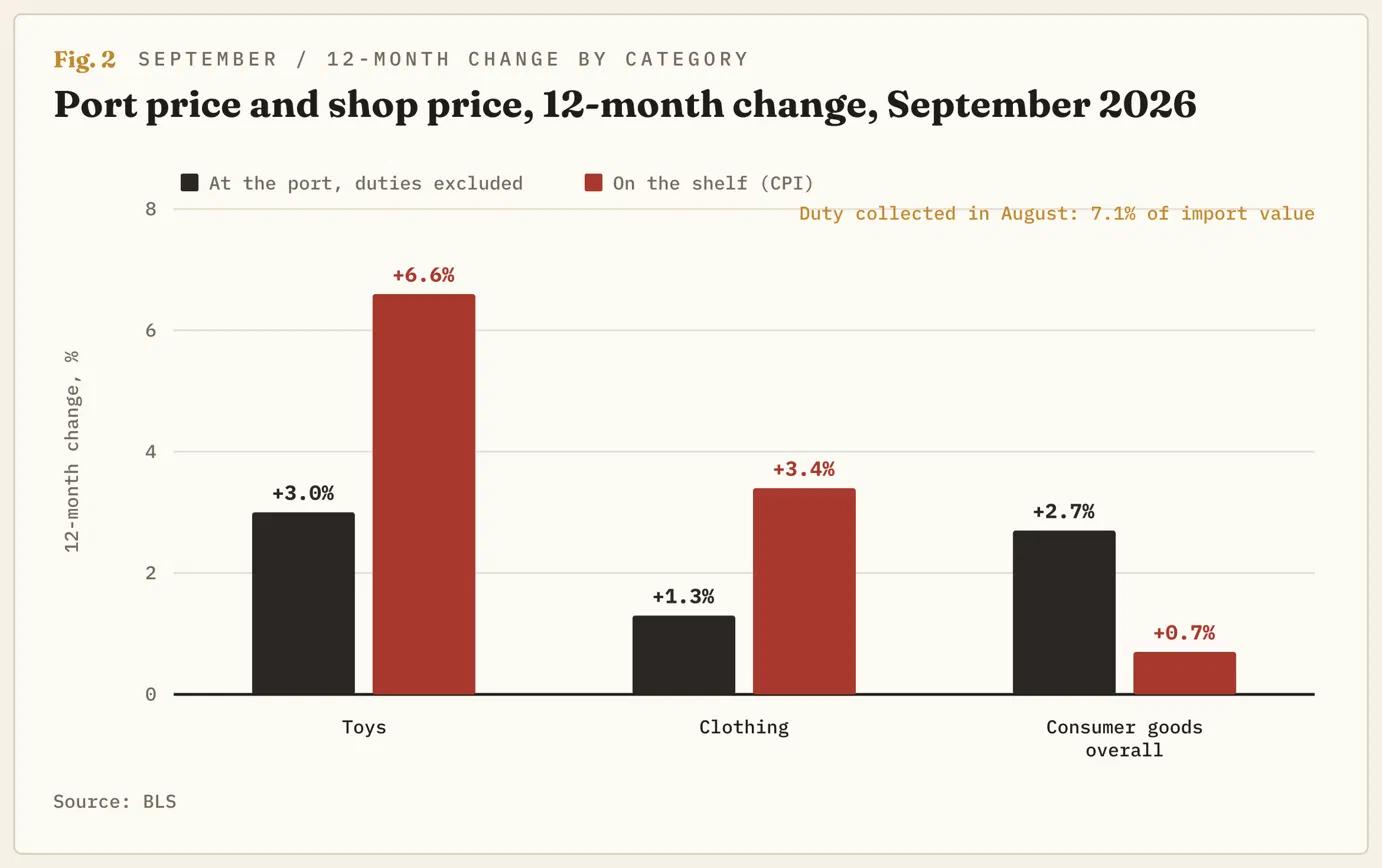
On the shelf, toys cost 6.6% more than a year ago, while dock prices rose 3%, and clothing cost 3.4% more while dock prices rose 1.3%. In both aisles the shelf rose more than the dock, and the difference is the duty and the margin. Computers cost 9.7% more, with imported semiconductors, the part of the machine the data-centre build-out is bidding for, up 36% at the dock. In September, the price of a toy was unchanged at the port and rose 4.2% in the shop, the largest monthly rise the toy index has recorded since it began in 1980.
The average that hides the bill
The CPI line the Federal Reserve (Fed) watches for goods and commodities, excluding food and energy, is 0.7% higher than a year ago, down from 1.5% a year earlier. Over the same period, the dock price of consumer goods went from 0.5% lower than a year earlier to 2.7% higher. The average is 6.6% for toys and 9.7% for computers, set against used cars at -1.5%, new cars at 0.6%, household furnishings at 1.6%, and medicines at -3.3%. The 0.7% is a doll that costs more, averaged with a used car that costs less, and the average is the number that gets quoted.
The University of Michigan (UoM) October survey shows buying conditions for durable goods are driven by high prices and borrowing costs. Sentiment is 46.3, the second-lowest reading on record after May, and current conditions are 44.7, down 12% in a month. The CPI split is between purchases that can wait and those that can't, and the ones that can wait aren't happening, which is why the price of a sofa barely moves.
The Fed raised its rate to 3.75%-4.00% on September 16, the first increase since 2023, into a market for cars and furniture that already had no buyers. After Wednesday's CPI, the futures market put the odds of another rise on October 28 near 44%. By Friday they were 16%, after Fed Chair Warsh told the International Monetary Fund (IMF) meetings in Bangkok that the Fed is moving away from previewing its decisions. The Fed stopped previewing its decisions in the week the market most wanted one.
America sells at the world price too
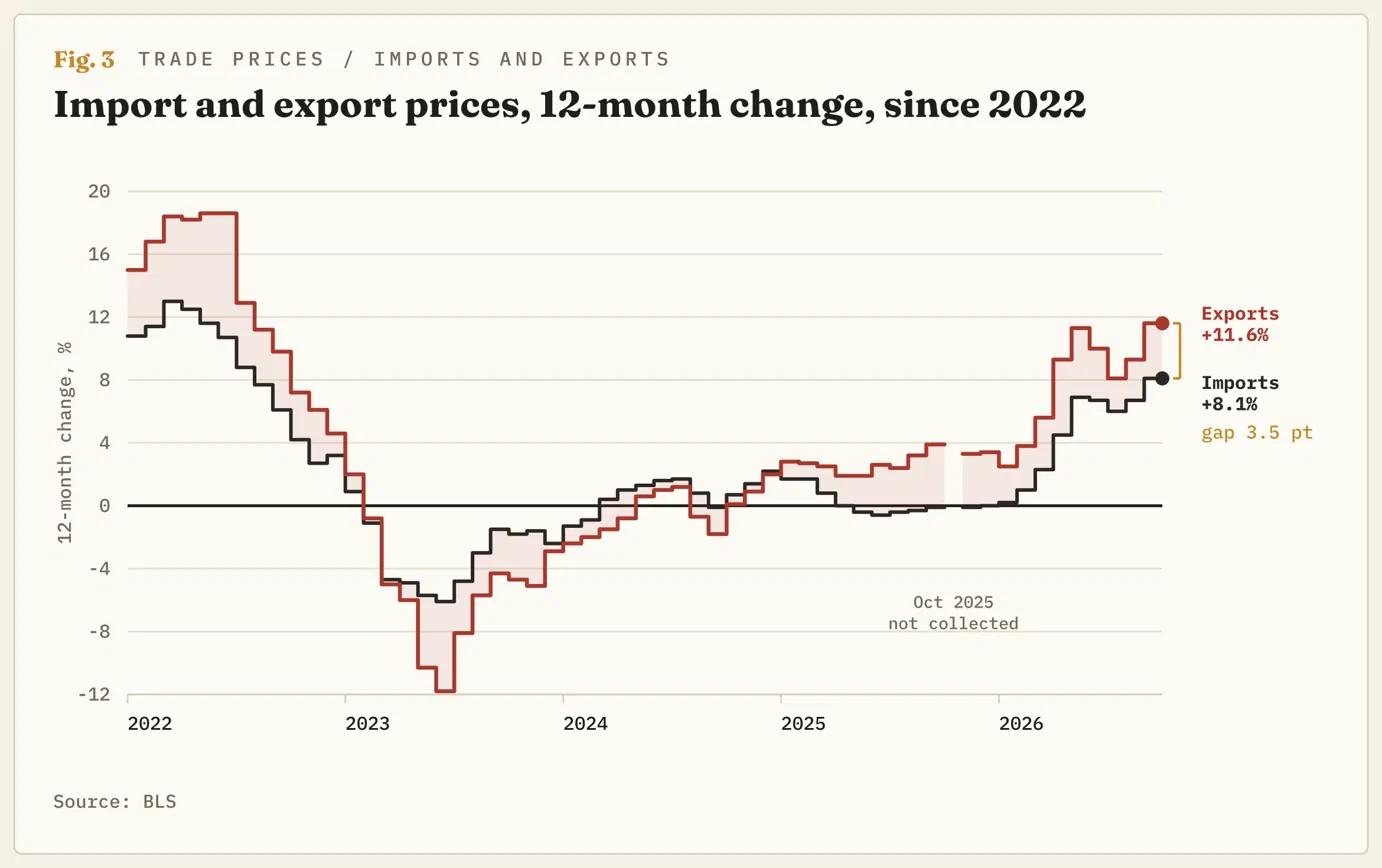
Export prices rose 2.2% in September, above the 1% forecast and 11.6% on the year, the most since July 2022. Agricultural export prices rose 2.6% in the month, the most since November 2022, and 9% on the year on soybeans, corn and wheat, and have not fallen in a month since December 2025. Exports of refined petroleum are priced 48.8% above a year ago. Prices for exports to China rose 2.7% in September, the largest monthly gain since March 2022.
A bushel of corn sells for the same price in Iowa and in Rotterdam, and a refiner sells diesel at the world price whether the truck is in Ohio or Hamburg. American exporters get abroad the same price Americans pay at home for the same corn and diesel. The US terms of trade with the European Union (EU) rose 3.6% in September, the largest monthly gain since the series began in January 2018. This statistic improves when America sells high and buys high, and it says nothing about who at home pays the high price. Exports are 11.8% higher in dollars this year, with export prices averaging 7.5% higher, and the trade deficit is 19.9% smaller, a better national ledger paid for in the grocery aisle.
The bill is flat and incomes are not
The Budget Lab at Yale estimates the tariff costs the bottom tenth of households 1.1% of income and the top tenth 0.4%, because fuel, clothes, toys and food take a larger share of a small budget. The UoM reports sentiment dropping steeply among lower-income consumers and those with small stock portfolios, the groups with the fewest resources to absorb price rises. Year-ahead inflation expectations are 4.7% against 3.4% in February, before the war. Average hourly earnings are 3.0% higher than a year ago, while CPI is 3.7% higher, so pay fell 0.7% after inflation, and the saving rate of 4.1% is the lowest since November 2022.
The $126 billion refund is paid to the importer, and the top 1% of households hold 50.9% of corporate equities, per the Fed's distributional accounts. The refund goes to the owners of the companies that paid it, and those owners are not in the bottom tenth.
What ends it
The question for the holiday quarter is whether the shopper's walkout forces someone above the till to absorb the bill, or whether the bill keeps arriving. The first branch shows the nonfuel import index falling for the first time in a month since August 2025, with the Dollar flat, which would mean suppliers have started discounting again.
It also shows up as retail margins falling while the toy and clothing CPI lines roll over. On that branch, the Fed holds at 3.75%-4.00% and the position is against the retailers that import what the shopper can put off. The second branch shows up as the dock price rising toward Yale's 11.8% statutory rate, with the shelf following and volumes falling further, which is the consumption economy giving way from the bottom. On that branch, a December rise comes back onto the table and the position is against the categories that can wait, which is the same position.
The Fed decides on October 28, the October jobs report comes on November 6, and the October CPI comes on November 10. That is also the day the fentanyl tariff reduction and the Section 301 exclusions in the November 2025 China deal lapse, unless the reported extension to January 2027 is made official. October import prices will be released on November 17, with no annual comparison because October 2025 was not collected during the shutdown, and Walmart (WMT) reports on November 19. The case is wrong if nonfuel import prices fall or if shop volumes rise alongside prices, because either one means someone other than the household is carrying it.
Author

Joshua Gibson
FXStreet
Joshua joins the FXStreet team as an Economics and Finance double major from Vancouver Island University with twelve years' experience as an independent trader focusing on technical analysis.

















