Silver at $100. Gold near $5,000 – The year of hard assets is officially here

Only three weeks into 2026, global Commodity markets are delivering a decisive verdict. What analysts at The Gold & Silver Club formally declared months ago – “2026 will be the Year of Hard Assets” – has crystallized into the defining macro theme of the year.
Across exchanges from London to Shanghai and Chicago to Dubai, capital is rotating with force. Liquidity is flowing out of stretched Equity valuations and depreciating currencies and into tangible assets whose scarcity can no longer be ignored. The result is a synchronised surge across both precious and industrial metals that is reshaping global portfolios in real time.
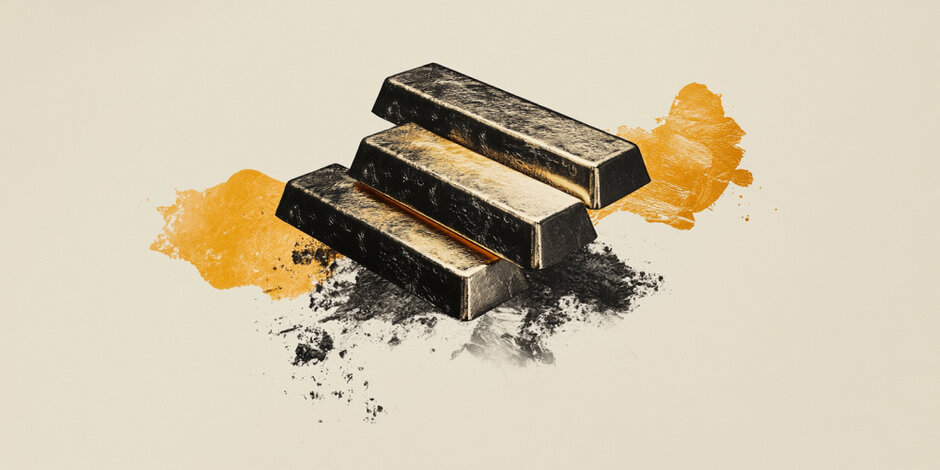
The opening weeks of the year have already delivered a watershed moment. Silver has surged through $100 an ounce for the first time in history, while Gold has advanced to within striking distance of $5,000.
Gold has now notched successive record highs in 2026, extending a run that sees the yellow metal outperform the S&P 500 for six consecutive months – the longest such stretch since the Global Financial Crisis in 2008. According to Lars Hansen, Head of Research at The Gold & Silver Club, “Gold is now the best-performing major asset of the 2020s, outperforming equities, real estate and bonds on an annualised basis.”
Silver, however, is where the move turns explosive.
The Gold-to-Silver ratio has plunged towards 50, its lowest level in roughly 14 years, after trading above 100 as recently as 2025. The implications are profound.
Gold’s rally – up nearly 90% in just 13 months – already rivals the early stages of the 1970s Supercycle. Silver’s ascent has been even more dramatic: prices above $101 represent gains of more than 43% year-to-date and an astonishing 248% in just over a year.
As Hansen observes, “Silver’s market capitalization has now crossed $5 trillion – overtaking the entire U.S bond market and eclipsing Germany’s equity market.” Once dismissed as the more volatile sibling to Gold, Silver has become the fulcrum of the hard-asset trade.
This is no longer a two-metal story. Uranium has reached its highest level since mid-2024. Copper, Aluminium, Nickel, Zinc, Platinum, Palladium and Tin have all pushed to multi-year, decade or all-time record highs. Across 47 listed Commodities, 38 are positive year-to-date, with more than two dozen now within striking distance of fresh all-time highs.
This marks the broadest synchronized Commodity breakout since the post-crisis renaissance of 2009 and in several cases, a stronger one.
The Gold & Silver Club has long argued that aggressive fiscal expansion, tightening supply chains and increasingly weaponized trade policy would collide. That thesis is now visible on trading screens worldwide. As Bank of America once put it, “all commodity charts will eventually look like Gold.” In early 2026, they already do.
“Liquidity is rising, purchasing power is eroding and scarcity is being repriced in real time,” Hansen says. Against that backdrop, The Gold & Silver Club has lifted its official targets to $5,300 an ounce for Gold and $125 an ounce for Silver in Q1, 2026 – a stance it describes as a conservative base case.
Major Banks are converging on similar conclusions and upgrading their 2026 precious metals forecasts. Goldman Sachs, UBS and Bank of America now see upside scenarios extending towards $5,700 for Gold and $130 – $150 for Silver. JPMorgan has gone further, floating projections as high as $8,000 for Gold by 2028 as portfolios rebalance into physical assets.
What distinguishes The Gold & Silver Club from consensus is not merely bullish positioning, but a consistent record of spotting regime shifts years before they become headline narrative. “We didn’t just predict the rally – we named it,” Hansen says. “History rewards early positioning, not hesitation.”
As 2026 accelerates, the conclusion is becoming unavoidable. The hard-asset cycle is no longer forming; it is underway. For traders still waiting for Confirmation, the cost of delay may prove to be the most expensive trade of the decade.
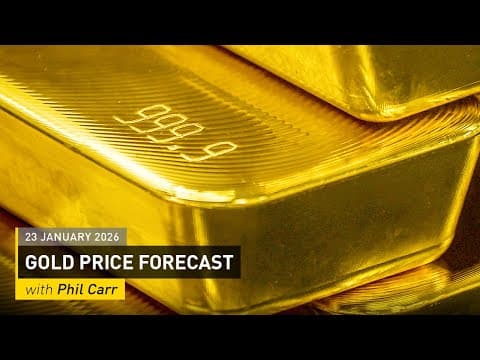
Where are prices heading next? Watch The Commodity Report now, for my latest price forecasts and predictions:
Author
Phil Carr
The Gold & Silver Club
Phil is the co-founder and Head of Trading at The Gold & Silver Club, an international Commodities Trading Firm specializing in Metals, Energies and Soft Commodities.