|

Shanghai Housing Sales Plunge 86% in Golden Week

fxsoriginal

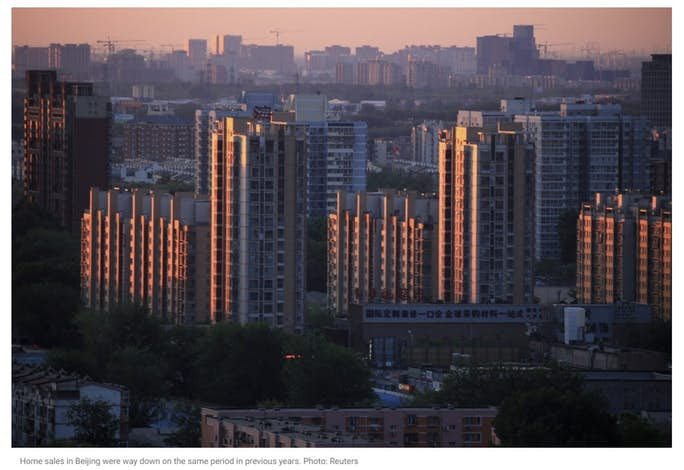
Golden Week, a seven-day Chinese holiday, is traditionally a peak period for home sales. This year, sales plummeted.

The South China Post reports ‘Golden Week’ Property Sales Plunge in Major Chinese Cities.

Property sales in China’s major cities saw one of their worst “golden week” holidays in years, as buyers held back amid a slowing economy and tight restrictions on mortgage loans.

Sales of new homes in Beijing dropped to their lowest level since 2014 during the week following the National Day holiday, according to data from the property information portal Zhuge.com.

By area, sales of new homes in Shanghai plummeted 86 per cent to 5,000 square metres, while the capital saw a 92 per cent plunge to 2,000 sq metre, according to data from Centaline Property.

Clement Luk, a director for east China at Centaline Property, said the home-buying mood has been dampened by the tightening of mortgage lending and the prolonged US-China trade war that discouraged spending.

“People do not want to commit in big investment now, like purchasing any homes, as market sentiment has cooled quickly since March,” he said. “Most owners prefer travelling during golden week holiday instead.”

“Deals are increasingly difficult to conclude unless owners are willing to cut selling prices at big discounts,” said Guo Yi, chief analyst at Beijing-based property consultancy Heshuo Institute.

Beijing Dilemma

Beijing faces the dilemma of all speculative markets: because most real estate buying is now driven by expected price increases, when prices credibly stop rising, buyers disappear and prices begin to fall. Price stability isn't a real option.https://www.scmp.com/business/article/3032030/golden-week-property-sales-plunge-major-chinese-cities-amid-slowing … via @scmpnews

Michael Pettis @michaelxpettis

When property speculation ends, property bloodbaths begin.

Author

Mike “Mish” Shedlock's

Mike “Mish” Shedlock's

Sitka Pacific Capital Management,Llc

Mike “Mish” Shedlock is a registered investment advisor for SitkaPacific Capital Management.

More from Mike “Mish” Shedlock's
Share:

Editor's Picks

AUD/USD recovers toward 0.7000 amid improving mood

AUD/USD is firming up toward 0.7000 in Asia on Tuesday, helped by improving market mood. A pause in the US Dollar rebound also aids the pair's upside. However, geopolitical risks and caution ahead of AI tech earnings report could limit the pair.

USD/JPY flatlines near 158.50 as markets seek direction

USD/JPY steadies around 158.50 in the Asian trading hours on Tuesday. Traders prefer to wait on the sidelines ahead of Japan’s National Consumer Price Index inflation data later on Friday. Meanwhile, elevated US bond yields provide some support to the US Dollar against the Japanese Yen.

Gold alternates gains with losses below $4,200

Gold prices trade without a clear direction on Tuesday, hovering around the $4,170 region per troy ounce and still struggling to regain upside traction following Monday’s pullback. In the meantime, lower US Treasury yields and a marked pullback in the US Dollar come in tandem with the yellow metal’s price action.

Crypto Today: Bitcoin, Ethereum, XRP tick lower amid mixed ETF flows

Bitcoin is trading above $81,000 on Tuesday, aligning with a lethargic tone in the broader cryptocurrency market. Altcoins, including Ethereum and Ripple, reflect Bitcoin’s lock-step price action, trading below $2,400 and $1.30, respectively.

Markets at a turning point: Bitcoin, Gold, FX and Tech react to a heavy macro week

The new trading week opens with a mixed but revealing picture across global markets. Indices, commodities, FX, tech stocks, and cryptocurrencies are all sending one message: risk appetite is alive, but it is cautious, selective, and highly sensitive to macro signals.

The US Dollar fell. Gold didn't rally. That tells you everything
Gold (XAU/USD) is struggling to capitalize on a weaker US Dollar (USD), after repeatedly failing to establish itself above the $4,200 level. The precious metal remains confined to a relatively narrow trading range despite a combination of developments that would normally support higher prices.