RBA Preview: On hold, statement to be balanced, marginal risks for AUD
- RBA unlikely to announce further policy changes at Tuesday's meeting.
- Statement is likely to be balanced with the Bank arguing that the economy will eventually recover.
- The main issue with RBA policy is the extent of their bond-buying program.
- AUD/USD bullish above 21-day moving average and 61.8% Fibo, bearish below.

As COVID-19 risks to the economy grew rapidly through March, the RBA lowered the cash rate to 0.25% through two consecutive 25bp cuts. We have the RBA interest rate decision this week, scheduled for the 7th April in Asia, but there has been a reluctance to embrace negative rates and we can expect this week's meeting to echo a similar theme, resulting rates on hold at 0.25% and the RBA unlikely to announce further policy changes at Tuesday's meeting.
If we cast out minds back to the RBA's Minutes of the 18th March meeting last week, pertaining to a very fluid COVID-19 global pandemic, and making it hard to forecast, the RBA at least was able to predict a material contraction in economic activity for Q1 and Q2 with the possibility that this extends. Indeed, the economic outlook has deteriorated since March 19, as COVID-19 continues to spread in Australia and globally, but markets have staged a modest recovery in response to the potential impact of global government and central bank stimulus and members have already agreed that the cash rate was now at its effective lower bound.
Bank's forecasts will be key for sentiment
The market will, therefore, continue to be interested in the Bank's forecasts with some more time past and perhaps not the worst outcome in the numbers of cases that might have been imagined-up, especially in Oceania. Indeed, with 0.25% seen as the lower bound for traditional monetary policy in Australia, the RBA has already introduced quantitative easing measures alongside the March cut.
Quantitative easing is focused on yield curve control, specifically holding the 3-year bond yield at “around 0.25%”. In the latest markets, Australian 3yr government bond yields have ranged between 0.24% and 0.26%, respecting the RBA’s QE target, while the 10yr yield slipped from 0.76% to 0.72% before closing at 0.75%. Borrowers and the Bank will be content with these ranges, for now, with longer-term yields being suppressed with asset purchases are occurring across the full spectrum of commonwealth government securities as well as state government debt.
RBA is seeking to preserve market liquidity
For now, the main issue with RBA policy is the extent of their bond-buying program. "The RBA is seeking to preserve market liquidity and proper function by injecting cash through repurchase agreements at multiple maturities," analysts at Westpac explained. "And, to mitigate the cost of larger bank settlement balances to the industry, the interest rate paid on funds in these accounts will be 0.10% rather than 0%." So, in addition to an economic outlook, the market will look to this week’s statement for further information about how the RBA sees the program evolves.
How will the RBA decision affect AUD/USD?
The statement is unlikely to surprise markets in way shape or form and should not generate very much AUD volatility. The RBA will likely repeat that they are ready to implement further measures as and when necessary, and will not raise rates until their growth, inflation and employment targets are in view, which could lean a little heavy on the Aussie. However, the statement is likely to be balanced with the Bank arguing that the economy will eventually recover and that the Australian financial system is resilient. Markets are forward-looking and to mark that off against a more uncertain outcome in the US, pertaining to the COVID-19 cases there, AUD could get a lift as Australia is well placed to rebound.
A bullish scenario for AUD/USD
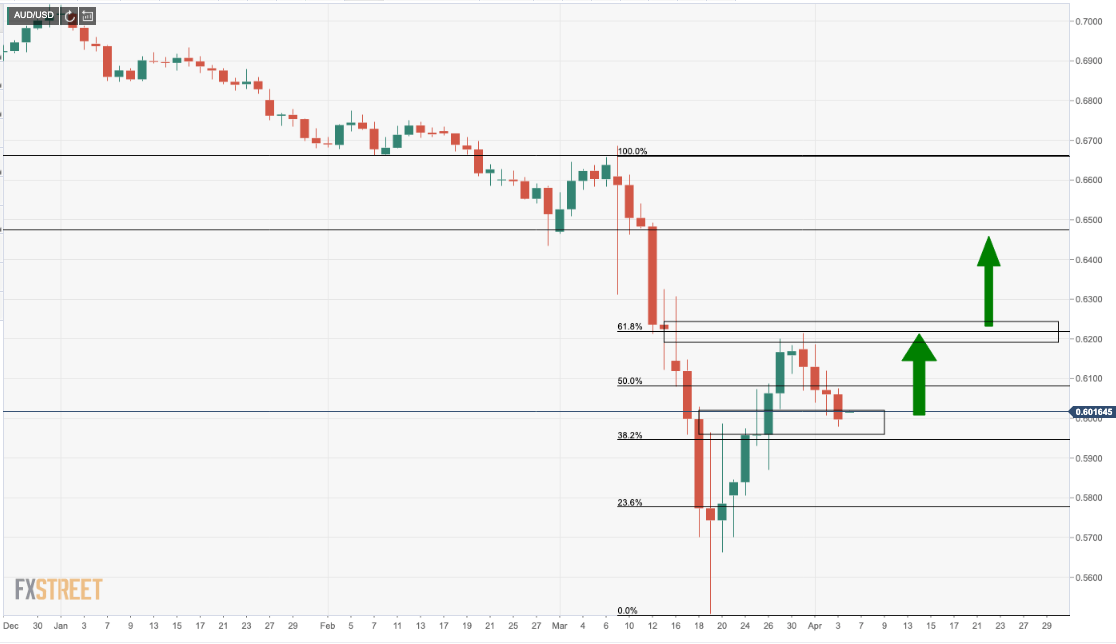
The bulls have made ground back to test the 61.8% Fibonacci in a strong impulse. The pullback is hading into a support structure, and if it were to hold, the next impulse will seek a close above the 61.8% Fibo for prospects of recovery to test the 0.65 mark.
A bearish case for AUD/USD
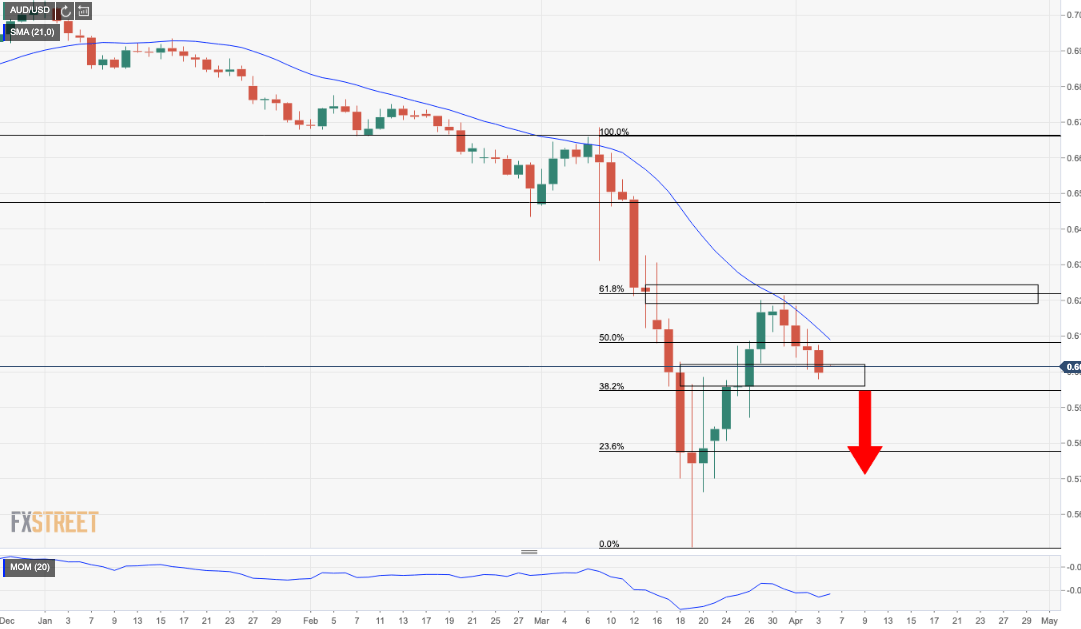
There is some bearish divergence in Momentum and the pair has been rejected at the 61.8% Fibo below the key resistance area. While smothered below the 21-day moving average, the price could continue to build into an extension impulses to the downside and extend below he 0.55 handle and recent lows for a bearish continuation.
Author

Ross J Burland
FXStreet
Ross J Burland, born in England, UK, is a sportsman at heart. He played Rugby and Judo for his county, Kent and the South East of England Rugby team.