RBA Preview: Imminent cut expectations to weigh heavily on AUD
- RBA could hold this week, but still, casting a dovish tone and outcome to weigh on the AUD.
- Coronavirus, bushfires outweigh green shoots in the latest data.

As the Australian dollar ended its worst week since last summer, the Reserve Bank of Australia is meeting this week, 4th Feb. Markets will be keenly tuned into the event as a critical deciding factor for the trajectory of the Aussie. RBA is expected to hold at 0.75%, but a surprise cut may not be all that much of a surprise, although could lead to an extension of the downside for the currency.
We have been subject to a series of data releases from both China and Australia while at the same time, the commodity complex has taken a beating due to the concerns over the coronavirus. Australia has been subjected also to the bushfire strategy which has also been a concern for Gross Domestic Product readings ahead while fires continue to blaze across the NSW south coast and south-east. Indeed, the coronavirus has stripped the positive tones from the US/Sino trade deal at the start of this year, a deal that offers only limited tariff relief for China in exchange for a huge increase in purchases of US exports, which doesn’t seem overly bullish for the yuan nor the Aussie. Then, there is recent data from Australia to consider.
Historical data
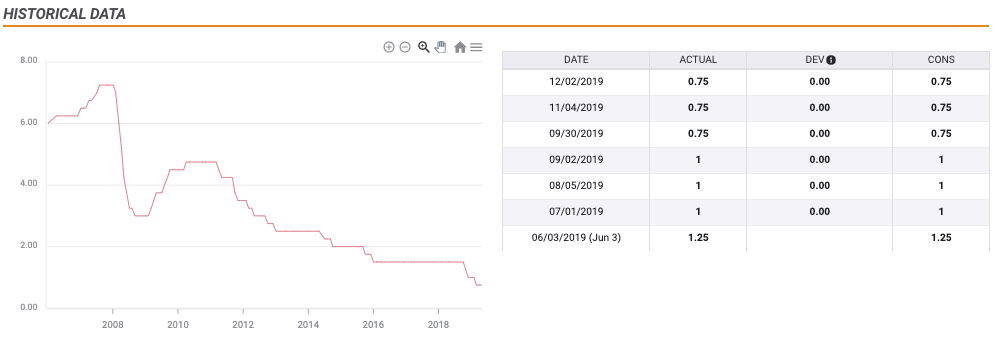
Aussie data enough to stave off an immediate cut, but not enough to price out a dovish sentiment
While the Aussie data made for some short-term relief in the momentum of the recent downtrend, it has by no means prevented prices from falling further. Markets have recently slashed their expectations for a cut: from almost 60% of implied probability to the current 17% in only ten days. Meanwhile, and regardless, AUD/USD has fallen some 5% this year despite bets being pulled from the table of an imminent rate cut from the RBA.
A great deal of the risks associated with the coronavirus has swallowed up the bulls and sell stops around critical support structures and coupled with the notion that the RBA will likely need to take action at some point down the line, there has been an afterglow in the bullish trends, despite some recent weakness in the US dollar, fighting its own battle with the curve.
Aussie fourth quarterly CPI has arrived with the headline slightly better than expected at +0.7 pct Q/Q vs a Reuters poll +0.6 pct – (slightly AUD bullish). There was also a beat in the YoY Trimmed Mean which is bullish AUD and an upside correction can be expected vs the greenback.
Data as follows
- Trimmed Mean CPI +0.4 pct QoQ (Reuters poll +0.4 pct).
- CPI (all groups) +0.7 pct QoQ (Reuters poll +0.6 pct).
- Q4 RBA weighted median CPI +0.4 pct QoQ (Reuters poll +0.4 pct).
- Q4 RBA Trimmed Mean CPI +1.6 pct YoY (Reuters poll +1.5 pct).
- CPI (all groups) +1.8 pct YoY (Reuters poll +1.7 pct).
- Q4 RBA weighted median CPI +1.3 pct YoY (Reuters poll +1.3 pct).
The Reserve Bank of Australia forecasted Trimmed Mean inflation to come in at 0.4% QoQ and 1.6% YoY, which had been published in the SoMP. The fact that there is a beat on both the Trimmed Mean YoY and in the headline, markets have taken their bets for a rate cut as soon as this week, especially when coupled with the Aussie jobs data back on the 23rd of this month which showed a positive trend in a falling unemployment rate:
However, a combination of the bushfire emergency, as well as the concerns related to the Coronavirus, could convince the RBA to lower the Cash Rate (by 25bp) this week. Or, in the least, we could see more dovish tone hence suggesting an imminent rate cut.
QE on the horizon? 0.66 in focus
RBA Governor Lowe, last year, outlined some parameters with respect to the use of unconventional policies in Australia. Although he made clear that conditions were currently not ripe for QE, he indicated that if the cash rate was cut by an additional 50 bps to 0.25%, then the RBA could embark on an asset purchases programme.
At this juncture, we are starting to see some improvement in the data, however, should economic headwinds persist and considering that there are some expectations that tensions between the US and China will rise again in the months ahead, coupled with the coronavirus spreading, the view remains that both the cash rate and the AUD will trend lower into 2020. AUD/USD could be forecasted to head towards a break below the 0.6600 handle in due course.
AUD/USD levels
Description
RBA Interest Rate Decision is announced by the Reserve Bank of Australia. If the RBA is hawkish about the inflationary outlook of the economy and rises the interest rates it is positive, or bullish, for the AUD. Likewise, if the RBA has a dovish view on the Australian economy and keeps the ongoing interest rate, or cuts the interest rate it is seen as negative, or bearish.
Author

Ross J Burland
FXStreet
Ross J Burland, born in England, UK, is a sportsman at heart. He played Rugby and Judo for his county, Kent and the South East of England Rugby team.

















