OPEC decision to threaten progress with inflation

This past Sunday, 2nd April, Saudi Arabia and other OPEC+ oil producers announced fresh oil production cutbacks of roughly 1.16 million barrels per day, which came as a surprise to many and was predicted to immediately drive up prices and hinder the ongoing efforts of many nations to contain inflation.
On Monday, 3rd of April, oil prices strongly increased, opening with a bullish gap of more than 6%, as a direct consequence of the changes which will supposedly take place next month. In the meantime, the US, the UK, and the EU among others are all fighting to minimise upward pressure on prices, so OPEC+'s unexpected action couldn't have come at a worse moment. The Biden administration has already strongly opposed the move and said that it is “not advisable.”
Let's examine in this article the causes and potential outcomes for inflation and interest rates if OPEC follows through with the decision to cut supply.
What caused OPEC to decide to reduce output?
Concern that the current global financial crisis will dampen demand has partly led to oil prices falling last month to below $64.50 a barrel according to ActivTrades’ commodity trading data, the lowest in 15 months. Crude eventually rebounded and hovered just below $80, and at the time some experts played down the likelihood of additional measures by OPEC+ to bolster the market.
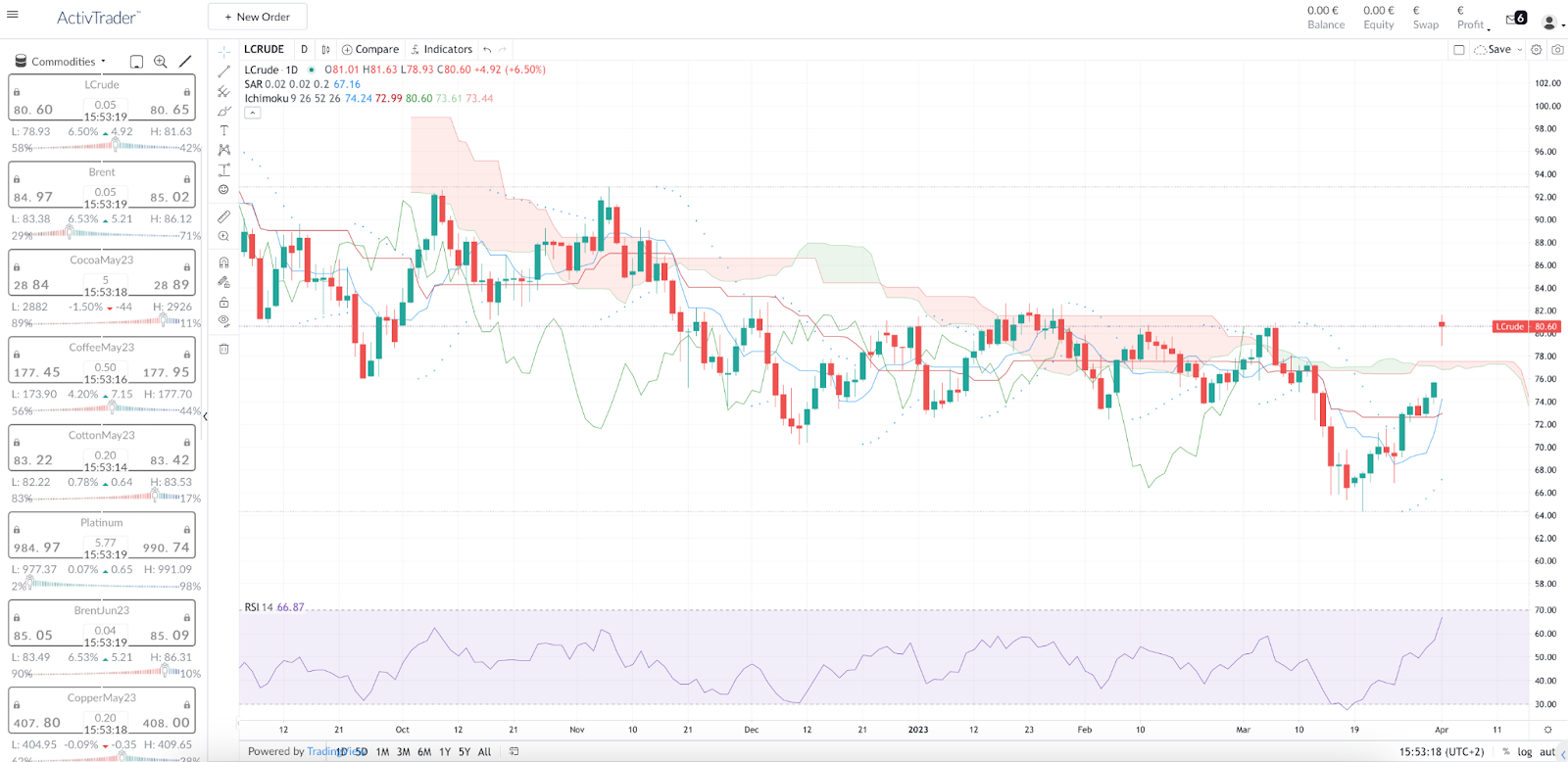
Daily Light Crude Oil Chart - Source: The online trading platform from ActivTrades
The move seems to be the group’s way of getting ahead of this probable economic downturn and recession, particularly in the US and larger economies in Europe later this year. With the idea of trying to maintain oil prices at around $80 per barrel, OPEC+ said, its decision was intended to support the “stability of the oil market.”
Part of the reason this decision has come as a surprise is that the announcement has come only one day before the OPEC+ conference. Members had previously indicated that they would continue the current production strategy, meaning no further cutbacks, which is why the news has come out of left field. The other reason for concern is that there is still a chance that other members of the organisation may follow the lead of their peers and announce voluntary reductions after the meeting too.
The cuts start in May and will reportedly go all the way through the end of the year. An official statement says that Iraq will cut its production by 211,000 barrels per day (bpd). The UAE said it would cut production by 144,000 bpd, Kuwait said it would cut production by 128,000 bpd, Oman said it would cut production by 40,000 bpd, and Algeria said it would cut production by 48,000 bpd. Kazakhstan will cut production by 78,000 bpd as well.
How does it impact inflation?
Increasing oil prices will eventually impact the cost of manufacturing and transportation among other things, while they also lower consumer purchasing power. Inflation, the pace at which prices throughout the economy are increasing, is affected by the price of crude oil since it is such a key economic input.
On the premise that there won't be a recurrence of the rise in energy prices brought on by Russia's invasion of Ukraine last year, central banks had been anticipating a dramatic decline in inflation this year as a result of their persistent tightening of monetary policy to cool demand.
Historically, oil prices have had a larger impact on the price of manufacturing/production than on the pricing of services, which is why there is a moderate association between the price of oil and the consumer price index, but a more significant correlation between crude and producer price index. Eventually, though, higher prices for producers leads to higher prices for consumers, it usually just takes a while to filter through.
The action by OPEC+ raises the possibility of overall inflation becoming more stubborn and making it more entrenched in the economy as prices rise.
What about interest rates?
If oil prices continue to rise at this point and the increase is prolonged enough, central banks across the globe will most likely become more cautious in their monetary policy decisions.
The balance of lifting interest rates to cool demand versus sending their respective economies into recession will become even more delicate, and the “soft landing” concept becomes more far-fetched than ever.
If OPEC+ succeeds in permanently driving up oil prices, the effect will more than likely be higher interest rates for a longer period of time which has many implications on the global economy.
Rising interest rates have an influence on the stock and bond markets, credit cards, personal loans, student loans, auto loans, and business loans, in addition to mortgages. Companies, both public and private, also face higher costs of operation when this happens. Stock prices and company growth rates might also be negatively affected by greater expenses and fewer business over time, which might help trigger a recession in time.
The information provided does not constitute investment research. The material has not been prepared in accordance with the legal requirements designed to promote the independence of investment research and as such is to be considered to be a marketing communication.
All information has been prepared by ActivTrades (“AT”). The information does not contain a record of AT’s prices, or an offer of or solicitation for a transaction in any financial instrument. No representation or warranty is given as to the accuracy or completeness of this information.
Any material provided does not have regard to the specific investment objective and financial situation of any person who may receive it. Past performance is not a reliable indicator of future performance. AT provides an execution-only service. Consequently, any person acting on the information provided does so at their own risk.
Stay up to date with what's moving and shaking on the world's markets and never miss another important headline again! Check ActivTrades daily news and analyses here.
Author
Carolane de Palmas
ActivTrades
Carolane graduated with a Masters in Corporate Finance & Financial Markets and got the AMF Certification (Financial Markets Regulator in France). Afterward, she became an independent trader, investing mostly in European and American stocks/indices.

















