|

Nonfarm Payrolls Preview: Encouraging data but little action expected

  • US employment sector is foreseen growing yet at a slow pace.
  • The US presidential election’s dispute will likely overshadow employment data.
  • USD moving on the market’s sentiment, risk-on may not survive upcoming events.

The US will release October employment figures this Friday. The Nonfarm Payroll report is expected to show that the economy added 600K positions, while the unemployment rate is foreseen declining from 7.9% to 7.7%.

The news will come in the heat of the US presidential election, as  President Trump is disputing the results of several states in court. Also, the US Federal Reserve is having a monetary policy meeting late Thursday, although the most likely scenario is that it will be a non-event. Elections, on the other hand, will likely continue to overshadow everything else.

Leading indicators hint at a strong figure

Ahead of the release, some mixed signals are coming from employment-related indicators. Overall, the numbers have been improving, suggesting a positive outcome, yet it seems that the employment sector has been growing at a slower pace when compared to the previous months.

The ADP survey on job creation in the private sector was the only negative number from these weeks, as it showed an increase of 365K, well below the 650K expected.

Initial Jobless Claims, on the other hand, have fallen below the 800K threshold mid-October and remain there.  Also, the Challenger Job Cuts report showed that the number of corporate layoffs has retraced to 80.666K.

The most encouraging signs come from ISM as the sub-employment component in the October Manufacturing PMI has jumped to 53.2 from 49.6, the first time it reaches expansion territory this year. The sub-component from the Services index came in at 50.1, beating expectations although below the previous 51.8.

US jobs report pre-release checklist – Nov 6th, 2020

Previous Non-Farm PayrollsNegativeThe US economy added 661K jobs in September, way worse than expected and less than half the number in August.
Challenger Job CutsPositiveThe number of corporate layoffs has retraced again in October (80.66K), down below 100K for the first time since the pandemic struck. 
Initial Jobless Claims PositiveFirst-time employment claims resumed the post-pandemic downtrend in the last couple of weeks, finally breaking below 800K per week.
Continuing Jobless Claims PositiveThe number of unemployment benefit claimants downtrend has accelerated in the last month, from more than 11M to below 8M in the week ending on Oct 16.
ISM Services PMI PositiveThe employment sub-index in the US main services survey has now registered two consecutive months of expansion.
ISM Manufacturing PMI PositiveThe employment sub-index in the US main manufacturing survey has accelerated its recovery, jumping to expansion territory in October for the first time since July 2019.
University of Michigan Consumer Confidence Index PositiveThe UMich consumer sentiment survey continued its slow recovery in October, rising from 80.4 to 81.8, still far from pre-pandemic levels.
Conference Board Consumer Confidence Index NeutralThe Conference Board Consumer Confidence Index® has seen its recovery halted in October, although it stays above 100.
ADP Employment Report NegativePrivate sector employment just added 365K jobs in October, much lower than the 650K expected.
JOLTS Job Openings NeutralThe hiring recovery slowed down in August, printing 6.49M job openings, down from 6.697M from July, but still way up from the numbers seen during the spring months. 

Dollar’s possible reaction to different scenarios

The dollar is down across the board against all of its major rivals, as the market is in risk-on mode. This last, however, could be affected by developments related to the US presidential election, which are still underway.

The safe-haven yen is the laggard, as investors are buying high-yielding assets. Should the dollar remain weak, the USD/JPY pair may be the worst performer. In such a scenario, Gold and the AUD could be the best performers.

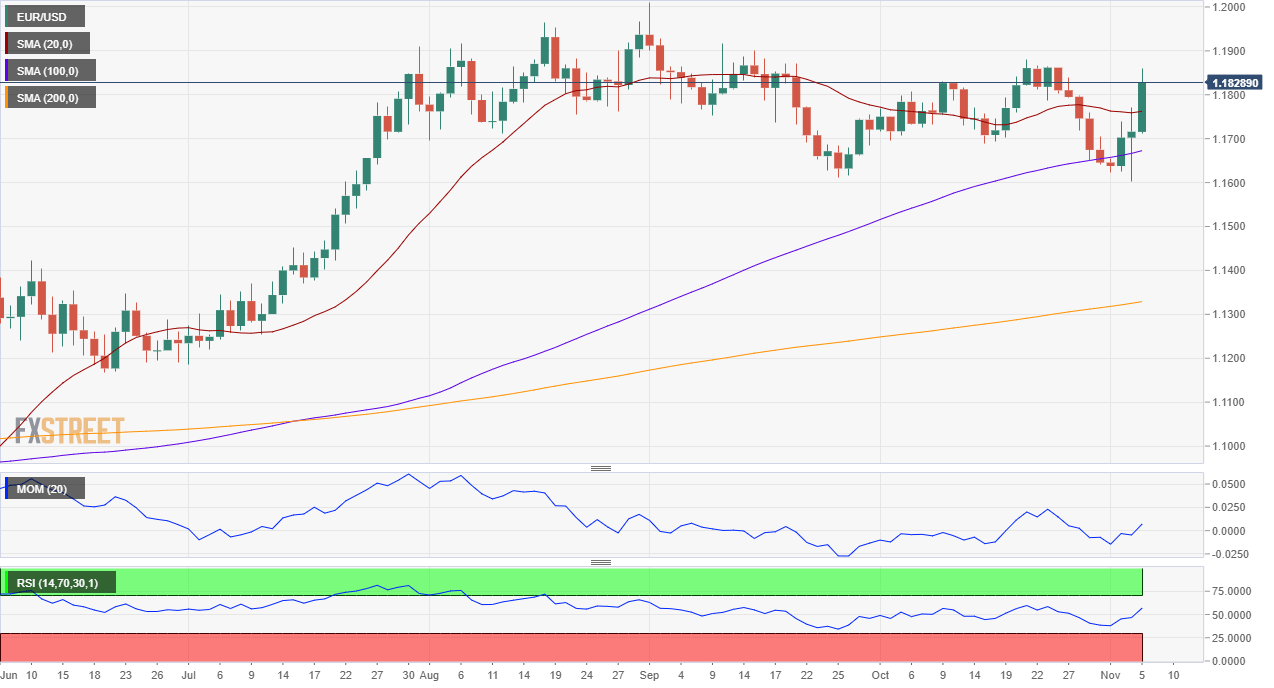
European currencies are up, but Brexit caps GBP while the latest ECB’s announcement should keep EUR gains in check. Rallies in EUR/USD and GBP/USD are expected to be temporal within the release of the NFP report.
Author

Valeria Bednarik

Valeria Bednarik was born and lives in Buenos Aires, Argentina. Her passion for math and numbers pushed her into studying economics in her younger years.


More from Valeria Bednarik
Share:

Editor's Picks

AUD/USD turns south toward 0.6900 as USD firms up

AUD/USD sees fresh selling and drops toward 0.6900 in late Asian trading on Monday, as renewed US Dollar strength weighs on the pair amid lingering Middle East and Russia-Ukraine geopolitical tensions. Focus remains on Oil prices, Treasury bond yields, and RBA expectations for fresh trading impetus in the major.

USD/JPY retakes 158.00 amid hawkish BoJ bets, firmer USD

USD/JPY erases losses and retakes 158.00 in the Asian session on Monday, trading within a one-week-old range. Geopolitical uncertainty continues to underpin the US Dollar, despite fading Fed rate hike hopes, supporting the pair's rebound. However, further upside could be capped by hawkish BoJ expectations and looming intervention risks that could support the Japanese Yen.

Gold flirts with $4,100, four-day lows

Gold adds to Friday’s losses and comes closer to the key $4,100 mark per troy ounce at the beginning of the week. The yellow metal’s retracement comes in response to the persistent advance in the US Dollar in combination with the resurgence of the upside momentum in US Treasury yields across the curve.

Crypto Today: Bitcoin rally slows while Ethereum and XRP extend recovery amid slowing ETF inflows

Bitcoin is narrowly consolidating while trading above $86,000 at the time of writing on Monday. Altcoins, on the other hand, show a positive outlook, with Ethereum edging higher above $2,700 while Ripple steadies above $1.52.

Eurozone inflation just hit 3.8%, its highest in three years. This chart shows why the ECB can’t simply hike its way out

The ECB would normally have a relatively straightforward answer to inflation running almost twice its target: raise interest rates. But these are not normal circumstances. This time, the bond market is already doing part of the tightening for it, leaving the ECB facing an increasingly difficult dilemma.

Eurozone inflation just hit 3.8%, its highest in three years. This chart shows why the ECB can’t simply hike its way out

The ECB would normally have a relatively straightforward answer to inflation running almost twice its target: raise interest rates. But these are not normal circumstances. This time, the bond market is already doing part of the tightening for it, leaving the ECB facing an increasingly difficult dilemma.














