Nonfarm Payrolls Preview: big hopes, small future

April has brought little certainties to market players, at least for now, with G10 currencies struggling for direction. Some hopes for activity to kick start are placed on Friday's US Nonfarm Payroll report, but beware, employment figures are not what they used to be. Clearly, the labor sector in the world's largest economy has been showing signs of healthy recovery for over two years, being less of a concern when the market has to speculate on which would be Fed's next step.
Furthermore, the US central bank is no longer surrounded by misery: speculative interest gets enough hints and clues from policymakers ahead of any movement. Just take a look at what happened with the last hike, with FOMC members hitting the wires multiple times daily basis. A good strategy to prevent unwanted sudden moves, particularly around equities.
Unless the final reading diverges strongly from market's expectations, seems unlikely the report will be able to trigger sustainable directional moves. The US economy is expected to have added 180K new jobs in March, after adding 235K in February, whilst the unemployment rate is expected to remain steady at 4.7%. As usual, wages will gather a lot of attention, as salaries are probably the weakest leg of the employment report. Average hourly earnings YoY last print was at 2.8%, while monthly basis stood at 0.2% in February, not as strong as many would like.
The ADP survey released last Wednesday pointed to another strong jobs report on Friday, lifting expectations' bar, as the private sector added 263,000 new jobs in March, well above market's consensus of 187,000.
Stronger wages could have a firmer positive effect over the greenback than an uptick in job's creation, although anything above 200,000, converging with higher wages, would be enough to trigger some interesting moves.
The EUR and the AUD are "weak", whilst the JPY and the GBP are "strong" in general terms, so depending on the result of the macroeconomic release, certain pairs will likely show more interesting moves than others.
EUR/USD levels to watch
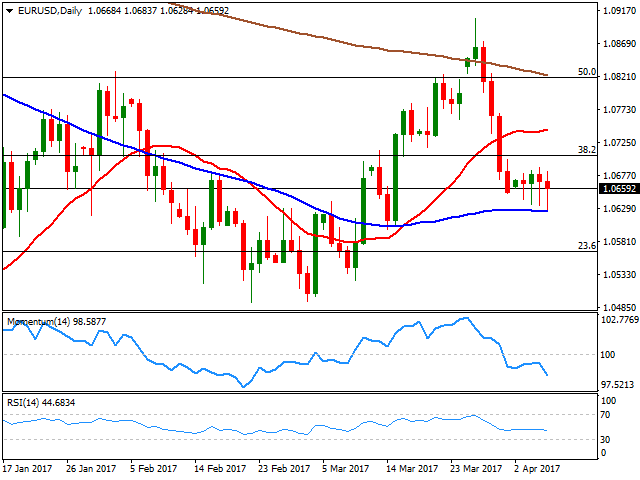
The EUR/USD pair stands near its lowest in three weeks ahead of the event, undermined by the ECB and self-political woes, bearish despite the ongoing consolidative phase ever since the week started, given that in the daily chart, technical indicators maintain their downward slopes within bearish territory. The 100 DMA offers an immediate support, horizontal around 1.0620, but the price is well below its 20 and 200 DMAs, this last maintaining a strong bearish slope. Also, the pair is capped below the 38.2% retracement of the post-US election's decline around 1.0710, the key resistance, as a firm recovery above it would open doors for additional advances, up to 1.0750 first, and 1.0800 later.
Below 1.0620 on the other hand, the pair has scope to extend its decline to 1.0565, the 23.6% retracement of the mentioned decline. A break below the level seems unlikely, albeit a weekly close sub 1.0550, should increase the downward pressure with 1.0340, the yearly low, back at sight for the upcoming weeks.
Author

Valeria Bednarik
FXStreet
Valeria Bednarik was born and lives in Buenos Aires, Argentina. Her passion for math and numbers pushed her into studying economics in her younger years.

















