|

Nonfarm Payrolls Preview: Another dollar’s disappointment underway

  • The US has recovered roughly 55% of the jobs lost with the pandemic.
  • Fundamental noise coming from different fronts is pressuring the greenback.
  • USD weakness overextended, but no signs of a U-turn in its bearish direction.

The US will publish this Friday the November Nonfarm Payrolls report and is set to bring more pain to the USD. The country is expected to have added 481K new positions in the month, below the previous 638K. The unemployment rate, however, is seen improving from 6.9% to 6.8%. Average Hourly Earnings are expected at 0.1% MoM and rising by 4.3% YoY, below the previous 4.5%.

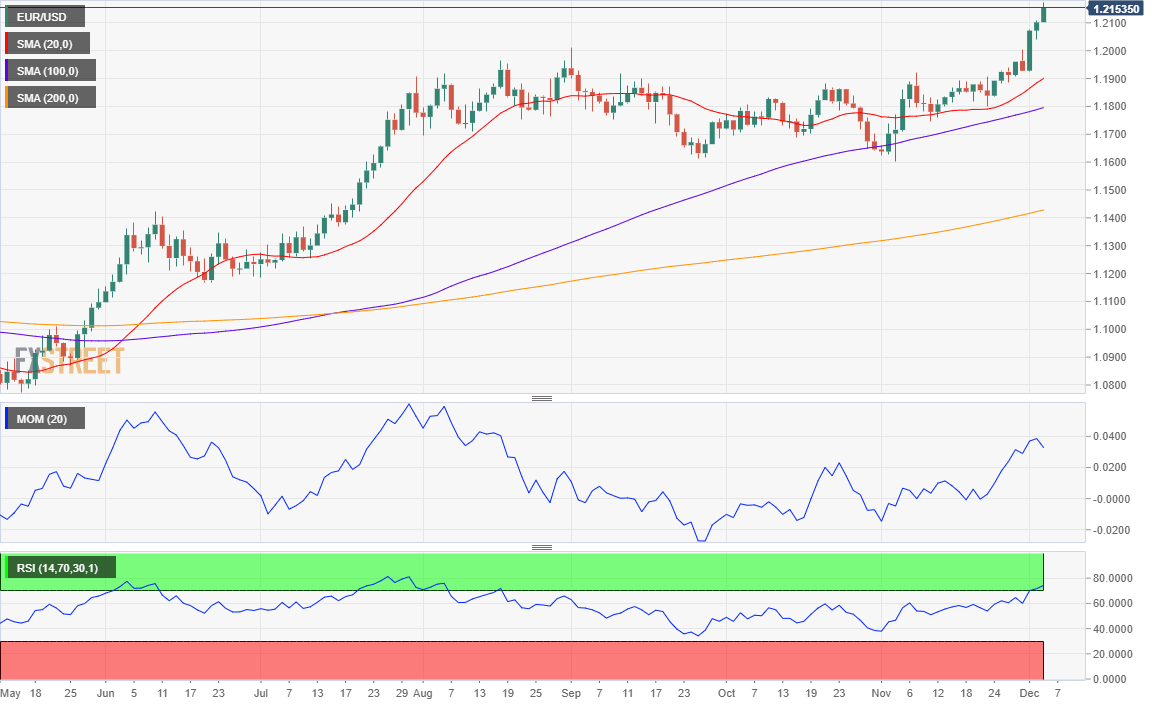
The dollar is fragile heading into the release, in a decline that’s hard to justify from the macroeconomic side. US data has been quite consistent with economic recovery, and while it may not yet be at pre-pandemic levels, it is heading in the right direction. Australia and the UK are behind the US, while other economies, such as the EU, are far beyond in the run. Brexit is a drag for the pound and the shared currency, but there’s little to justify EUR/USD trading at 1.2100 or GBPUSD at 1.3400.

Covid vaccines, trade tensions between the US and China, Brexit and a US stimulus package, introduce loads of noise in the markets these days. In this scenario, US employment data will likely have a limited impact on currencies.

Leading Indicators suggest further pressure on the greenback

While the previous NFP was kind of encouraging, the economy added just 638K new positions in October. At this point, the economy recovered roughly 55% of the 22 million jobs that were lost with the pandemic. The expected 481K win for November will barely move the bar.  

The ISM Manufacturing PMI employment sub-components contracted sharply, below the 50 threshold. The Services PMI employment reading, however, improved from 50.1 to 51.5. Consumer confidence suffered a major setback in November, amid resurgent coronavirus cases.

The ADP report showed that the private sector created less than anticipated jobs, printing at 307K. Finally, the JOLTS Job Openings report showed that hiring also slowed in the last two months reported.

Previous Non-Farm PayrollsPositiveThe US economy added 638K jobs in October, better than the 600K expected, stabilizing the declining job growth pace.
Challenger Job CutsPositiveThe number of corporate layoffs was just below 65K in November, continuing the downward trend from the peak set in April. 
Initial Jobless Claims PositiveFirst-time employment claims averaged 739.5K for the last four weeks, the lowest figure since the pandemic outbreak.
Continuing Jobless Claims PositiveThe number of unemployment benefit claimants downtrend seems relentless, falling below 6 million for the first time since the COVID-19 halted the economic activity.
ISM Services PMI PositiveThe employment sub-index in the US main services survey has enchained three consecutive months in positive territory, registering 51.5 in November.
ISM Manufacturing PMI NegativeThe employment sub-index in the US main manufacturing survey has retraced back below 50, having been in positive ground just for one month.
University of Michigan Consumer Confidence Index NegativeThe UMich consumer sentiment survey fell sharply in November from 81.8 to 76.9, and has never been close to recovering its pre-pandemic highs above 100.
Conference Board Consumer Confidence Index NegativeThe Conference Board Consumer Confidence Index® registered its second consecutive month of retracement, showing that the US consumers are still wary of spending too much.
ADP Employment Report NegativePrivate sector employment just added 307K jobs in November, lower than the 410K expected, disappointing expectations for the fifth time in the last six months.
JOLTS Job Openings NegativeHiring has also slowed down in the latest two JOLTS releases, although the lagging nature of this indicator makes it less decisive for evaluating NFP. 

 Dollar’s possible reaction to different scenarios

The broad dollar’s weakness has left the currency quite oversold across the board. A corrective movement´s chances are high, and an upbeat employment report could be the catalyst, exacerbated by profit-taking ahead of the weekend.

A better-than-anticipated report may also underpin equities and the generally positive mood, favoring the most European currencies and commodity-linked ones. Given Brexit talks, the GBP may not be the best trading choice. Canada is also publishing its employment figures on Friday, so USD/CAD may be too noisy. EUR/USD and AUD/USD may be the best options.

 EUR/USD’s overbought conditions may see it correcting south, yet as long as it holds above 1.2000, bulls will remain in control.

Author

Valeria Bednarik

Valeria Bednarik was born and lives in Buenos Aires, Argentina. Her passion for math and numbers pushed her into studying economics in her younger years.


More from Valeria Bednarik
Share:

Editor's Picks

GBP/USD stays defensive near 1.3300 amid pre-Fed market caution

GBP/USD stays defensive near 1.3300 in the European session on Tuesday. The pair struggles as the US Dollar (USD) sits at monthly highs amid market caution ahead of the two-day US Federal Reserve monetary policy meeting, starting later this Tuesday.

EUR/USD hangs close to monthly lows near 1.1350 on USD strength

EUR/USD is consolidating near the monthly trough, trading near mid-1.1300s in the European morning on Tuesday, undermined by persistent US Dollar demand. Traders seem hesitant and await the outcome of a two-day FOMC policy meeting before placing aggressive directional bets.

Gold sticks to intraday losses below $4,050 as focus remains on FOMC meeting

Gold maintains its offered tone through the Asian session on Tuesday and currently trades just below $4,050, down 0.85% for the day. This follows the previous day's failure to find acceptance above the $4,100 mark and suggests that the path of least resistance for the bullion remains to the downside. 

XRP and XLM extend correction as bearish pressure builds

Ripple and Stellar remain under pressure on Tuesday after losing over 4% and over 5%, respectively, the previous day. In addition, weakening momentum indicators and deteriorating derivatives metrics suggest sellers remain in control, raising the risk of further downside for both altcoins. Derivatives data shows a slight bearish tilt.

Asian stocks including KOSPI slide as AI doubts hit chipmakers
Asian stocks fall sharply on Tuesday as mounting skepticism over the massive financial returns on artificial intelligence spending triggered a widespread sell-off across global semiconductor shares. The tech-driven downturn rippled from Wall Street into Asian markets, while investors shifted toward safety, driving bond prices higher and sending oil lower.
US Dollar mid-year outlook: Exceptional currency, exceptional risks?
The US Dollar enters the second half of 2026 in a markedly different position from a year ago. The King currency has recovered, reflecting persistent US inflation, changing expectations for Fed policy, geopolitical tensions and renewed demand for defensive assets.