Non-Farm Payrolls Preview: Meager job growth likely – Five EUR/USD scenarios
- Fears for a slowdown in hiring cloud September's Non-Farm Payrolls report.
- The Fed is closely watching the figures and volatility is set to rise.
- EUR/USD would need significant disappointment to recover.

Fears are growing that American hiring is slowing down – that has already hurt the dollar – but can EUR/USD rise? September's Non-Farm Payrolls report is eyed with fear and may trigger more volatility than normal – breaking the trend of relatively muted reactions.
The NFP is due on Friday, October 4, at 12:30 GMT. Follow it live here.
The shining star is dimming
The labor market has been standing out in the US economy with its strength – and stability. The world's largest economy has been gaining roughly 200,000 jobs on average in the past few years. Ups and downs in growth, inflation, and interest rates came and went – but average job growth remained stable.
And now, fears of a slowdown in hiring have risen. Two sub-100K job reports – in February and in May – were followed by substantial bounces. However, a more gradual slowdown – and more worrying because of its persistent nature – has taken hold in recent months. America gained 159,000 jobs in July and only 130,000 in August.
Moreover, the slowdown has also impacted expectations. As the chart below shows, the consensus of economists has dropped in recent months.
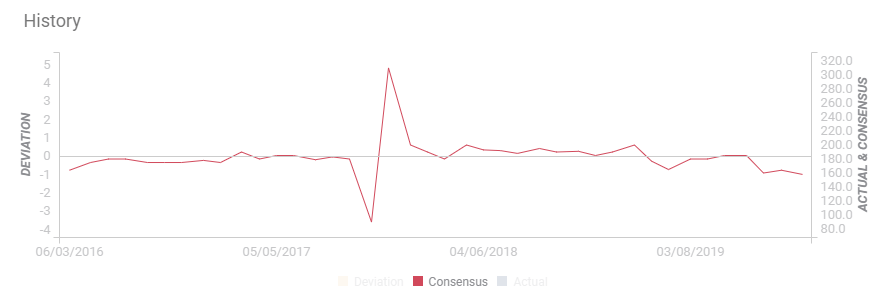
Will this downtrend continue? Signs for the upcoming September report are discouraging.
Leading indicators leaning lower
The ISM's Purchasing Managers' Index for the manufacturing sector dropped to 47.8 points in September – the lowest level in over ten years. Moreover, the employment component also dropped – indicating weaker hiring. This shocking forward-looking indicator sent the US dollar down.
ADP's Non-Farm Payrolls report also missed estimates by showing an increase of only 135,000 private-sector jobs in September – on top of a downward-revised increase of 157,000 in August.
Overall, leading indicators ahead of Friday's report are pointing lower:
US jobs report pre-release checklist – Oct 4th, 2019
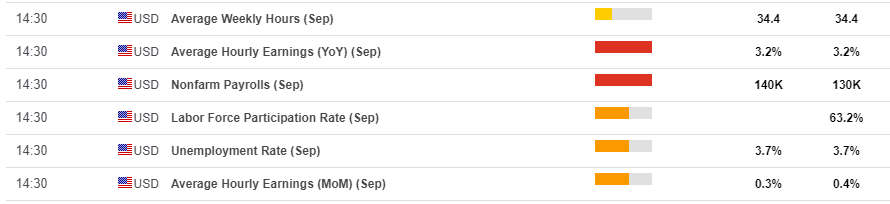
Apart from the change in jobs, markets will also be watching Average Hourly Earnings – which have been satisfactory of late. Wages have risen by 3.2% yearly in August and a repeat is expected in September. An increase of 0.3% is forecast on a monthly basis after 0.4% beforehand. Salaries used to carry more weight while job growth was robust – but the recent weakness puts the headline figure firmly in the spotlight – overshadowing the headline.
The Unemployment Rate is expected to remain at 3.7% and as always, it is dependent on the Labor Force Participation Rate – which hit 63.2% in August.
Fed watching closely
The Federal Reserve cut interest rates in its past two decisions but signaled a pause. However, recent data has pushed the odds of another rate reduction in late October to above 70% – and the jobs report will undoubtedly shape expectations.
The Fed has two mandates – inflation and employment. Price development was subdued for a long time but has recently picked up – while employment may be going in the other direction. As recently as earlier this year, the bank was looking at wages – hoping to see an increase that would push prices higher. But now – the Fed and everybody else is focused on jobs.
An increase of fewer than 100,000 jobs may push the market pricing of a cut in the October 30 meeting to 100%. That does not oblige Jerome Powell, Chair of the Federal Reserve, to go in that direction. Nevertheless, the central bank closely watches bond prices which reflect expectations for interest rates.
On the other hand, investors may price out another cut if the economy gains 200,000 positions or more – alleviating concerns.
How to trade the Non-Farm Payrolls with EUR/USD
Odds of a rate cut and the US Dollar are set to move as described above – especially against the safe-haven yen. However, the greenback may show more strength against the euro than against other currencies.
The old continent has issues of its own. The Manufacturing PMI in the euro-zone is lower than in the US. Germany is on the verge of a recession after contracting in the second quarter and stumbling through the third. And the euro zone's Consumer Price Index is rising by 0.9% yearly against 2.4% in the US.
Overall, European data disappointments have been worse than American ones. It is visibly seen as FXStreet's Surprise Index shows US indicators crossing above European ones.
That means that EUR/USD may need a disastrous NFP to rise. Before examining the scenarios, let us examine the technical levels.
EUR/USD Technical Levels
-637056204563785686.png)
1.1165 worked as support in early August. It is followed by 1.1115 which worked twice as support in the spring and capped teh currency pair in September. It is followed by the 1.1025 swing low recorded in July, and then by 1.0965 which separated ranges late in September.
Below the 2019 low, EUR/USD has support at the April 2017's gap lines of 1.0820 and 1.0780. Further down, 1.07 capped EUR/USD in March 2017. Lower, 1.0580 worked as support around the same time.
Five EUR/USD Scenarios
1) Within expectations – 100-150K
The "within expectations" range leans to the downside in comparison with the 140,000 consensus that appears on the calendar as downward data has pushed estimates lower.
In this scenario, the Dollar will likely chop around while EUR/USD may resume its gradual decline to the downside. It would serve as a reminder that "the US is the cleanest shirt in a dirty pile."
This scenario has a high probability.
2) Above expectations – 150-200K
A return to the normal range could send the dollar higher across the board and EUR/USD could lean toward the lows. The odds of a Fed rate cut would fall, but the option would remain on the table.
This scenario has a medium probability
3) Well above expectations – 200K+
Non-Farm Payrolls reports tend to surprise, and a rebound – as seen in March or due to further hiring toward the 2020 census – may send the greenback surging and could easily send EUR/USD to new two-year lows.
However, if such a substantial increase is underpinned only by the census – an initial rise of the dollar could be followed by a downfall.
This scenario has a low probability.
4) Below expectations – 50-100K
An extension of the gradual downfall – from 159K to 130K and to below 100K has a high to medium probability. In this case, the US Dollar may retreat across the board on rising chances for the Fed to cut rates.
However, EUR/USD may take the other direction and drop. An outcome which is disappointing but not devastating may be insufficient to push the embattled euro higher.
5) Well below expectations 50K or worse
In the truly devastating case that the US economy hardly gains jobs – or even loses positions – the dollar would plunge as a rate cut in late October would be cemented. It could also open the door to a new round of bond-buying – or Quantitative Easing – by the Fed.
And only in this scenario – which has low probability – EUR/USD will have room to rise.
Conclusion
The US Non-Farm Payrolls report for September is expected to show unimpressive job growth amid an economic slowdown. The Federal Reserve is watching the all-important release to determine its next move. The euro is badly-positioned to take advantage of this weakness and would need a horrible figure to rise.
Author

Yohay Elam
FXStreet
Yohay is in Forex since 2008 when he founded Forex Crunch, a blog crafted in his free time that turned into a fully-fledged currency website later sold to Finixio.

















