Gold Weekly Forecast: Will investors continue to dismiss overbought conditions?
- Gold’s unabated rally extended to a new record high above $3,350.
- The precious metal benefited from safe-haven flows as US-China tensions remained elevated.
- The technical outlook suggests that XAU/USD stays overbought in the near term.

Gold (XAU/USD) started the week in a quite manner but gathered bullish momentum mid-week to reach a new record peak above $3,350 on Thursday. In the absence of high-tier data releases, geopolitical headlines are likely to continue to drive XAU/USD’s action.
Gold rises as US-China trade tensions remain high
Improving risk mood at the beginning of the week caused Gold to enter a consolidation phase on Monday. Ahead of the weekend, United States (US) President Donald Trump's administration granted some technology imports, including smartphones, computers, laptops and disc drives, exemptions from the steep reciprocal tariffs imposed on China. Trump clarified over the weekend that these goods will still be subject to the 20% existing tariffs on China. However, US Commerce Secretary Howard Lutnick told ABC News on Sunday that these products, alongside semiconductors, will face separate new levies within the next two months.
Trump said late Monday that his administration will look at semiconductors and the whole electronics supply chain in the upcoming national security tariff investigations. The President also noted that he expects to impose tariffs on imported pharmaceuticals in the "not-too-distant future." Gold remained relatively quiet on Tuesday and ended the day marginally higher.
Bloomberg reported late Tuesday that US President Donald Trump launched a probe into the need for tariffs on critical minerals, the latest move in an escalating trade war that has targeted key sectors of the global economy. In the meantime, citing individuals familiar with the discussions, the Wall Street Journal said early Wednesday that the Trump administration plans to use ongoing tariff negotiations to pressure US trading partners to limit their dealings with China. Gold gathered bullish momentum following this headline and gained more than 3% on Wednesday. After stretching higher to a new record-peak of $3,357 in the Asian session on Thursday, XAU/USD staged a correction and settled at $3,327 ahead of the Easter Holiday on Friday.
Meanwhile, the data from the US showed on Wednesday that Retail Sales rose by 1.4% on a monthly basis in March, following the 0.2% increase recorded in February. On Thursday, the US Department of Labor reported that the number of first-time applications for unemployment benefits declined to 215,000 in the week ending April 12 from 224,000 in the previous week.
Gold investors to remain focused on tariff headlines
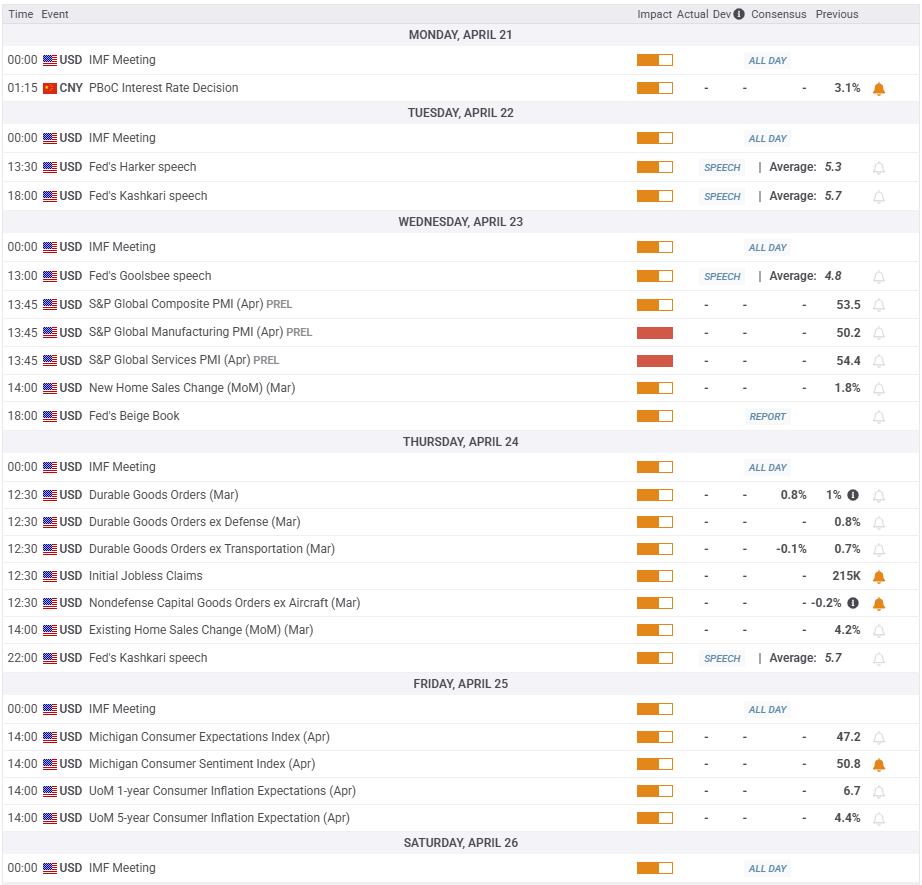
With many major financial markets remaining closed on Monday, Gold is likely to have a difficult time making a decisive move in either direction to start the week. On Wednesday, the US economic calendar will feature preliminary S&P Global Purchasing Managers Index (PMI) data for April. In case either the Manufacturing PMI or the Services PMI comes in below 50 and shows contraction in the respective sector’s business activity, the US Dollar (USD) could come under selling pressure with the immediate reaction and allow XAU/USD to push higher.
Thursday’s Durable Goods Orders for March will be the other noteworthy data release of the week from the US. A significant increase in this data could support the USD, but the market reaction is likely to remain short-lived given the lagging nature of this release.
Investors will also pay close attention to comments from Federal Reserve (Fed) officials before the blackout period starts on Saturday, April 26. CME FedWatch Tool shows that markets currently price in about a 10% probability of a 25 basis points (bps) rate cut at the May policy meeting. This market positioning suggests that the USD doesn’t have a lot of room left on the upside, even if policymakers confirm a policy hold at the next meeting.
Meanwhile, fresh developments surrounding the US-China trade relations could continue to impact Gold’s valuation in the near term. A de-escalation of the conflict could trigger a sharp correction. On the other hand, the precious metal is likely to continue to benefit from safe-haven flows if markets remain concerned over a global economic downturn.
Gold technical analysis
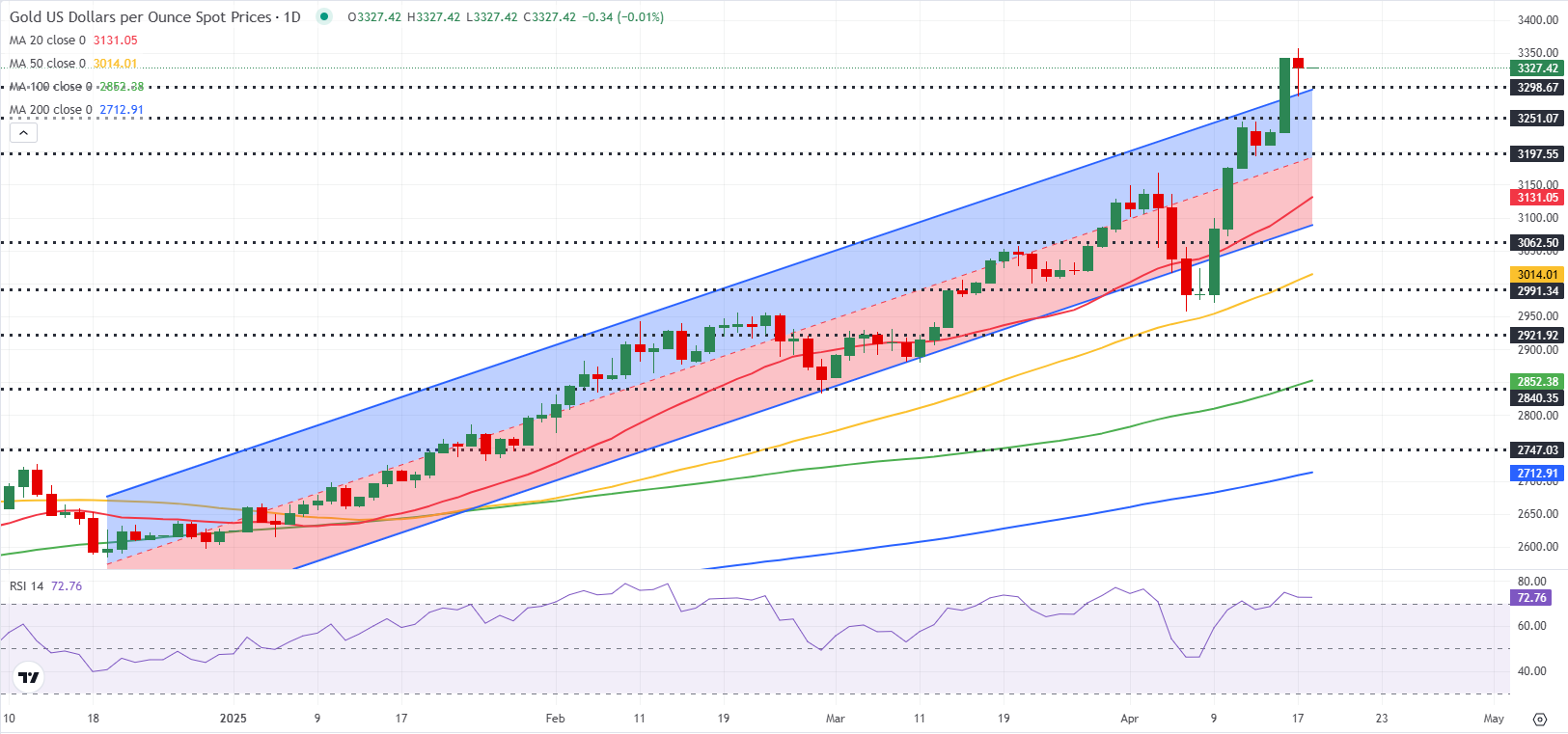
Gold ended the week well above the upper limit of the four-month-old ascending regression channel, and the Relative Strength Index (RSI) indicator on the daily chart remained above 70 despite Thursday’s pullback, highlighting overbought conditions.
On the upside, $3,357 (record high) aligns as first resistance before $3,400 (round level) and $3,500 (round level). In case XAU/USD starts correcting lower on improving market mood, the first support could be spotted at $3,300 (round level, upper limit of the ascending channel), ahead of $3,250 (static level, former resistance) and $3,200 (round level, mid-point of the ascending channel).
Gold FAQs
Gold has played a key role in human’s history as it has been widely used as a store of value and medium of exchange. Currently, apart from its shine and usage for jewelry, the precious metal is widely seen as a safe-haven asset, meaning that it is considered a good investment during turbulent times. Gold is also widely seen as a hedge against inflation and against depreciating currencies as it doesn’t rely on any specific issuer or government.
Central banks are the biggest Gold holders. In their aim to support their currencies in turbulent times, central banks tend to diversify their reserves and buy Gold to improve the perceived strength of the economy and the currency. High Gold reserves can be a source of trust for a country’s solvency. Central banks added 1,136 tonnes of Gold worth around $70 billion to their reserves in 2022, according to data from the World Gold Council. This is the highest yearly purchase since records began. Central banks from emerging economies such as China, India and Turkey are quickly increasing their Gold reserves.
Gold has an inverse correlation with the US Dollar and US Treasuries, which are both major reserve and safe-haven assets. When the Dollar depreciates, Gold tends to rise, enabling investors and central banks to diversify their assets in turbulent times. Gold is also inversely correlated with risk assets. A rally in the stock market tends to weaken Gold price, while sell-offs in riskier markets tend to favor the precious metal.
The price can move due to a wide range of factors. Geopolitical instability or fears of a deep recession can quickly make Gold price escalate due to its safe-haven status. As a yield-less asset, Gold tends to rise with lower interest rates, while higher cost of money usually weighs down on the yellow metal. Still, most moves depend on how the US Dollar (USD) behaves as the asset is priced in dollars (XAU/USD). A strong Dollar tends to keep the price of Gold controlled, whereas a weaker Dollar is likely to push Gold prices up.
Author

Eren Sengezer
FXStreet
As an economist at heart, Eren Sengezer specializes in the assessment of the short-term and long-term impacts of macroeconomic data, central bank policies and political developments on financial assets.














