Gold Weekly Forecast: Geopolitics to drive near-term action
- Gold staged a rebound following a bearish opening to the week.
- Investors will keep a close eye on headlines surrounding the US-Iran conflict.
- The near-term technical outlook points to a lack of directional momentum.

Gold (XAU/USD) struggled to make a decisive move in either direction this week as it quickly recovered above $5,000 after posting losses on Monday and Tuesday. In the absence of high-tier macroeconomic data releases, geopolitical developments will likely become the main driver for XAU/USD in the near term.
Gold benefits from safe-haven flows
Gold registered marginal losses on Monday as the Presidents’ Day holiday in the US limited the market volatility. The bearish action seen in Wall Street’s main indexes following the long weekend helped the US Dollar (USD) gather strength on Tuesday, dragging XAU/USD to below $5,000.
Although the USD benefited from the hawkish tone seen in the minutes of the Federal Reserve’s (Fed) January policy meeting, XAU/USD gathered bullish momentum in the late American session on Wednesday as markets reacted to escalating tensions in the Middle East.
CBS News reported that the US military was preparing for possible strikes on Iran as soon as Saturday. Citing sources familiar with the matter, the news outlet said that the USS Abraham Lincoln aircraft carrier group and its flotilla of warships are already in the region, and the USS Gerald Ford, a second carrier group, is en route to the Middle East.
Meanwhile, the Fed's publication showed that the Committee wanted to deliver a message to make it clear that it is not operating with a one-way bias. According to the document, several policymakers noted that they would have supported describing future decisions in more two-sided terms, reflecting the possibility that hikes could be appropriate if inflation remained above target.
While the USD preserved its strength in the second half of the week, Gold kept its footing and recovered above $5,000. The US Bureau of Economic Analysis’ (BEA) initial estimate showed on Friday that the US’ Gross Domestic Product (GDP) expanded at an annual rate of 1.4% in the fourth quarter of 2025. This marked a significant slowdown from the 4.4% growth recorded in the previous quarter and missed the market expectation of 3% by a wide margin.
Despite the disappointing GDP print, however, the USD stood resilient against its peers as the underlying details of the report highlighted sticky inflation, making it difficult for XAU/USD to gather further bullish momentum. The core Personal Consumption Expenditures (PCE) Price Index rose by 0.4% in December, at a stronger pace than the market expectation and the November’s increase of 0.3% and 0.2%, respectively.
Gold traders focus on geopolitics
The US economic calendar will not offer any high-tier data releases that could influence the market pricing of the Fed policy outlook and trigger a significant reaction. Hence, investors will remain focused on the headlines surrounding the US-Iran conflict.
BBC News reported late Thursday that US President Donald Trump said that Iran must make a deal, or “bad things will happen." Trump later told reporters that his timeline was a maximum of two weeks. In the meantime, Iran told UN Secretary-General Antonio Guterres that it does not seek war but said that they will not tolerate military aggression. Moreover, Iranian officials reportedly also warned of a decisive response if the US takes military action over the nuclear dispute.
Following this development, it would be a surprise if the US were to strike Iran until the end of the month. Hence, a large-scale US military action within the time frame that Trump mentioned could trigger a market response.
In this scenario, Gold is likely to gather bullish momentum as the traditional safe-haven asset. According to the Wall Street Journal, some people familiar with the situation said that Trump could initiate a limited military strike, targeting a few military and government sites, to force Iran to make a deal. In case the US refrains from striking Iran but there is no nuclear deal by the end of the week, Gold could still attract demand toward the weekend.
On the other hand, geopolitical tensions could ease and cause Gold to correct lower if Iran signs a nuclear deal before there is a military confrontation.
Investors will pay close attention to comments from Fed policymakers as well.
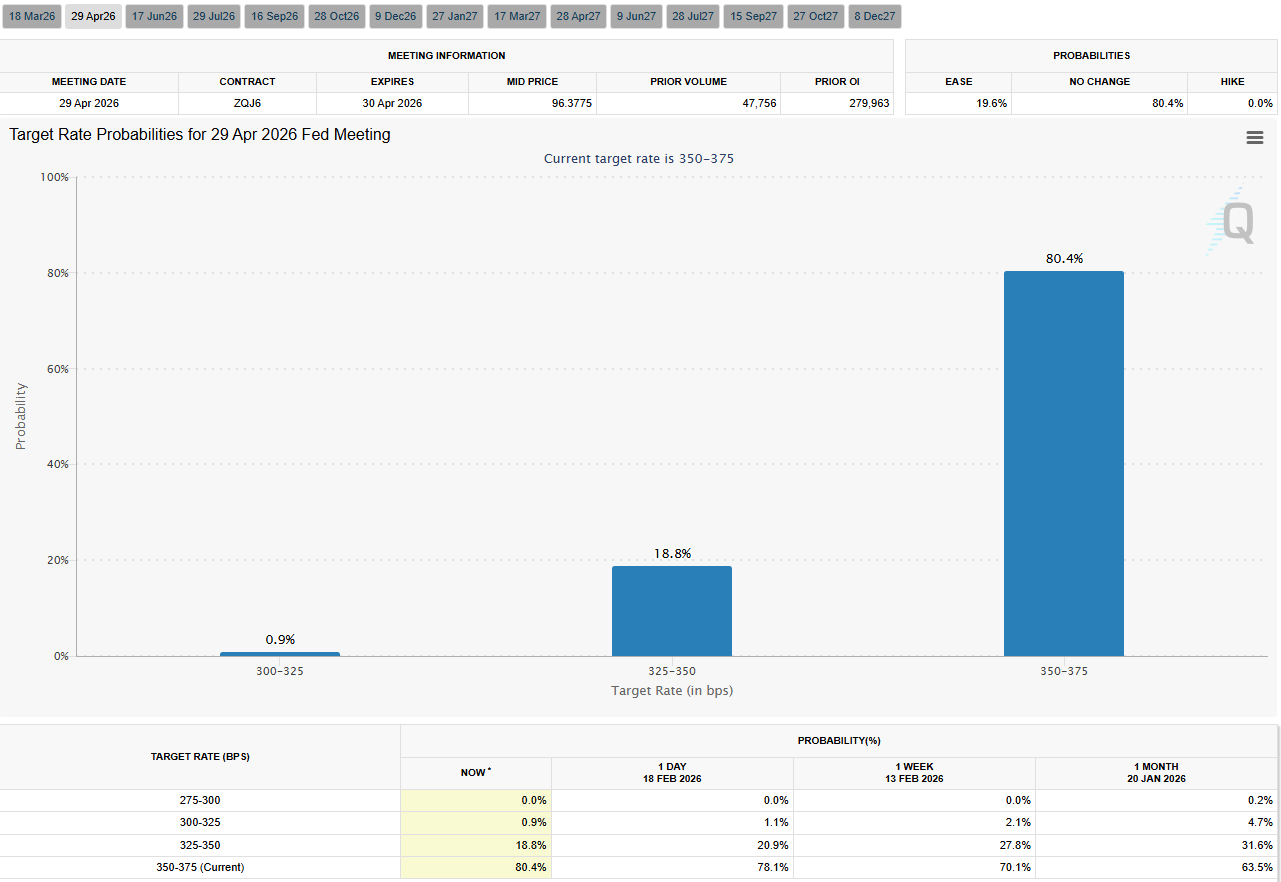
The CME FedWatch Tool shows that markets virtually see no chance of a Fed rate cut in March and price in about a 80% probability of another policy hold in April. In case Fed officials leave the door open to a rate cut in April, the USD could come under pressure and allow XAU/USD to gain traction. On the flip side, the USD could continue to outperform its rivals and weigh on XAU/USD, if Fed commentary reiterates the possibility of a rate hike consideration, as mentioned in the January meeting minutes.
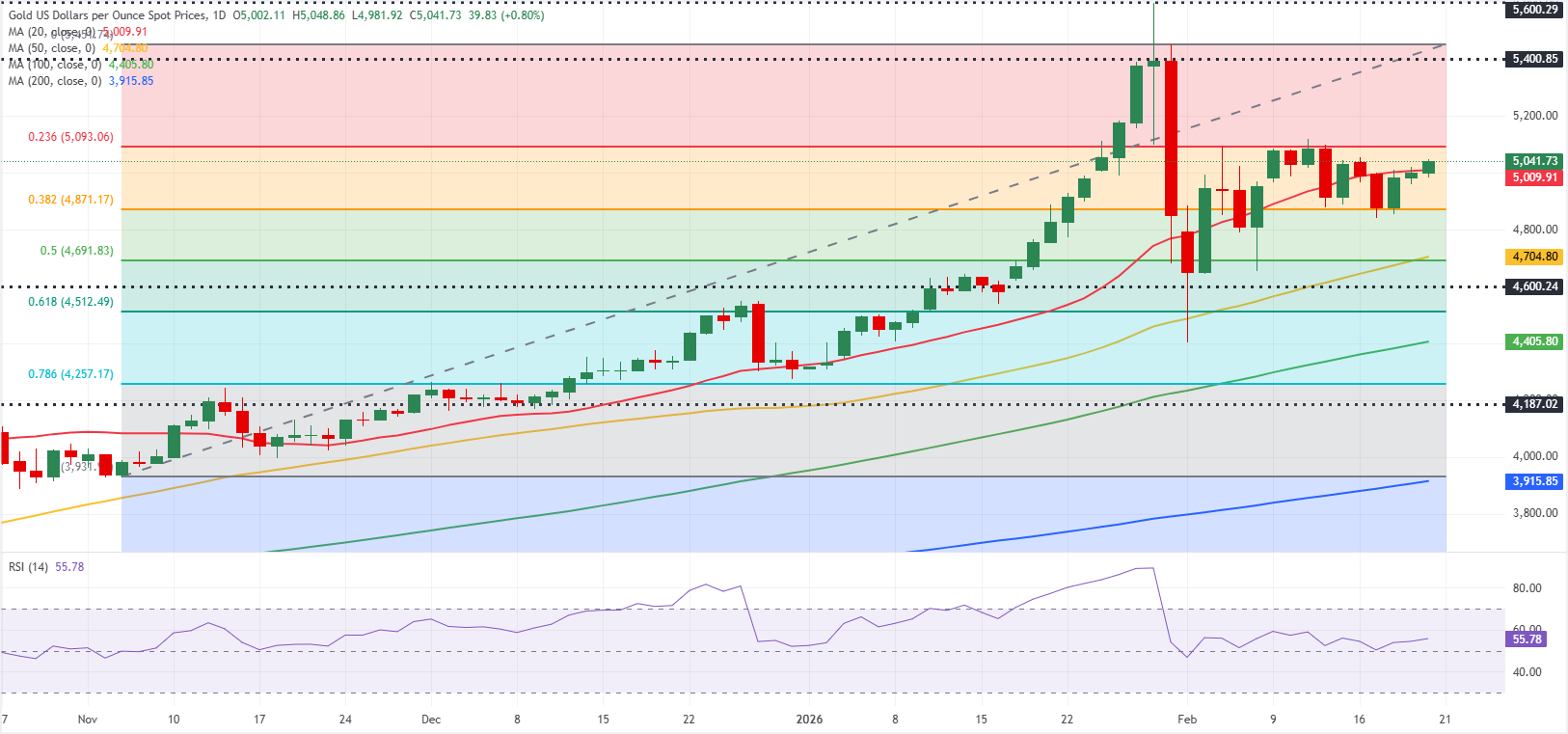
Gold technical analysis: Recovery mode still on
The Relative Strength Index (RSI) on the daily chart holds above 50 but stays relatively flat, suggesting that the bullish bias remains intact but lacks momentum.
On the upside, $5,090-$5,100 (Fibonacci 23.6% retracement of the November-February uptrend, round level) aligns as a key resistance area. In case XAU/USD stabilizes above this area and confirms it as support, $5,200 (round level) and $5,400 (round level, static level) could be seen as the next resistance levels.
In case Gold comes under renewed selling pressure and drops below $4,870 (Fibonacci 38.2% retracement), technical sellers could step in. In this scenario, $4,700-$4,690 (round level, Fibonacci 50% retracement, 50-day SMA) could be seen as the next support level before $4,600 (round level, static level).
Gold FAQs
Gold has played a key role in human’s history as it has been widely used as a store of value and medium of exchange. Currently, apart from its shine and usage for jewelry, the precious metal is widely seen as a safe-haven asset, meaning that it is considered a good investment during turbulent times. Gold is also widely seen as a hedge against inflation and against depreciating currencies as it doesn’t rely on any specific issuer or government.
Central banks are the biggest Gold holders. In their aim to support their currencies in turbulent times, central banks tend to diversify their reserves and buy Gold to improve the perceived strength of the economy and the currency. High Gold reserves can be a source of trust for a country’s solvency. Central banks added 1,136 tonnes of Gold worth around $70 billion to their reserves in 2022, according to data from the World Gold Council. This is the highest yearly purchase since records began. Central banks from emerging economies such as China, India and Turkey are quickly increasing their Gold reserves.
Gold has an inverse correlation with the US Dollar and US Treasuries, which are both major reserve and safe-haven assets. When the Dollar depreciates, Gold tends to rise, enabling investors and central banks to diversify their assets in turbulent times. Gold is also inversely correlated with risk assets. A rally in the stock market tends to weaken Gold price, while sell-offs in riskier markets tend to favor the precious metal.
The price can move due to a wide range of factors. Geopolitical instability or fears of a deep recession can quickly make Gold price escalate due to its safe-haven status. As a yield-less asset, Gold tends to rise with lower interest rates, while higher cost of money usually weighs down on the yellow metal. Still, most moves depend on how the US Dollar (USD) behaves as the asset is priced in dollars (XAU/USD). A strong Dollar tends to keep the price of Gold controlled, whereas a weaker Dollar is likely to push Gold prices up.
Author

Eren Sengezer
FXStreet
As an economist at heart, Eren Sengezer specializes in the assessment of the short-term and long-term impacts of macroeconomic data, central bank policies and political developments on financial assets.