Gold Weekly Forecast: Buyers hesitate as US data backlog feeds into uncertainty
- Gold gathered bullish momentum and climbed to a three-week high above $4,200.
- Investors await clarity on how the US data backlog will be handled.
- The technical outlook points to a loss of bullish momentum in the near term.

Gold (XAU/USD) gained traction and climbed to its highest level since October 21, above $4,200, after having spent the previous week in a tight consolidation channel. Nevertheless, heightened doubts about the Federal Reserve’s potential rate cut in December caused XAU/USD to erase a portion of its gains heading into the weekend. With the United States (US) government shutdown coming to an end, investors await clarity on how the economic data backlog will be handled and what they will say about the state of the US economy.
Gold gathers bullish momentum as safe-haven flows dominate
Gold started the week on a bullish note as the improving risk mood made it difficult for the US Dollar (USD) to find demand. Over the weekend, a group of centrist Democrats negotiated a deal, paving the way for the US Senate to approve the temporary funding bill with a 60-40 vote and move one step closer to ending the government shutdown.
On Tuesday, Automatic Data Processing (ADP) reported that private employers shed an average of 11,250 jobs a week in the four weeks ending October 25. This data revived concerns over worsening labor market conditions and caused the USD to continue weakening. In turn, XAU/USD continued to stretch higher.
Late Wednesday, the House of Representatives approved the funding bill as anticipated. Shortly after, US President Donald Trump signed the bill, officially reopening the government. During a briefing with reporters on Wednesday, White House Press Secretary Karoline Leavitt said that the Bureau of Labor Statistics (BLS) might never release the employment and inflation data for October. These remarks caused the USD to come under renewed selling pressure and allowed XAU/USD to extend its rally to a fresh three-week high above $4,200.
On Thursday, the bearish action seen on Wall Street triggered a flight to safety and helped Gold hold its ground. However, hawkish comments from Federal Reserve (Fed) officials caused investors to scale back bets on a December rate cut by the central bank. As a result, Gold lost its bullish momentum and dropped below $4,100 on Friday after closing in negative territory on Thursday.
Fed Bank of St. Louis President Alberto Musalem said that he expects the labor market to stay around full employment and added that they need to proceed with caution now. Meanwhile, Minneapolis Fed President Neel Kashkari reiterated that inflation is still too high. According to the CME Group FedWatch Tool, the probability of a 25 basis points (bps) rate cut in December declined to nearly 50% from about 67% a week earlier.
Gold investors to focus again on US economic data
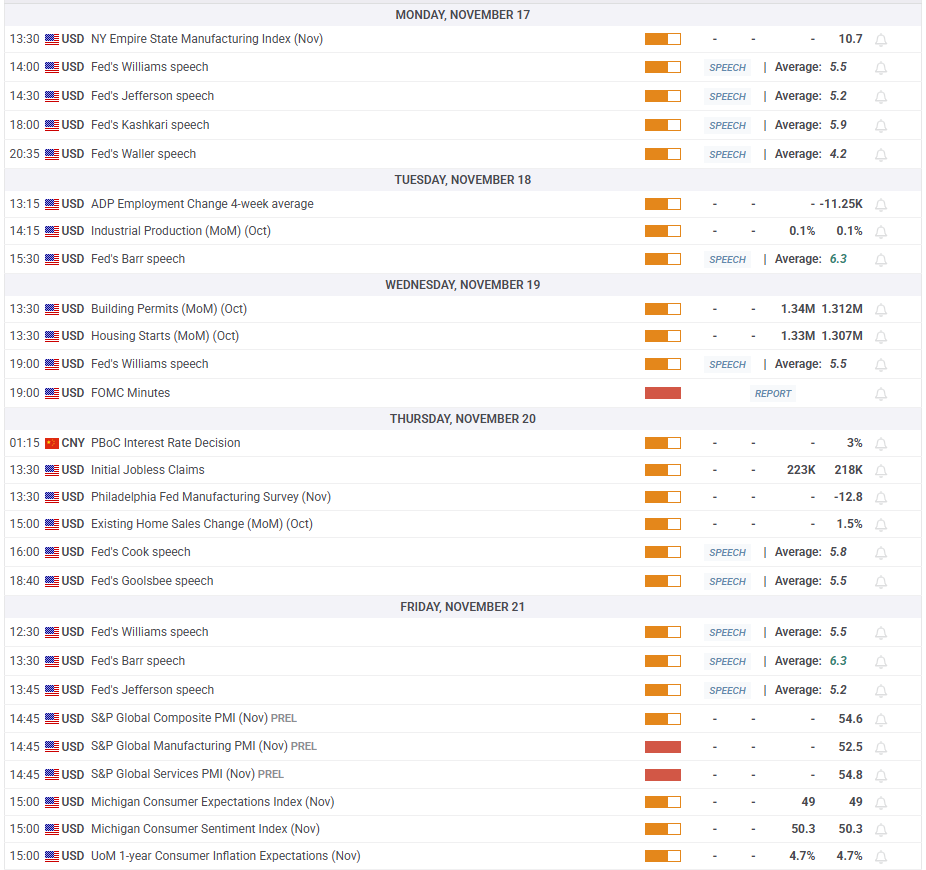
Market participants are yet to hear an official word about how the backlog of US economic data releases will be handled. There are growing expectations that the BLS could publish the employment data for September as early as next Friday. Even if that’s the case, the September employment figures will be outdated by mid-November, and they are unlikely to trigger a significant market reaction.
The weekly ADP Employment Change data will be closely watched by investors on Tuesday, especially if the BLS confirms that it will not publish the employment report for October. A negative print could feed into fears over worsening labor market conditions and hurt the USD, helping XAU/USD edge higher.
On Friday, S&P Global will publish the preliminary Manufacturing and Services Purchasing Managers’ Index (PMI) reports for November. A reading in the contraction territory, below 50, in either PMI could weigh on the USD and lift XAU/USD. On the other hand, Gold could come under bearish pressure if PMI reports show that the business activity in the private sector continued to expand at a healthy pace.
Comments from Fed officials will continue to grab markets’ attention in the short term. In case policymakers put more emphasis on labor market concerns than on the inflation outlook, markets may view this as a confirmation of further policy easing. Conversely, the USD is likely to preserve its strength and weigh on XAU/USD if central bank officials suggest that they could opt to hold rates steady in December and wait for data to provide a clearer picture of the current state of the economy.
Gold Technical Analysis:
The 20-day Simple Moving Average (SMA) has turned lower, while the 50-, 100-, and 200-day SMAs extend higher, preserving a positive broader tone. Price holds above all these averages, with the 20-day SMA at $4,065.07 offering nearby dynamic support. The Relative Strength Index (RSI) at 53 (neutral) has cooled, reflecting slower upside momentum. Immediate resistance aligns at $4,245, followed by $4,360. A break above the first barrier could extend the advance.
Measured from the $3,310 low to the $4,380 high, the 38.2% retracement at $3,975 offers initial support, with the 50% retracement at $3,845 below. Holding above the former keeps the bullish bias intact, while a close under it could extend the corrective phase toward the latter. Trend support also emerges at the rising 50-day SMA near $3,938.26. A sustained bid above the short-term averages would improve momentum and maintain scope for further gains.
(The technical analysis of this story was written with the help of an AI tool).
Gold FAQs
Gold has played a key role in human’s history as it has been widely used as a store of value and medium of exchange. Currently, apart from its shine and usage for jewelry, the precious metal is widely seen as a safe-haven asset, meaning that it is considered a good investment during turbulent times. Gold is also widely seen as a hedge against inflation and against depreciating currencies as it doesn’t rely on any specific issuer or government.
Central banks are the biggest Gold holders. In their aim to support their currencies in turbulent times, central banks tend to diversify their reserves and buy Gold to improve the perceived strength of the economy and the currency. High Gold reserves can be a source of trust for a country’s solvency. Central banks added 1,136 tonnes of Gold worth around $70 billion to their reserves in 2022, according to data from the World Gold Council. This is the highest yearly purchase since records began. Central banks from emerging economies such as China, India and Turkey are quickly increasing their Gold reserves.
Gold has an inverse correlation with the US Dollar and US Treasuries, which are both major reserve and safe-haven assets. When the Dollar depreciates, Gold tends to rise, enabling investors and central banks to diversify their assets in turbulent times. Gold is also inversely correlated with risk assets. A rally in the stock market tends to weaken Gold price, while sell-offs in riskier markets tend to favor the precious metal.
The price can move due to a wide range of factors. Geopolitical instability or fears of a deep recession can quickly make Gold price escalate due to its safe-haven status. As a yield-less asset, Gold tends to rise with lower interest rates, while higher cost of money usually weighs down on the yellow metal. Still, most moves depend on how the US Dollar (USD) behaves as the asset is priced in dollars (XAU/USD). A strong Dollar tends to keep the price of Gold controlled, whereas a weaker Dollar is likely to push Gold prices up.
Author

Eren Sengezer
FXStreet
As an economist at heart, Eren Sengezer specializes in the assessment of the short-term and long-term impacts of macroeconomic data, central bank policies and political developments on financial assets.

















