Technical analysis – USD/JPY under pressure following double top near 157.90
- USDJPY drops for third straight day.
- Tests support at 20-day SMA near 155.70.
- Momentum indicators hold neutral-to-bearish bias.


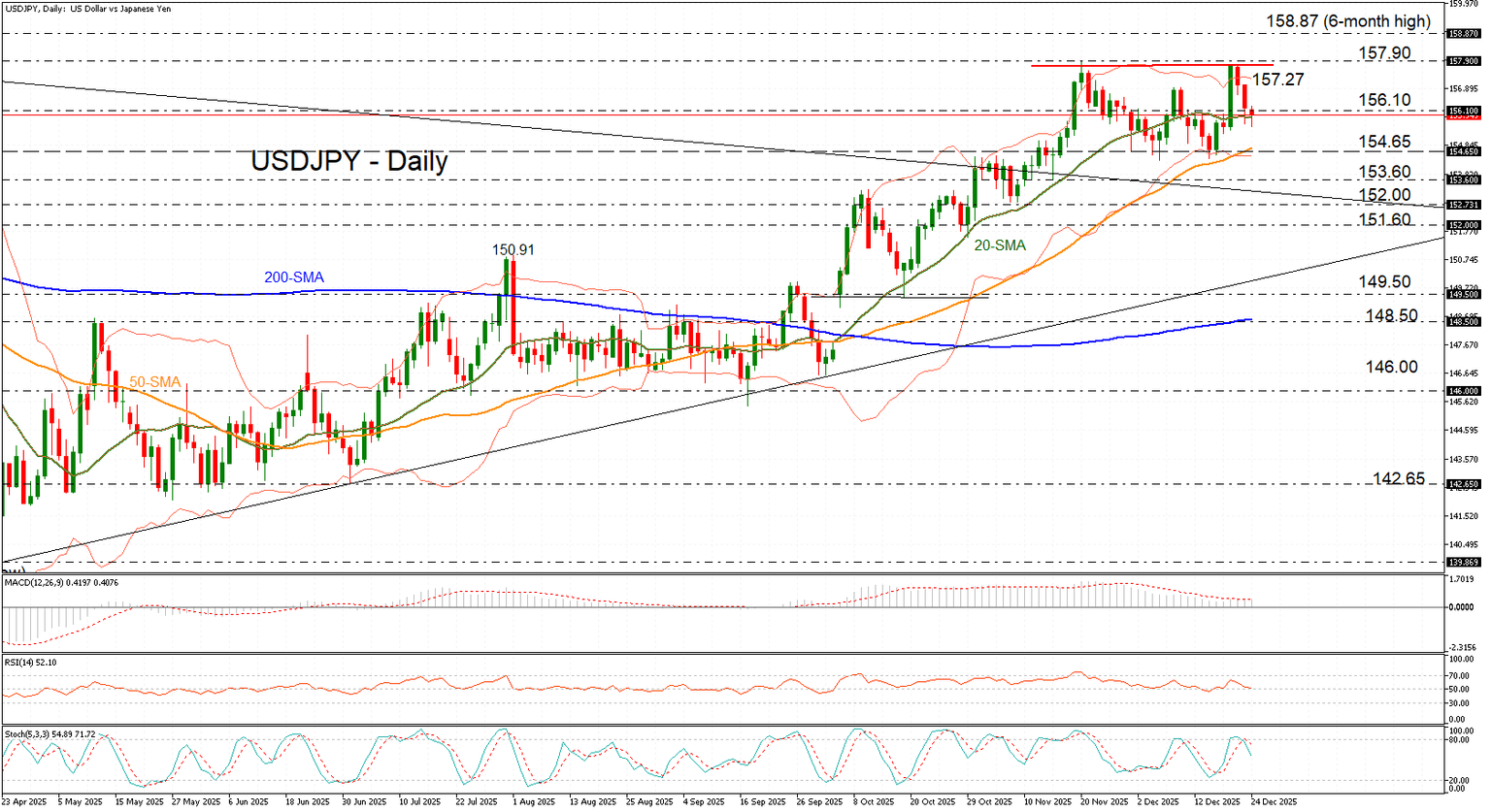
USDJPY is extending its three-day pullback from 157.90, forming a bearish double-top pattern, and is currently testing support at the 20-day simple moving average (SMA) near 155.70.
The move reflects BoJ-Fed policy divergence, as investors digest the BoJ meeting minutes –where policymakers debated the need for further rate hikes – while rising Fed rate-cut expectations continue to weigh on the US dollar. These expectations were not altered by upbeat GDP data showing the US economy expanded at its fastest pace in two years in Q3.
From a technical perspective, momentum indicators confirm the bearish tone. The MACD is retreating below its red signal line while remaining above zero, the RSI is tilting toward a breach below the 50 neutral mark, and the stochastics have posted a bearish crossover from the overbought region. Meanwhile, the Bollinger bands are contracting, with price action pulling back after breaching the upper band.
A break below the 20-day SMA could expose strong support at the 50-day SMA near 154.65 – a level that has capped losses for over a month and coincides with the lower Bollinger band. Below that, the next targets are the November 14 swing low near 153.60, followed by the October and September lows around 152.00 (aligned with the July downtrend line) and 151.60.
Conversely, a rebound could aim for the upper Bollinger band near 157.27, followed by 157.90 – the level that triggered the current pullback – and the six-month high near 158.87.
To sum up, USDJPY is losing momentum, testing the midline of the contracting Bollinger bands, signalling a wait-and-see stance before the next decisive move. For now, the pair needs to hold strong support near 155.70 to limit further downside risks.
Author
Nicola joined Trading Point as a Market Analyst in January 2025. She holds a BA in English Literature from Kingston University, London, and an MA in Applied Linguistics (Research Methodology) from the University of Southampton with distinction.