Gold Weekly Forecast: Buyers hesitate ahead of US inflation data
- Gold climbed above $3,400 for the first time since July 23.
- Gold futures rallied to a new record-high early Friday.
- July inflation data from the US could trigger a big reaction.

After fluctuating in a relatively tight range in the first half of the week, Gold (XAU/USD) gained traction and climbed to a two-week high above $3,400 before correcting lower toward the end of the week. July inflation data from the United States (US) and the action in Gold futures could influence XAU/USD’s performance in the short term.
Gold climbs above $3,400 area in choppy week
Gold edged slightly higher on Monday as US Treasury bond yields continued to push lower after declining sharply on disappointing labor market data the previous Friday. Later in the American session, US President Donald Trump announced that he will raise the tariff rate on Indian imports "substantially." This development caused markets to adopt a cautious stance and helped Gold hold its ground.
The data from the US showed on Tuesday that the Institute for Supply Management’s (ISM) Services Purchasing Managers Index (PMI) declined to 50.1 in July from 50.8 in June. The Employment Index of the PMI survey dropped to 46.4 from 47.2 in the same period, while the Prices Paid Index, the inflation component, rose to 69.9 from 67.5. As the US Dollar (USD) struggled to stay resilient against its rivals after the PMI report, XAU/USD registered small gains on Tuesday.
In the American session on Wednesday, safe-haven flows returned to markets as Trump announced new tariffs and delivered threats. Trump issued an executive order imposing an additional 25% tariff on Indian imports and said that he could impose an extra 25% tariff on Chinese goods over China's purchases of Russian Oil. Additionally, he noted that he might impose a 100% tariff on semiconductors and chips not built in the US, and threatened an extra 15% tariff on all Japanese imports. Gold benefited from risk aversion and climbed to the $3,400 area in the European session on Thursday.
Early Friday, Gold climbed to its highest level in two weeks near $3,410. Citing a so-called ruling letter issued by the US Customs Border Protection, the Financial Times reported that one-kilo and 100-ounce Gold bars will be classified under a customs code that won’t allow them to be exempt from tariffs imposed on the exporting country. “One-kilo bars are the most common form traded on Comex, the world’s largest gold futures market, and comprise the bulk of Switzerland’s bullion exports to the US,” the news outlet noted. Following this development, US Gold futures for December delivery hit a new record-high above $3,530 before retreating sharply below $3,500. In turn, XAU/USD turned south and declined below $3,400.
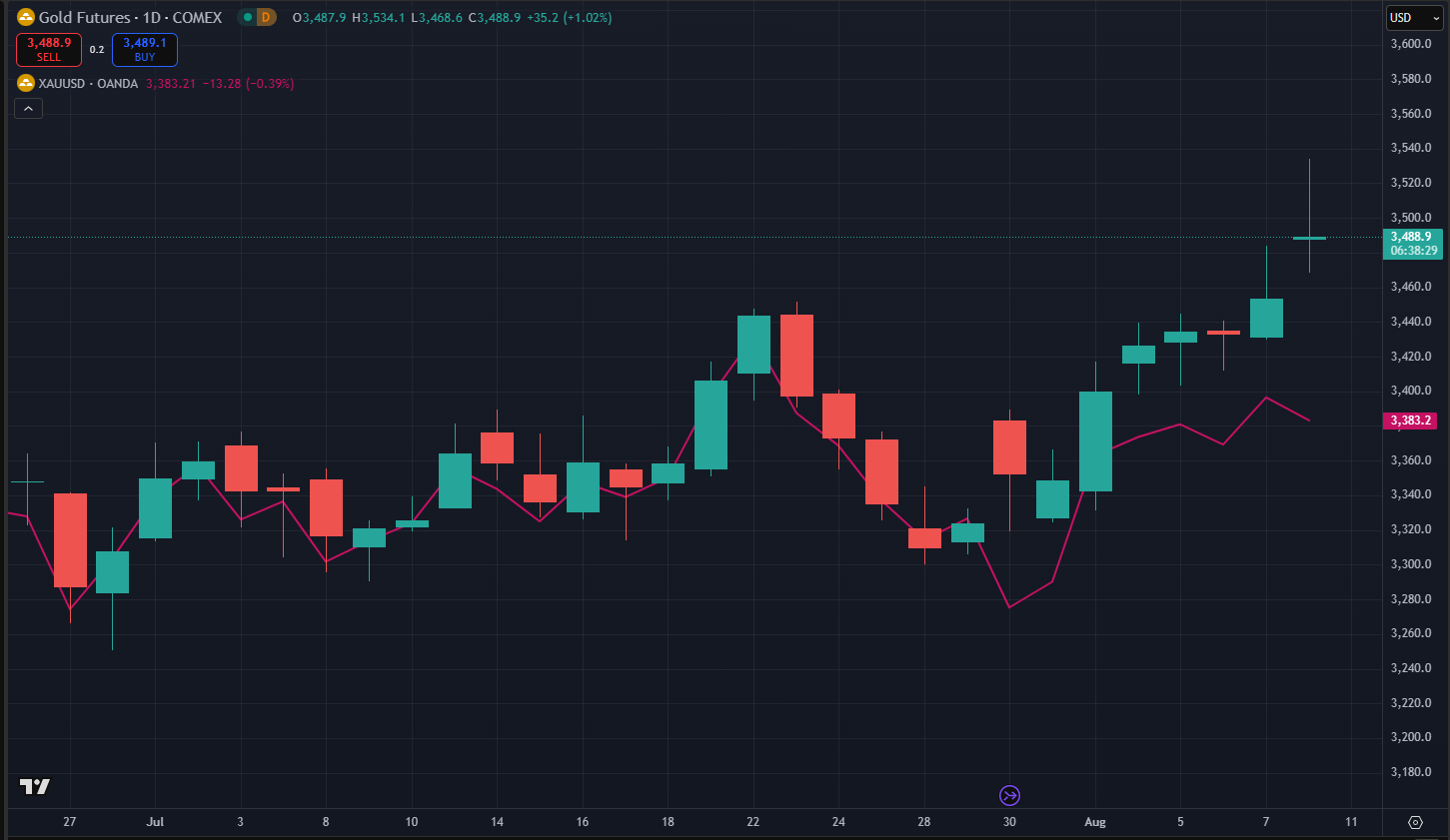
December delivery Gold Comex Futures vs. Gold spot. Source: Tradingview
Gold investors await US inflation data
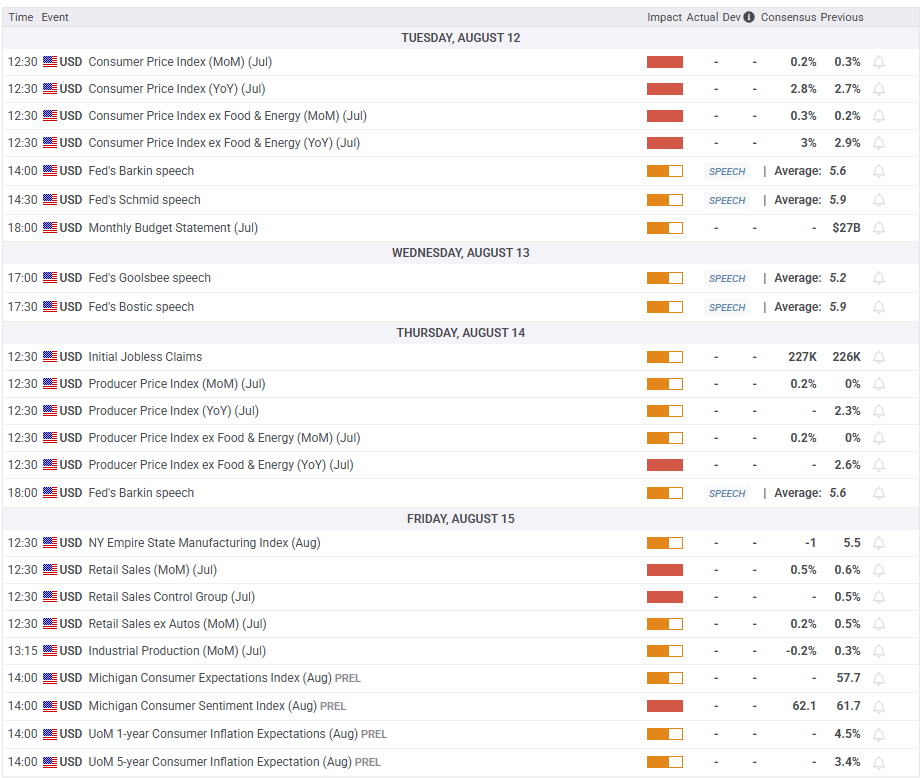
The US Bureau of Labor Statistics will publish the Consumer Price Index (CPI) data for July on Tuesday. Investors expect the headline annual CPI inflation to edge higher to 2.8% from 2.7% in June and see the core CPI rising 0.3% on a monthly basis. Markets are largely convinced that the Federal Reserve (Fed) will cut the policy rate by 25 basis points (bps) in September.
San Francisco Fed President Mary Daly said recently that the Fed still has some ground to cover on its fight with inflation pressures, and cautioned against the US central bank acting too soon without having the full picture. Meanwhile, Atlanta Fed President Raphael Bostic warned that rising price pressures over the next six to twelve months could intensify the Fed’s challenges.
Hence, a significant upside surprise in the headline CPI reading and/or the monthly core print could cause investors to reassess the possibility of a Fed policy hold in September. In this scenario, US Treasury bond yields could turn north and support the USD, putting XAU/USD under bearish pressure.
Later in the week, July Retail Sales data will be featured in the US economic calendar. A negative print could hint at cooling consumer activity and weigh on the USD with the immediate reaction.
In the meantime, market participants will keep a close eye on the action in Gold futures. In case Gold futures remain well above spot prices, market participants could see that as an opportunity to purchase Gold to sell in the futures market. In this scenario, Gold demand is likely to remain strong and support spot prices.
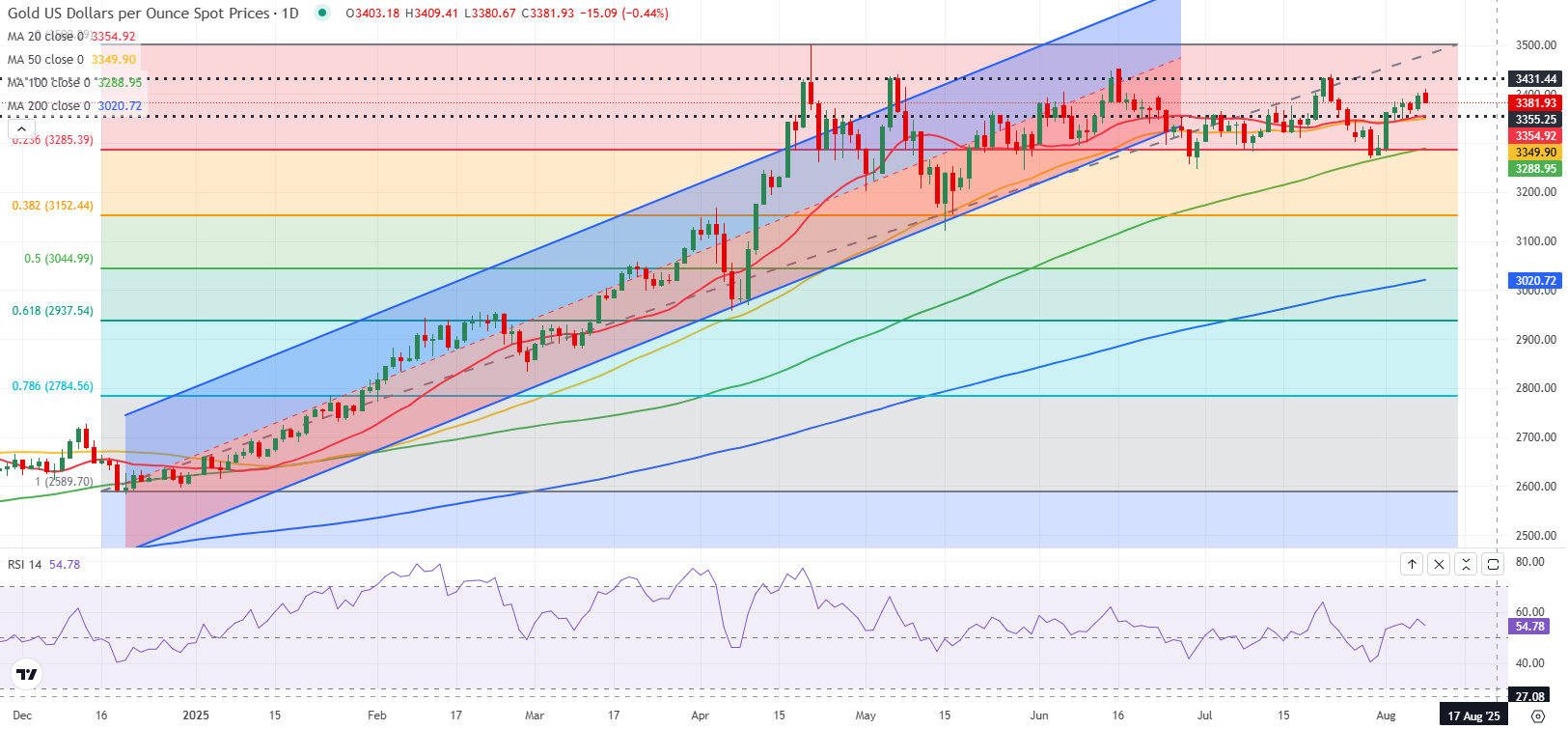
Gold technical analysis
The Relative Strength Index (RSI) indicator on the daily chart holds above 50 and Gold continues to trade above $3,355, where the 20-day and the 50-day Simple Moving Averages (SMAs) align. This technical picture suggests that the bullish bias remains intact but lacks momentum.
On the downside, $3,355 (20-day SMA, 50-day SMA) aligns as the first support level before $3,300-$3,285 (round level, 100-day SMA, Fibonacci 23.6% retracement of the January-June uptrend) and $3,200 (static level, round level).
In case Gold rises above $3,400 (static level, round level) and starts using this level as support, $3,430 (static level) could be seen as an interim resistance level before $3,500 (all-time-high).
Gold FAQs
Gold has played a key role in human’s history as it has been widely used as a store of value and medium of exchange. Currently, apart from its shine and usage for jewelry, the precious metal is widely seen as a safe-haven asset, meaning that it is considered a good investment during turbulent times. Gold is also widely seen as a hedge against inflation and against depreciating currencies as it doesn’t rely on any specific issuer or government.
Central banks are the biggest Gold holders. In their aim to support their currencies in turbulent times, central banks tend to diversify their reserves and buy Gold to improve the perceived strength of the economy and the currency. High Gold reserves can be a source of trust for a country’s solvency. Central banks added 1,136 tonnes of Gold worth around $70 billion to their reserves in 2022, according to data from the World Gold Council. This is the highest yearly purchase since records began. Central banks from emerging economies such as China, India and Turkey are quickly increasing their Gold reserves.
Gold has an inverse correlation with the US Dollar and US Treasuries, which are both major reserve and safe-haven assets. When the Dollar depreciates, Gold tends to rise, enabling investors and central banks to diversify their assets in turbulent times. Gold is also inversely correlated with risk assets. A rally in the stock market tends to weaken Gold price, while sell-offs in riskier markets tend to favor the precious metal.
The price can move due to a wide range of factors. Geopolitical instability or fears of a deep recession can quickly make Gold price escalate due to its safe-haven status. As a yield-less asset, Gold tends to rise with lower interest rates, while higher cost of money usually weighs down on the yellow metal. Still, most moves depend on how the US Dollar (USD) behaves as the asset is priced in dollars (XAU/USD). A strong Dollar tends to keep the price of Gold controlled, whereas a weaker Dollar is likely to push Gold prices up.
Author

Eren Sengezer
FXStreet
As an economist at heart, Eren Sengezer specializes in the assessment of the short-term and long-term impacts of macroeconomic data, central bank policies and political developments on financial assets.


![How Wall Street rigs the game [Video]](https://editorial.fxsstatic.com/images/i/market-chaos-01.jpg)