Gold Price Weekly Forecast: No signs of recovery yet in XAU/USD
- Gold price continued to push lower throughout the week.
- XAU/USD trades dangerously close to key $1,935 support.
- US May jobs report and deb-limit news will drive the pair's action next week.

Gold price extended its slide for the third straight week, touching on Thursday its lowest level in more than two months below $1,940 amid rising US Treasury bond yields and persistent US Dollar (USD) strength. In the upcoming week, May jobs report from the US and developments surrounding the US debt-limit negotiations will help markets decide whether XAU/USD shakes off the bearish pressure.
What happened last week?
The risk-averse market atmosphere amid a lack of progress in the US debt-limit talks helped the USD hold its ground on Monday and didn’t allow XAU/USD to stage a rebound after the previous week’s sharp decline. Additionally, hawkish comments from Federal Reserve (Fed) officials further weighed on Gold price by lifting US yields. St. Louis Federal Reserve President James Bullard said that the Fed wants to fight inflation while the labour market remains strong and added that the policy rate will have to go higher this year, perhaps by an additional 50 basis points.
Following Tuesday’s choppy action, XAU/USD came under heavy bearish pressure mid-week as US yields continued to push higher. "I do not support stopping rate hikes unless we get clear evidence that inflation is moving down towards our 2% objective," Fed Governor Christopher Waller said Wednesday. These remarks sent the benchmark 10-year US Treasury bond yield to 3.8% for the first time since mid-March.
On Thursday, US Bureau of Economic Analysis (BEA) data showed that the annualized Gross Domestic Product (GDP) growth rate for the first quarter was revised higher to 1.3% from 1.1% initially estimated. With this data reviving expectations for another Fed rate hike in June, the 10-year yield pushed higher, causing inversely-correlated XAU/USD to drop below $1,940. According to the CME Group FedWatch Tool, the probability of the Fed leaving its policy rate unchanged in June fell below 60% from nearly 80% earlier in the week.
In the meantime, debt-limit negotiations continued throughout the week without making any headway, forcing investors to adopt a cautious approach. In turn, the USD benefited from safe-haven flows and made it difficult for Gold price to stage a rebound.
XAU/USD's recovery attempt remained shallow on the last trading of the day of the week after the US BEA reported that the Core Personal Consumption Expenditures (PCE) Price Index, the Fed's preferred inflation gauge, rose 4.7% annually in April, compared to analysts' estimate of 4.6%.
Next week
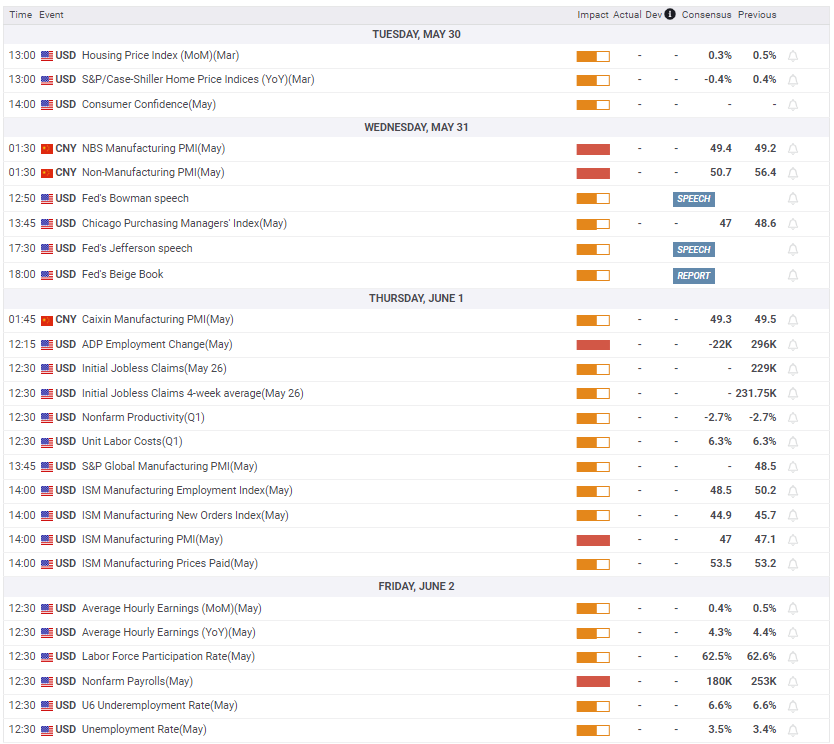
On Tuesday, the Conference Board will release the Consumer Confidence Index data for May. In April, the one-year inflation expectation component of the survey ticked down to 6.2% from 6.3% in March. In case there is a noticeable decline in that component in May, the USD could have a difficult time finding demand. Still, any market reaction should remain short-lived as investors are likely to refrain from making large bets ahead of the high-tier data releases later in the week.
The ISM will publish the Manufacturing PMI report for May on Thursday. Markets are likely to pay close attention to the inflation component of the PMI survey, the Prices Paid Index. In April, this index climbed to 53.2 from 50.4 in March, a sign of strengthening input inflation in the manufacturing sector. A further increase in this component could weigh on XAU/USD by helping the USD stay resilient against its rivals. The ADP’s private sector employment report will also be featured in the US economic docket. Unless there is a significant divergence from the market expectation, investors could opt to wait for Friday’s May jobs report before deciding whether labour market conditions support a pause in the current rate-hiking cycle next month.
Nonfarm Payrolls (NFP) in the US are forecast to rise by 180,000 in May following April’s better-than-expected increase of 253,000. Fed policymakers, including Chairman Jerome Powell, have been saying that labour market conditions remain tight in the US. Even if the monthly growth in NFP softens as expected in May, it would still be considered good enough for the Fed to cling to its willingness to keep the policy tight for the remainder of the year. Hence, an NFP reading at or above the market consensus would likely cause XAU/USD to turn south ahead of the weekend.
On the other hand, a reading below 100,000 could force investors to reassess the Fed’s rate outlook and trigger a decline in US yields. In that scenario, Gold price should be able to register strong gains on the last trading day of the week.
In the meantime, market participants will stay focused on fresh developments surrounding debt-limit talks. June 1st is reportedly the deadline for Republicans and the White House to reach a deal to raise the debt ceiling. As we move closer to the deadline without progress, markets could stay risk-averse. Although the USD is likely to outperform risk-sensitive currencies, stronger demand for safe-haven US government bonds could push yields lower and help XAU/USD gather bullish momentum. If an agreement is reached earlier in the week, a relief rally could trigger a USD sell-off. Nevertheless, investors are likely to wait for the data releases mentioned above before betting on a steady USD weakness.
Gold price technical outlook
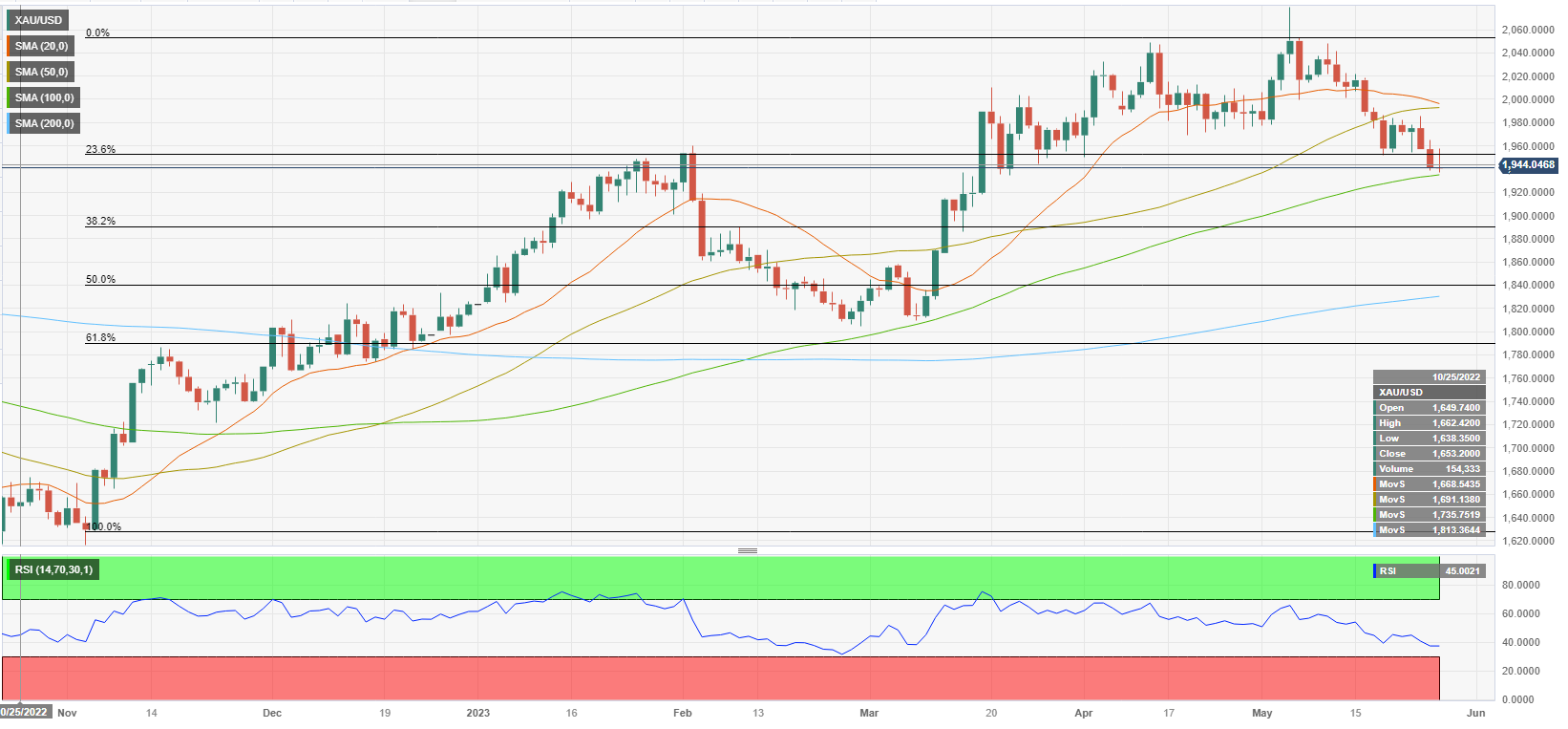
XAU/USD closed below the Fibonacci 23.6% retracement level of the latest uptrend, currently located at $1,950, on Thursday after having tested this support several times earlier in the week. Additionally, the Relative Strength Index (RSI) indicator on the daily chart stays well below 50, confirming the bearish bias.
On the downside, the 100-day Simple Moving Average (SMA) aligns as key support at $1,935. A daily close below that level could attract sellers and open the door for an extended slide toward $1,900 (psychological level) and $1,890 (Fibonacci 38.2% retracement).
In order to attract buyers, Gold price needs to stabilize above $1,950. In that scenario, XAU/USD could face interim resistance at $1,980 (static level) before targeting $2,000 (20-day SMA, 50-day SMA, psychological level).
Gold price forecast poll
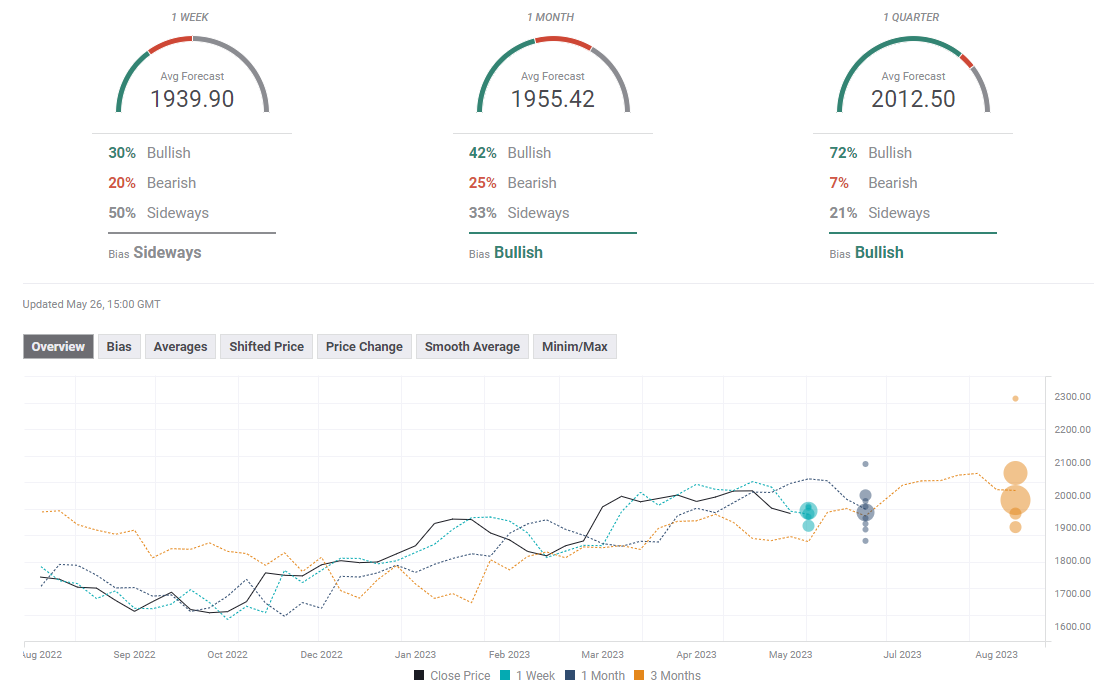
FXStreet Forecast Poll paints a mixed picture for XAU/USD in the near term with the one-week average target sitting near $1,940. The one-quarter outlook remains overwhelmingly bullish as the majority of polled experts see Gold price reclaiming $2,000 in that time frame.
Author

Eren Sengezer
FXStreet
As an economist at heart, Eren Sengezer specializes in the assessment of the short-term and long-term impacts of macroeconomic data, central bank policies and political developments on financial assets.