Gold Price Forecast: XAU/USD turns cautious, awaits US-Russia talks, Fedspeak
- Gold price stalls rebounds and treads water, bracing for US-Russia bilateral talks.
- The US Dollar finds footing as nervousness seeps in; US Treasury yields attempt a bouce.
- Gold price could see a fresh leg down toward $2,850 but bullish bias remains intact.

Gold price is treading water near $2,900 early Tuesday, struggling to build on the previous rebound. Gold buyers turn cautious amid a broad-based US Dollar rebound, bracing for the much-awaited US-Russia bilateral talks in Saudi Arabia.
Gold price pauses, eyes on US-Russia meeting
Top delegates from the US and Russia are set to hold a meeting to discuss ending the war in Ukraine. Despite the prospects of a Russia-Ukraine peace deal, a sense of caution prevails as any decision could be made without the presence of Ukraine and European leaders.
“French President Emmanuel Macron hosted an emergency summit on Ukraine on Monday after US officials suggested Europe would have no role in any talks this week in Saudi Arabia aimed at ending the conflict,” per Reuters.
The tepid risk sentiment seems to have put a fresh bid under the safe-haven US Dollar (USD), checking the upside in the Gold price. Additionally, US Federal Reserve (Fed) policymakers calling for prudence on the inflation and interest-rate cut outlook aids the USD upswing alongside the US Treasury bond yields.
Fed Governor Michelle Bowman said on Monday that rising asset prices may have hampered the Fed's recent progress on inflation. Fed Governor Christopher Waller noted: Inflation progress in past year excruciatingly slow. Cuts are appropriate in 2025 if inflation repeats the 2024 pattern.”
Meanwhile, Philadelphia Fed President Patrick Harker said that the current economy argues for a steady policy for now.
Looking ahead, more speeches from Fed officials Mary Daly and Michael Barr will be closely scrutinized for fresh hints on the policy outlook as the focus shifts to the Minutes of the Fed’s January meeting.
However, developments surrounding the talks between the Kremlin and Washinton will emerge as the primary market driver, with US traders returning to their desks after a long weekend. In case of a fallout, risk aversion could amplify and Gold price could find renewed haven demand and advance in sync with the Greenback.
Gold price technical analysis: Daily chart
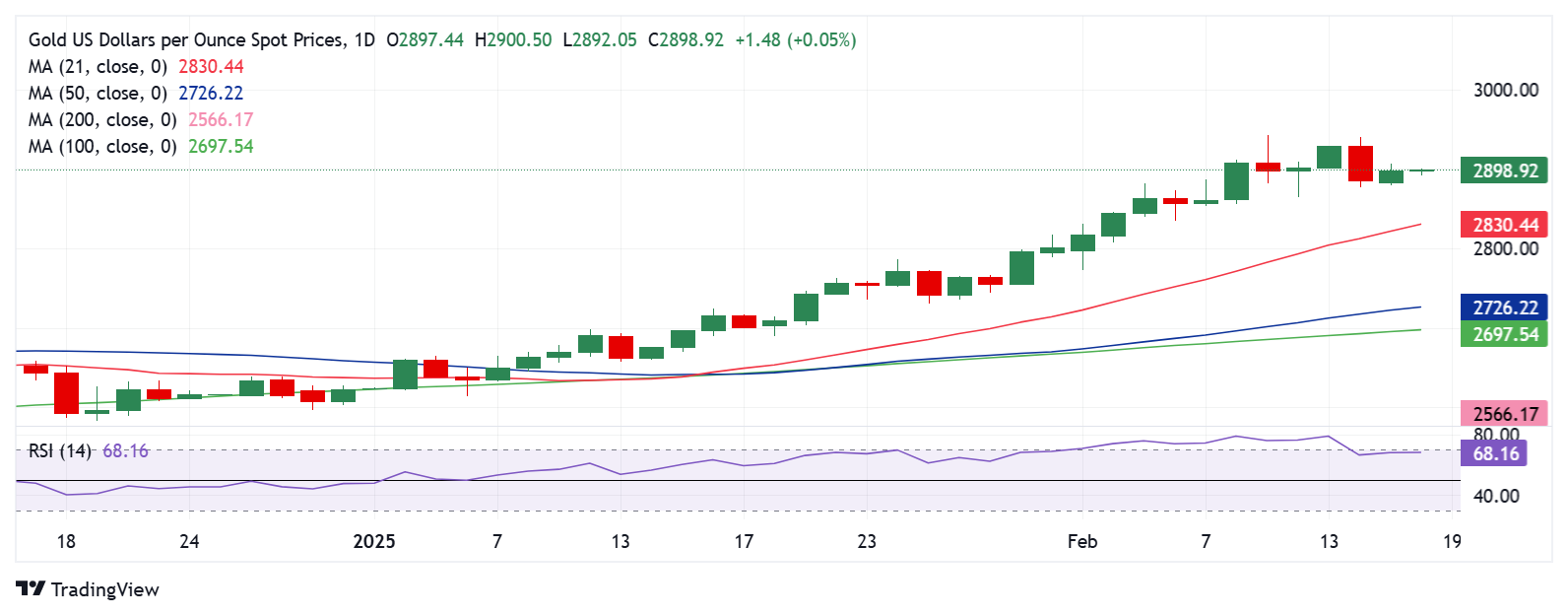
The daily chart shows that Gold price hovers around $2,900 after failing to find acceptance above that level on Monday.
The 14-day Relative Strength Index (RSI) has flatlined while within in the bullish zone, currently near 68, suggesting a lack of fresh impetus.
Should sellers jump in the game, the February low of $2,864 will be tested, below which a fresh downside could be initiated toward the $2,850 psychological barrier.
Further south, the 21-day Simple Moving Average (SMA) at $2,830 could come into play.
On the flip side, Gold buyers will aim for a record high of $2,943 if the rebound regains momentum. Ahead of that, the February 12 high of $2,909 could test bearish commitments.
The next relevant resistance is seen at the $2,970 round level.
(This story was corrected on February 18 at 6.45 GMT to say that "Gold price could see a fresh leg down toward $2,850 but bullish bias remains intact," not $2,950.)
Gold FAQs
Gold has played a key role in human’s history as it has been widely used as a store of value and medium of exchange. Currently, apart from its shine and usage for jewelry, the precious metal is widely seen as a safe-haven asset, meaning that it is considered a good investment during turbulent times. Gold is also widely seen as a hedge against inflation and against depreciating currencies as it doesn’t rely on any specific issuer or government.
Central banks are the biggest Gold holders. In their aim to support their currencies in turbulent times, central banks tend to diversify their reserves and buy Gold to improve the perceived strength of the economy and the currency. High Gold reserves can be a source of trust for a country’s solvency. Central banks added 1,136 tonnes of Gold worth around $70 billion to their reserves in 2022, according to data from the World Gold Council. This is the highest yearly purchase since records began. Central banks from emerging economies such as China, India and Turkey are quickly increasing their Gold reserves.
Gold has an inverse correlation with the US Dollar and US Treasuries, which are both major reserve and safe-haven assets. When the Dollar depreciates, Gold tends to rise, enabling investors and central banks to diversify their assets in turbulent times. Gold is also inversely correlated with risk assets. A rally in the stock market tends to weaken Gold price, while sell-offs in riskier markets tend to favor the precious metal.
The price can move due to a wide range of factors. Geopolitical instability or fears of a deep recession can quickly make Gold price escalate due to its safe-haven status. As a yield-less asset, Gold tends to rise with lower interest rates, while higher cost of money usually weighs down on the yellow metal. Still, most moves depend on how the US Dollar (USD) behaves as the asset is priced in dollars (XAU/USD). A strong Dollar tends to keep the price of Gold controlled, whereas a weaker Dollar is likely to push Gold prices up.
Author

Dhwani Mehta
FXStreet
Residing in Mumbai (India), Dhwani is a Senior Analyst and Manager of the Asian session at FXStreet. She has over 10 years of experience in analyzing and covering the global financial markets, with specialization in Forex and commodities markets.

















