Gold Price Forecast: XAU/USD holds within familiar levels around $3,020

XAU/USD Current price: $3,016.75
- US President Donald Trump's trade war exacerbates uncertainty levels.
- The sentiment soured amid expectations of additional US levies.
- XAU/USD trades with a softer tone, but holds within familiar levels.
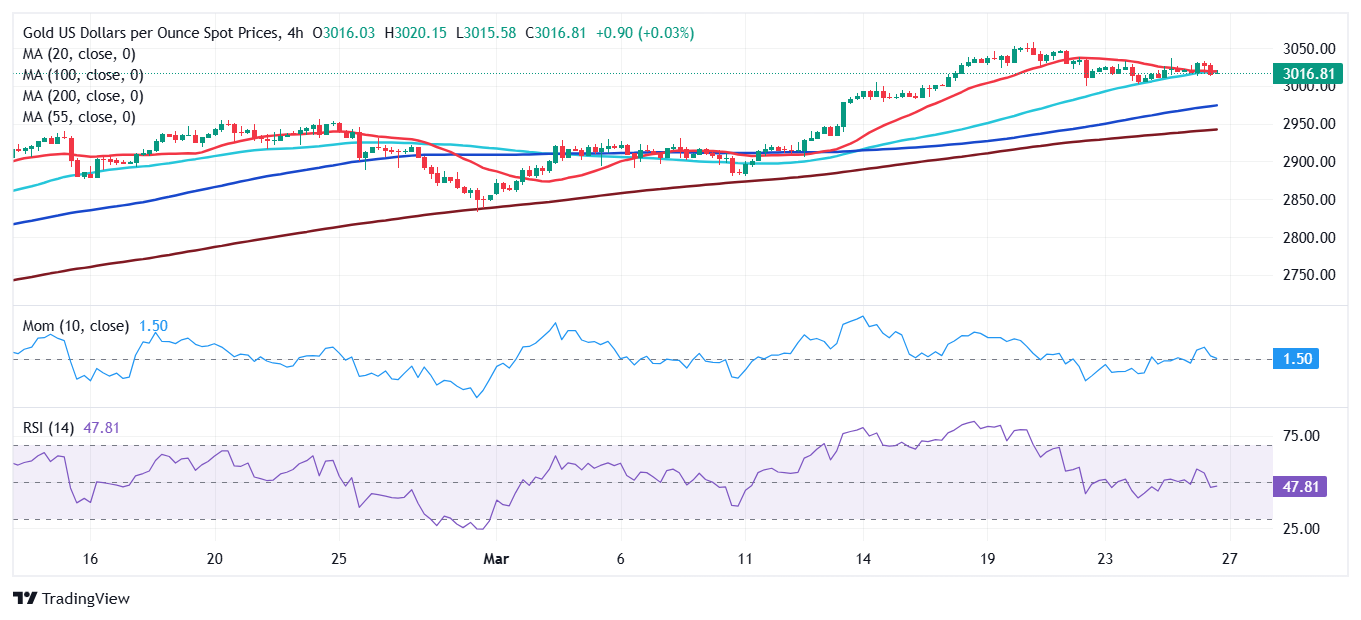
Gold price is stable on Wednesday, hovering in a tight range around its daily opening. The bright metal failed to attract fresh buyers despite fresh US Dollar (USD) strength and a generally sour mood. Wall Street turned red after the opening, reflecting the risk-off sentiment.
Concerns gyrate around United States (US) President Donald Trump's tariff announcements, with the latest on the matter indicating he is preparing auto tariffs and will unveil his plan as soon as today. His massive levies on US imports from around the world have triggered concerns among authorities and representatives from major economies, as such taxes could affect economic growth and inflation levels beyond the US. According to the latest data available, reciprocal tariffs will come into effect on April 2.
Meanwhile, US data was encouraging. The country released February Durable Goods Orders, which rose by 0.9%, beating the -1%. The latest update on the Q4 Gross Domestic Product (GDP) will be out on Thursday, alongside Initial Jobless Claims for the previous week.
Meanwhile, Federal Reserve (Fed) member Neel Kashkari reiterated that there is still job to be done regarding inflation, while adding he is still uncertain about the effects of tariffs. He added that he takes very seriously the hit to confidence, and that the Fed should sit were it is, referring to maintain a wait-and-see stance.
XAU/USD short-term technical outlook
The XAU/USD pair's daily chart shows it trades around its daily opening, just below $3,020. The upward momentum faded, but the risk remains skewed to the upside, given that technical indicators hold well above their midlines, with modest upward slopes. At the same time, the pair keeps developing above all its moving averages, with a bullish 20 Simple Moving Average (SMA) providing support at around $2,960.
The 4-hour chart shows XAU/USD remains stuck around a mildly bearish 20 SMA while the 100 and 200 SMAs maintain their bullish slopes far below the current level. Technical indicators, in the meantime, head modestly lower just below their midlines, not enough to confirm a steeper decline.
Support levels: 2,999.30 2,984.70 2,970.20
Resistance levels: 3,030.50 3,047.40 3,060.00
Tariffs FAQs
Tariffs are customs duties levied on certain merchandise imports or a category of products. Tariffs are designed to help local producers and manufacturers be more competitive in the market by providing a price advantage over similar goods that can be imported. Tariffs are widely used as tools of protectionism, along with trade barriers and import quotas.
Although tariffs and taxes both generate government revenue to fund public goods and services, they have several distinctions. Tariffs are prepaid at the port of entry, while taxes are paid at the time of purchase. Taxes are imposed on individual taxpayers and businesses, while tariffs are paid by importers.
There are two schools of thought among economists regarding the usage of tariffs. While some argue that tariffs are necessary to protect domestic industries and address trade imbalances, others see them as a harmful tool that could potentially drive prices higher over the long term and lead to a damaging trade war by encouraging tit-for-tat tariffs.
During the run-up to the presidential election in November 2024, Donald Trump made it clear that he intends to use tariffs to support the US economy and American producers. In 2024, Mexico, China and Canada accounted for 42% of total US imports. In this period, Mexico stood out as the top exporter with $466.6 billion, according to the US Census Bureau. Hence, Trump wants to focus on these three nations when imposing tariffs. He also plans to use the revenue generated through tariffs to lower personal income taxes.
Author

Valeria Bednarik
FXStreet
Valeria Bednarik was born and lives in Buenos Aires, Argentina. Her passion for math and numbers pushed her into studying economics in her younger years.