Gold Price Forecast: XAU/USD eyes US CPI/Powell’s testimony for a fresh directional impetus
- Gold edged higher on Friday and posted a third straight week of gains amid weaker USD.
- The risk-on mood, rebounding US bond yields kept a lid on any further gains for the metal.
- The market focus now shifts to the US CPI and Fed Chair Powell’s congressional testimony.

Gold showed some resilience below the $1,800 mark and regained some positive traction on Friday. A weaker US dollar was seen as a key factor that benefitted the dollar-denominated commodity amid worries about the economic fallout from the spread of the highly contagious Delta variant of COVID-19. That said, a strong rally in the US equity markets and a modest bounce in the US Treasury bond yields kept a lid on any further gains for the commodity. Apart from this, indications that the Fed is moving towards tapering its asset purchases sooner than anticipated also acted as a headwind for the non-yielding yellow metal and capped the upside.
The June FOMC meeting minutes released last Wednesday revealed that policymakers expect conditions to reduce the pace of asset purchases could be met earlier than previously expected. Fed officials also agreed that they must be ready to act if inflation or other risks materialize, suggesting that QE tapering discussions could begin in the coming months. Hence, the market focus will remain on the latest US consumer inflation figures due on Tuesday. This, along with the Fed Chair Jerome Powell's semi-annual congressional testimony on Wednesday and Thursday, will play a key role in determining the next leg of a directional move for the XAU/USD.
In the meantime, a generally positive tone around the Asian equity markets prompted some fresh selling on the first day of a new trading week. The precious metal has now erased a major part of its gains posted on Friday, though the downside seems limited amid absent relevant market-moving economic release from the US. Heading into this week's key data/event risks, the broader market risk sentiment and the USD price dynamics will continue to influence the commodity. Traders might further take cues from the US bond yields to grab some short-term opportunities.
Technical outlook
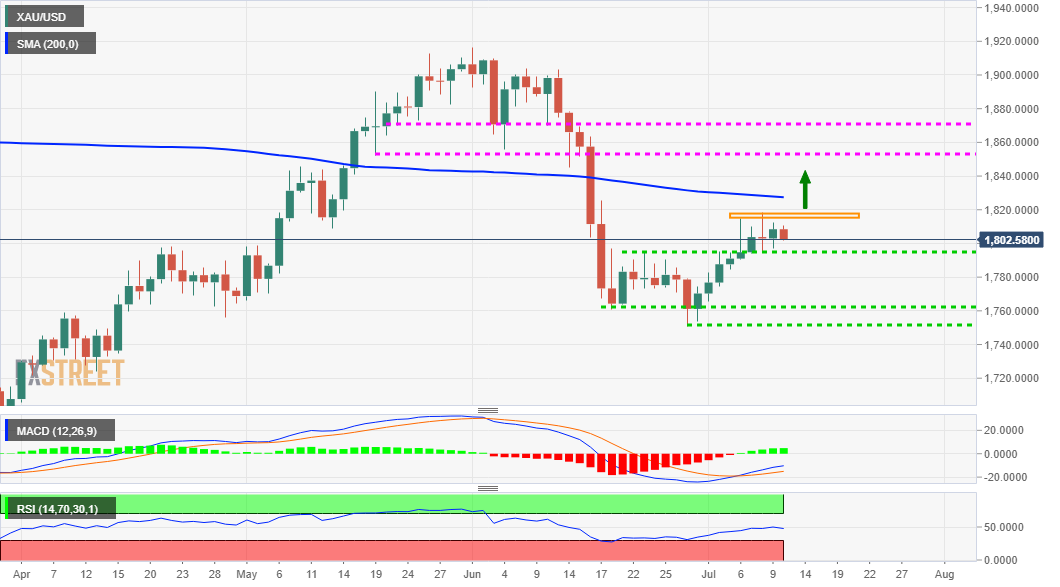
From a technical perspective, the recent range-bound price action over the past few trading sessions points to indecision among traders. This, in turn, makes it prudent to wait for a sustained move in either direction before placing any aggressive bets. Meanwhile, dips below the $1,800 mark might continue to find some support near the $1,795-93 horizontal support, which should act as a key pivotal point for intraday traders. A convincing break below might prompt some technical selling and accelerate the slide further towards the $1,780-78 support zone. Some follow-through selling below the $1,775 level will negate any near-term positive bias and turn the commodity vulnerable. The next relevant support is pegged near the $1,762-60 region, below which the XAU/USD could slide back to retest June monthly swing lows, around the $1,750 area.
On the flip side, the $1,815-18 region now seems to have emerged as immediate resistance. This is followed by the very important 200-day SMA, around the $1,828-29 zone. A sustained strength beyond will be seen as a fresh trigger for bullish traders and set the stage for an extension of the recent positive momentum witnessed over the past three weeks or so. The commodity might then aim to surpass an intermediate barrier around the $1,852-55 region and test the next major hurdle near the $1,870 level.
Author

Haresh Menghani
FXStreet
Haresh Menghani is a detail-oriented professional with 10+ years of extensive experience in analysing the global financial markets.