Gold Price Forecast: XAU/USD eyes US-China trade talks and third straight weekly gain
- Gold price defends weekly gains early Friday, finding stiff resistance near $3,370.
- The US Dollar picks up bids on the US trade deal optimism with its Asian allies.
- The daily technical setup remains in favor of Gold buyers, with $3,400 a key topside barrier.

Gold price holds Thursday’s rebound, defending weekly gains near $3,350 early Friday. Gold buyers catch a breather, taking stock of the trade developments globally after US President Donald Trump’s tariffs whiplash.
Gold price pauses its rebound as US Dollar rebounds
This Friday, the US Dollar (USD) sees fresh signs of life as risk sentiment remains upbeat on optimism for trade deals. Reuters reported that the Trump administration seems to be progressing in early trade talks with Asian allies South Korea and Japan.
On Thursday, Seoul's delegation said that both sides aim to craft a trade package before the pause on reciprocal tariffs is lifted in July. Meanwhile, Japanese Finance Minister Kato Katsunobu held talks with US Treasury Secretary Scott Bessent in Washington on Thursday, noting that Bessent did not raise the Yen’s level in bilateral talks.
In evidence of further progress, Japan's chief negotiator, Economy Minister Ryosei Akazawa, will hold a second round of trade talks with Bessent next week.
Receding recession fears, following encouraging earnings reports from American tech giants, offer some respite to the beleaguered US Dollar. Shares of Google parent Alphabet jumped over 3% in after-hours after its first-quarter earnings beat analysts' expectations.
The resurgent US Dollar demand and trade deal hopes heading into the weekend limit the Gold price upswing. The US Federal Reserve (Fed) officials’ cautious stance on revising the policy, as they continue to assess the impact of Trump’s tariffs on the economy and inflation prospects, acts as a headwind for the recent upswing in Gold price.
However, Gold buyers remain hopeful amid a lack of certainty on the US-China trade talks front.
Looking ahead, traders will pay close attention to any trade-related headlines from the White House or US President Trump for fresh cues on the Gold price action. The end-of-the-week flows will also emerge as one of the forces behind the Gold and the US Dollar movement later in the day.
Gold price technical analysis: Daily chart
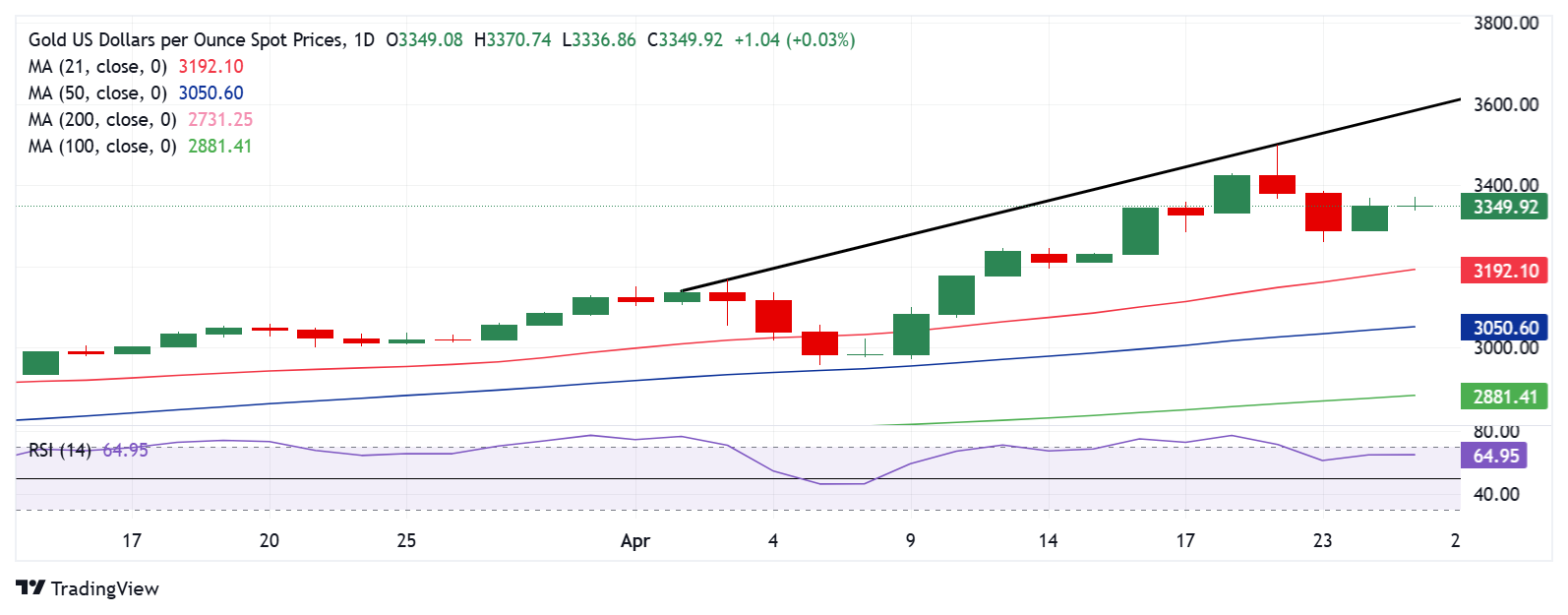
The short-term technical outlook for the Gold price remains constructive as the 14-day Relative Strength Index (RSI) holds firm above the midline, currently near 65.
Gold price must find acceptance above the $3,400 threshold for resuming the uptrend toward the record highs of $3,500. Further up, the rising trendline resistance at $3,583 will come into play.
If the upside loses traction, a 21-day Simple Moving Average (SMA) test at $3,175 will be inevitable on a sustained move below Wednesday’s low of $3,260.
The line in the sand for Gold buyers is seen at the $3,200 barrier.
Gold FAQs
Gold has played a key role in human’s history as it has been widely used as a store of value and medium of exchange. Currently, apart from its shine and usage for jewelry, the precious metal is widely seen as a safe-haven asset, meaning that it is considered a good investment during turbulent times. Gold is also widely seen as a hedge against inflation and against depreciating currencies as it doesn’t rely on any specific issuer or government.
Central banks are the biggest Gold holders. In their aim to support their currencies in turbulent times, central banks tend to diversify their reserves and buy Gold to improve the perceived strength of the economy and the currency. High Gold reserves can be a source of trust for a country’s solvency. Central banks added 1,136 tonnes of Gold worth around $70 billion to their reserves in 2022, according to data from the World Gold Council. This is the highest yearly purchase since records began. Central banks from emerging economies such as China, India and Turkey are quickly increasing their Gold reserves.
Gold has an inverse correlation with the US Dollar and US Treasuries, which are both major reserve and safe-haven assets. When the Dollar depreciates, Gold tends to rise, enabling investors and central banks to diversify their assets in turbulent times. Gold is also inversely correlated with risk assets. A rally in the stock market tends to weaken Gold price, while sell-offs in riskier markets tend to favor the precious metal.
The price can move due to a wide range of factors. Geopolitical instability or fears of a deep recession can quickly make Gold price escalate due to its safe-haven status. As a yield-less asset, Gold tends to rise with lower interest rates, while higher cost of money usually weighs down on the yellow metal. Still, most moves depend on how the US Dollar (USD) behaves as the asset is priced in dollars (XAU/USD). A strong Dollar tends to keep the price of Gold controlled, whereas a weaker Dollar is likely to push Gold prices up.
Author

Dhwani Mehta
FXStreet
Residing in Mumbai (India), Dhwani is a Senior Analyst and Manager of the Asian session at FXStreet. She has over 10 years of experience in analyzing and covering the global financial markets, with specialization in Forex and commodities markets.