Gold Price Forecast: XAU/USD defends 50-day SMA, but for how long?
- Gold price extends Tuesday’s late rebound into early Wednesday, looks to $3,350.
- US Dollar rebound loses steam despite shaky Middle East ceasefire, hawkish Fed’s Powell.
- Gold price defends the critical 50-day SMA support while the daily RSI struggles near the middle.

Gold price is building on its previous rebound early Wednesday, snapping a three-day bearish streak as the US Dollar (USD) rebound fizzles ahead of day 2 of Federal Reserve (Fed) Chair Jerome Powell’s congressional testimony and mid-tier US data.
Gold price bounces as USD suffers from Middle East ceasefire
Gold price is benefiting from a slight negative shift in risk sentiment in Asian trading on Wednesday as traders remain wary about the shaky Iran-Isreal ceasefire.
A renewed US Dollar selling, fuelled by a downtick in the USD/JPY pair following the hawkish commentary from Bank of Japan (BoJ) board member Naoki Tamura and hot Japanese Services Producer Price Index (PPI), also supports the Gold price upswing.
Meanwhile, markets digest the hawkish remarks from Fed Chair Powell delivered during his testimony on the semi-annual Monetary Policy Report before the House Financial Committee on Tuesday.
Powell said he expects policymakers to stay on hold until they have a better handle on the impact tariffs will have on prices, per CNBC News.
“We’re just trying to be careful and cautious,” he added.
The Greenback briefly drew support from Powell’s comments but the Middle East ceasefire optimism boosted risk appetite and drove US stocks higher, diminishing the USD’s appeal as a safe-haven.
Amid hawkish Fed Chair Powell’s comments and the shaky Middle East truce, Gold price tumbled to two-week lows at $3,295 before reversing sharply to settle Tuesday well above the $3,300 level.
The focus now shifts toward the mid-tier US housing data release and Powell’s testimony before the Senate later in the day. Markets will continue to pay close attention to any fresh developments on the Iran-Israel geopolitical front.
Gold price technical analysis: Daily chart
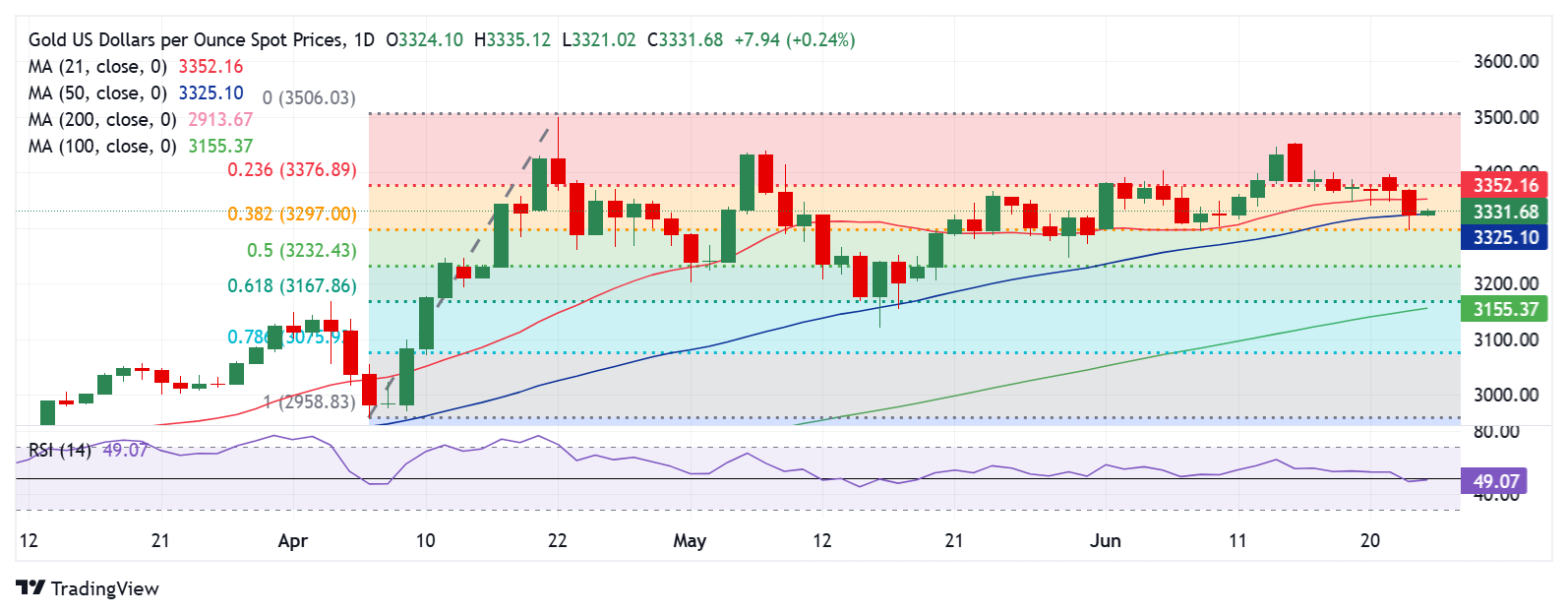
The daily chart shows that Gold price has managed to defend the strong support of the 50-day Simple Moving Average (SMA), now at $3,325.
However, the 14-day Relative Strength Index (RSI) struggles to regain the midline so far, currently trading near 49.
Therefore, it remains to be seen if the bright metal can retain its hold above the 50-day SMA yet again.
A failure to resist above the 50-day SMA on a daily closing basis will retest the 38.2% Fibonacci Retracement (Fibo) level of the April record rally at $3,297.
A sustained break of the latter could trigger a fresh downtrend toward the $3,250 psychological barrier, below which the 50% Fibo level at $3,232 will come into play.
On the other hand, recapturing the 21-day SMA at $3,352 is critical for a sustained recovery from two-week troughs.
The next upside hurdle is aligned at the 23.6% Fibo level at $3,377.
Gold buyers will then target the $3,400 threshold once the 23.6% Fibo resistance is decisively taken out.
Gold FAQs
Gold has played a key role in human’s history as it has been widely used as a store of value and medium of exchange. Currently, apart from its shine and usage for jewelry, the precious metal is widely seen as a safe-haven asset, meaning that it is considered a good investment during turbulent times. Gold is also widely seen as a hedge against inflation and against depreciating currencies as it doesn’t rely on any specific issuer or government.
Central banks are the biggest Gold holders. In their aim to support their currencies in turbulent times, central banks tend to diversify their reserves and buy Gold to improve the perceived strength of the economy and the currency. High Gold reserves can be a source of trust for a country’s solvency. Central banks added 1,136 tonnes of Gold worth around $70 billion to their reserves in 2022, according to data from the World Gold Council. This is the highest yearly purchase since records began. Central banks from emerging economies such as China, India and Turkey are quickly increasing their Gold reserves.
Gold has an inverse correlation with the US Dollar and US Treasuries, which are both major reserve and safe-haven assets. When the Dollar depreciates, Gold tends to rise, enabling investors and central banks to diversify their assets in turbulent times. Gold is also inversely correlated with risk assets. A rally in the stock market tends to weaken Gold price, while sell-offs in riskier markets tend to favor the precious metal.
The price can move due to a wide range of factors. Geopolitical instability or fears of a deep recession can quickly make Gold price escalate due to its safe-haven status. As a yield-less asset, Gold tends to rise with lower interest rates, while higher cost of money usually weighs down on the yellow metal. Still, most moves depend on how the US Dollar (USD) behaves as the asset is priced in dollars (XAU/USD). A strong Dollar tends to keep the price of Gold controlled, whereas a weaker Dollar is likely to push Gold prices up.
Author

Dhwani Mehta
FXStreet
Residing in Mumbai (India), Dhwani is a Senior Analyst and Manager of the Asian session at FXStreet. She has over 10 years of experience in analyzing and covering the global financial markets, with specialization in Forex and commodities markets.