Gold Price Forecast: Buyers defending the 1,750 price zone

XAU/USD Current price: $1,760.52
- A better market mood limits demand for safe-haven gold.
- Upbeat US data provided support to high-yielding equities.
- XAU/USD could advance in the near term, although sustained gains seem unlikely.
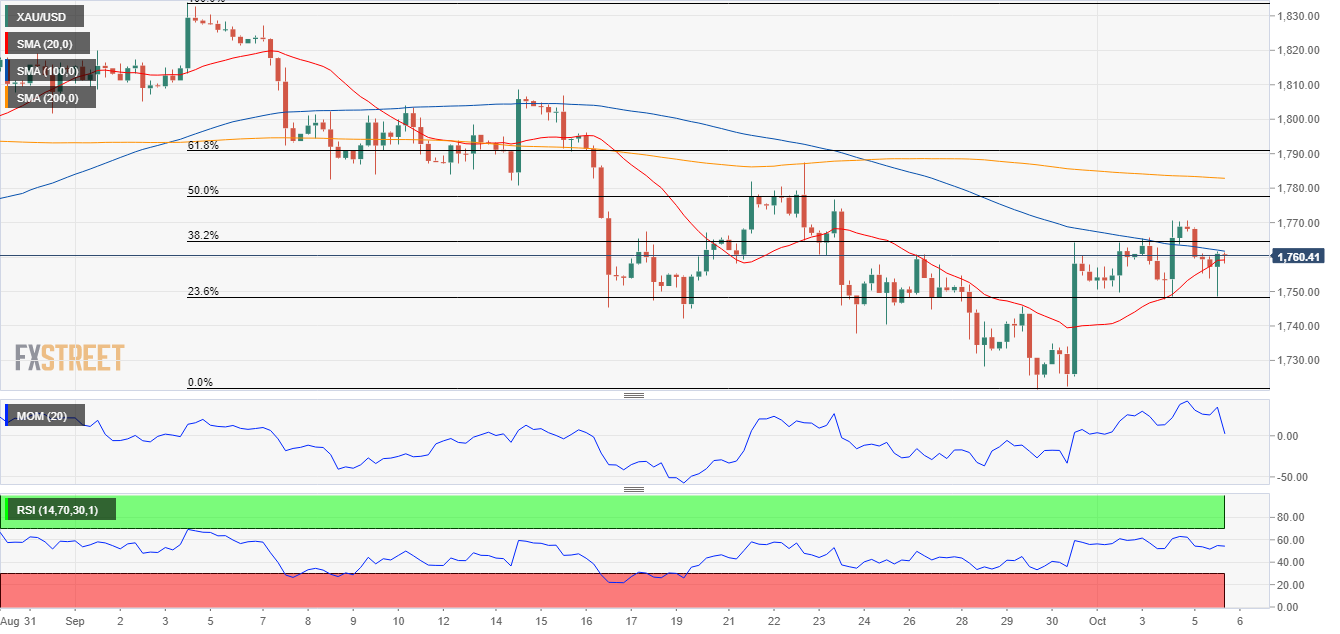
Gold has trimmed all of its Monday’s gains and trades just below the 1,760 price zone, although off its daily lows. Demand for the bright metal receded amid a better performance of equities, reflecting a better market’s mood. The American dollar also remained away from investors’ radar, shedding ground against other major currencies.
Better than anticipated US data lifted further the market’s sentiment, as the September ISM Services PMI improved from 61.7 to 61.9, much better than the 60 expected. Services businesses activity in the country improved for the 16th month in a row, although the official report also showed rising concerns about bottlenecks and constraints on logistics, alongside “challenges with labour resources.”
Meanwhile, US government bond yields surged to a fresh weekly high, another sign of a better market mood. The yield on the 10-year Treasury note peaked t 1.54% and currently stands at 1.52%.
Gold price short-term technical outlook
XAU/USD keeps trading between Fibonacci levels. The daily chart shows that gold was unable to retain gains above a bearish 20 SMA and currently trades below it, meeting buyers for a third consecutive day around the 23.6% retracement of its latest daily slump at 1,748.05. Technical indicators are directionless within negative levels, with the RSI slowly turning south.
For the near term, the outlook is neutral-to-bullish as XAU/USD is standing above a bullish 20 SMA, while technical indicators aim higher from around their midlines. The 100 SMA maintains a modest bearish slope near the next Fibonacci resistance level at 1,764.35, the level to beat to expect additional gains in the upcoming sessions.
Support levels: 1,748.05 1,735.26 1,721.60
Resistance levels: 1,764.35 1,777.75 1,787.30
Author

Valeria Bednarik
FXStreet
Valeria Bednarik was born and lives in Buenos Aires, Argentina. Her passion for math and numbers pushed her into studying economics in her younger years.
















