Gold climbs toward record highs amid rising global trade war risks

Gold (XAU/USD) continues to climb as trade tensions between the U.S. and Europe intensify, boosting safe-haven demand. President Trump’s tariff threats against major European economies have reignited fears of a broader trade war. The European Union has responded with both diplomacy and preparations for retaliation, adding to global uncertainty. Meanwhile, the Federal Reserve’s hawkish stance has delayed rate cut expectations, supporting the U.S. Dollar and limiting some of gold’s gains. Despite this, the volatile macro backdrop continues to favor gold as capital shifts toward safer assets.
Gold price surges on renewed global trade war concerns
Gold is pushing toward fresh record territory as geopolitical tensions intensify and safe-haven flows accelerate. President Trump unveiled a 10% tariff plan targeting eight European countries that opposed his Greenland acquisition proposal. This includes major economies such as Germany, France, the UK, and the Netherlands. The unexpected move has reignited fears of a broader trade war between the US and the EU.
In response to these developments, European Union ambassadors moved quickly, reaching a preliminary agreement to discourage Washington from moving ahead with the proposed duties. At the same time, they began preparing potential countermeasures, signaling that trade tensions could escalate further. In this environment of rising uncertainty, gold typically attracts stronger safe-haven flows as capital shifts away from risk-sensitive assets.
Meanwhile, the Federal Reserve’s hawkish stance has capped some of gold’s gains. Recent labor market strength in the US has delayed expectations for interest rate cuts. Markets now see the first Fed cut potentially arriving in June or later. This shift has supported the U.S. Dollar, putting mild pressure on non-yielding assets like gold. Still, the macro environment remains volatile, with gold continuing to outperform amid heightened geopolitical risk.
Gold tests ascending channel resistance after a steady climb
The gold chart below shows a well-defined ascending channel that has guided price action since November. Throughout this period, price has moved steadily within the structure, with each pullback finding support near the lower boundary. This consistent behavior highlights the channel’s reliability as a framework for tracking gold’s ongoing trend.
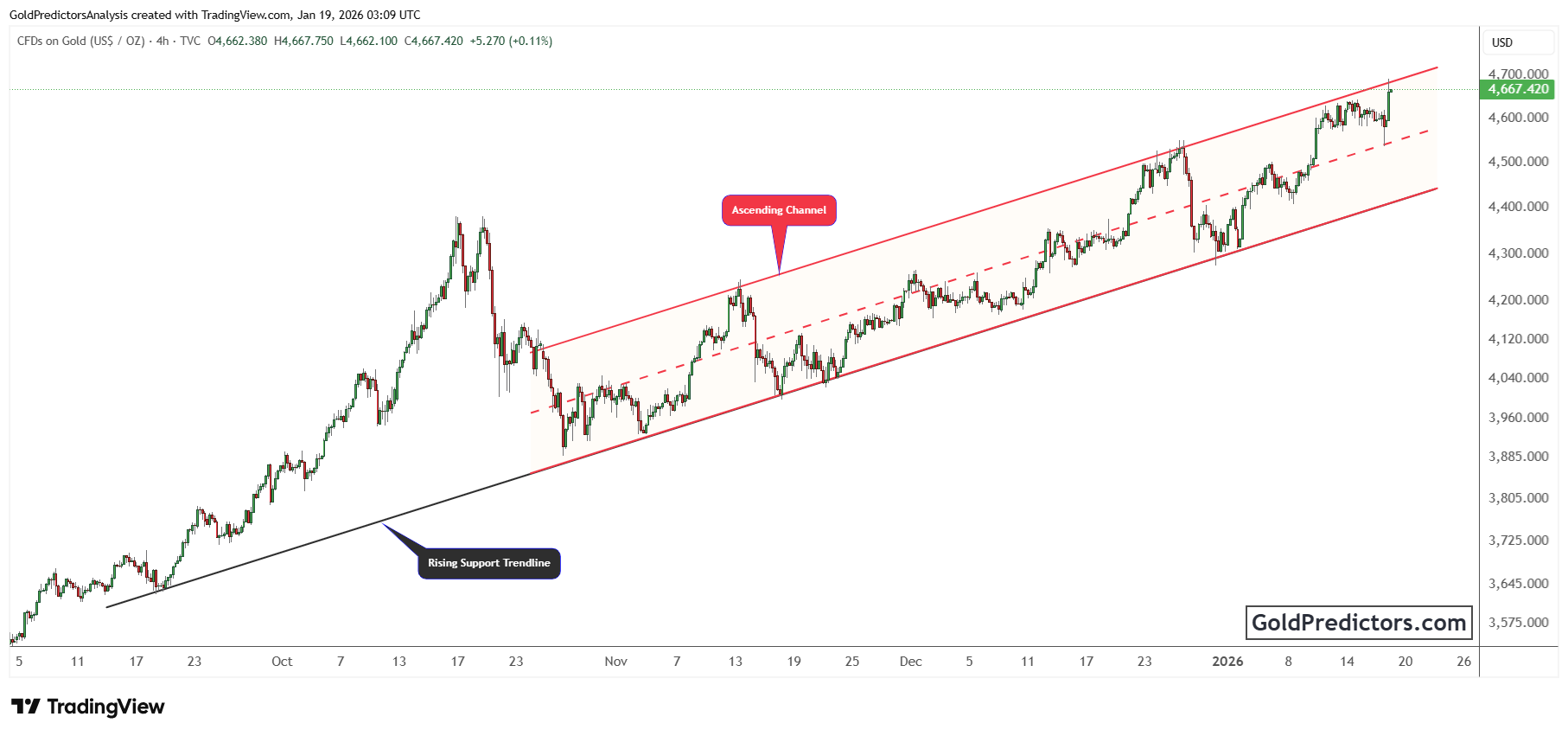
Recent price action shows gold approaching the upper boundary of this ascending channel. This approach follows a strong rebound from the channel’s midline and a consistent pattern of higher lows that continue to support the bullish trend. The sharp rally has carried gold to the upper edge of its channel, where short-term resistance could start to build.
The overall structure remains intact, with price action continuing to respect the channel boundaries. There are no clear signs of exhaustion or breakdown, suggesting the trend remains firmly in place. A decisive break above the upper boundary could open the door to a fresh upward leg. Until that occurs, the channel offers a reliable framework for tracking potential consolidations and breakout scenarios.
Gold outlook: Trade tensions and technical structure support continued upside
Gold remains in a strong uptrend, supported by escalating trade tensions and persistent safe-haven demand. While the Federal Reserve’s hawkish stance has limited some upside by delaying rate cut expectations, the broader macro backdrop continues to favor gold. The metal is now testing key channel resistance after a sharp rally, with no signs of trend exhaustion. As long as geopolitical risks remain elevated and global uncertainty persists, gold is likely to retain its upward momentum.
Unlock exclusive gold and silver trading signals and updates that most investors don’t see. Join our free newsletter now!
Author

Muhammad Umair, PhD
Gold Predictors
Muhammad Umair is a financial markets analyst and investor who focuses on the forex and precious metals markets.















