GBP/USD Weekly Outlook: Geopolitical and economic concerns weigh on Pound Sterling
- The Pound Sterling faced rejection above $1.3000 against the US Dollar.
- GBP/USD’s further upside hinges on the UK and US inflation data.
- The pair eased off the overbought region on the daily chart as a Bull Cross suggests further gains ahead.

The Pound Sterling (GBP) corrected after topping near 1.3000 against the US Dollar (USD) mid-week. However, the GBP/USD pair holds at its highest level in four months.
Pound Sterling faded the upper hand
Over the weekend, the US launched large-scale airstrikes on Yemen, targeting the Iran-backed militant group Houthis. In response, Houthis attacked US vessels in the Red Sea, which Trump vowed to stop, warning that "hell will rain down" if they continue.
Meanwhile, Reuters reported early Tuesday that the ceasefire between Israel and Hamas collapsed after Israeli military hit targets across Gaza, with Palestinian health ministry officials reporting at least 100 dead. In response, Hamas turned down the proposal of releasing 59 hostages still held in Gaza.
Further, some unconfirmed reports that an Iranian ship gathering intelligence was sunk by US forces as Gaza attacks took place added to the Middle East tensions.
Despite all geopolitical developments, US President Donald Trump’s tariff-led global economic and trade uncertainties remained at the fore, keeping the broader market sentiment undermined alongside the US Dollar in the first half of the week.
The risk-sensitive Pound Sterling remained resilient, mainly due to the sustained weakness in the Greenback. The USD continued to bear the brunt of growing concerns over a potential US recession, which could prompt the US Federal Reserve (Fed) to resume its interest-rate-cutting cycle earlier than expected.
Despite the gradual advance, the GBP/USD pair remained in a narrow range at four months highs near 1.3000 as traders weighed escalating geopolitical tensions in the Middle East, the looming trade war and economic risks.
The White House reaffirmed on Tuesday that the reciprocal tariffs would come into effect on April 2. Meanwhile, US Retail Sales for February rose less than expected, coming in at 0.2% on a monthly basis. The market forecast was for a 0.7% growth. The data added to the US economic slowdown worries.
In the latter part of the week, the US Dollar found some support from the Fed’s cautious outlook on interest rates. Fed Chair Jerome Powell said during his post-policy meeting press conference on Wednesday that the central bank is in no rush to cut rates.
However, USD buyers remained wary as the Fed’s updated economic forecasts continued to project two rate reductions for the current year. Meanwhile, the Bank of England (BoE) held interest rates at 4.5% on Thursday, warranting caution against expectations that they would be cut over its next few meetings amid heightened uncertainty over the UK and global economies.
The BoE’s cautious outlook helped the Pound Sterling limit its losses, but only temporarily, as economic uncertainties and profit-taking ahead of UK and US inflation data sustained the corrective move lower in GBP/USD.
Week ahead: All eyes on UK and US inflation reports
A data-busy week returns, with the primary focus on inflation data releases from both sides of the Atlantic, which will likely offer fresh insights into the Fed’s and the BoE's policy outlooks.
The week begins with a bang on Monday, as the S&P Global preliminary Manufacturing and Services Purchasing Managers Index (PMI) data for March will be released. All eyes will also remain on BoE Governor Andrew Bailey's speech about the UK economy at the University of Leicester Chancellor's Distinguished Lecture Series later that day.
Tuesday will feature the US Conference Board (CB) Consumer Confidence and New Home Sales data.
The UK Consumer Price Index (CPI) data stands out on Wednesday, alongside the release of the British Annual Budget. The mid-tier US Durable Goods Orders will be published in the American session on the same day.
Thursday is quiet in terms of economic data from the UK, and therefore, the US fourth-quarter Gross Domestic Product (GDP) revision, Jobless Claims, and Pending Home Sales data will likely entertain GBP/USD traders.
On Friday, the focus will be on the US core Personal Consumption Expenditures (PCE) Price Index, the Fed’s favorite inflation gauge, for fresh trading directives. Meanwhile, the UK Retail Sales report for February is also expected to grab attention earlier in the day.
Besides the statistics, the speeches from Fed policymakers will also be closely scrutinized, along with renewed developments surrounding tariffs and the Middle East geopolitical tensions.
GBP/USD: Technical Outlook
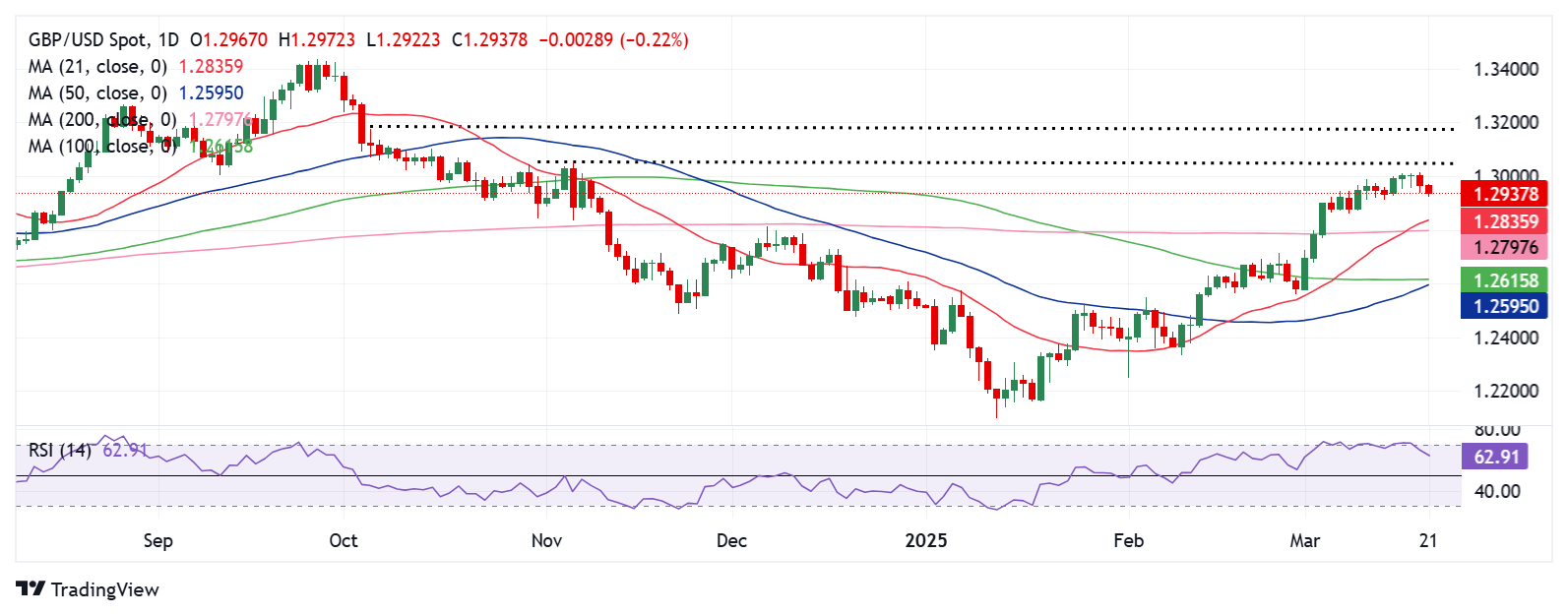
The short-term technical outlook for GBP/USD remains bullish, but given its recent upward trajectory, it could be a bumpy ride.
The daily chart indicates that the pair requires acceptance above the 1.3000 barrier on a weekly closing basis to establish a sustained uptrend, targeting the November 6, 2024, high of 1.3048.
Further up, buyers would aim for the 1.3150 – 1.3200 resistance area, above which a fresh rally could initiate toward the 1.3300 round figure.
The 14-day Relative Strength Index (RSI) has returned to the bullish zone after a brief stint in the overbought region, currently trading near 63.00. The momentum indicator suggests that upside risks remain intact for the major.
Additionally, the 21-day Simple Moving Average (SMA) crossed above the 200-day SMA on Wednesday, validating a Bull Cross and strengthening the bullish outlook.
Should the correction persist, the immediate downside target is the previous week’s low of 1.2862, where the 21-day SMA approaches.
Further down, the 200-day SMA at 1.2797 could be exposed on additional declines.
A sustained break below the latter will likely trigger a fresh downtrend toward the 100-day SMA at 1.2616.
Pound Sterling FAQs
The Pound Sterling (GBP) is the oldest currency in the world (886 AD) and the official currency of the United Kingdom. It is the fourth most traded unit for foreign exchange (FX) in the world, accounting for 12% of all transactions, averaging $630 billion a day, according to 2022 data. Its key trading pairs are GBP/USD, also known as ‘Cable’, which accounts for 11% of FX, GBP/JPY, or the ‘Dragon’ as it is known by traders (3%), and EUR/GBP (2%). The Pound Sterling is issued by the Bank of England (BoE).
The single most important factor influencing the value of the Pound Sterling is monetary policy decided by the Bank of England. The BoE bases its decisions on whether it has achieved its primary goal of “price stability” – a steady inflation rate of around 2%. Its primary tool for achieving this is the adjustment of interest rates. When inflation is too high, the BoE will try to rein it in by raising interest rates, making it more expensive for people and businesses to access credit. This is generally positive for GBP, as higher interest rates make the UK a more attractive place for global investors to park their money. When inflation falls too low it is a sign economic growth is slowing. In this scenario, the BoE will consider lowering interest rates to cheapen credit so businesses will borrow more to invest in growth-generating projects.
Data releases gauge the health of the economy and can impact the value of the Pound Sterling. Indicators such as GDP, Manufacturing and Services PMIs, and employment can all influence the direction of the GBP. A strong economy is good for Sterling. Not only does it attract more foreign investment but it may encourage the BoE to put up interest rates, which will directly strengthen GBP. Otherwise, if economic data is weak, the Pound Sterling is likely to fall.
Another significant data release for the Pound Sterling is the Trade Balance. This indicator measures the difference between what a country earns from its exports and what it spends on imports over a given period. If a country produces highly sought-after exports, its currency will benefit purely from the extra demand created from foreign buyers seeking to purchase these goods. Therefore, a positive net Trade Balance strengthens a currency and vice versa for a negative balance.
Author

Dhwani Mehta
FXStreet
Residing in Mumbai (India), Dhwani is a Senior Analyst and Manager of the Asian session at FXStreet. She has over 10 years of experience in analyzing and covering the global financial markets, with specialization in Forex and commodities markets.