GBP/USD Weekly Forecast: Sterling set to halt the slide lower as technicals favor a pullback higher
- The fourth-quarter UK GDP rose 0.2% over the previous quarter while decelerating to 1.3% over the year with business investment down -1.4% Q/Q and -3.7% y/y.
- The UK manufacturing output disappointed in December falling -0.7% over the month while contracting -2.1% over the year.
- The headline UK inflation decelerated to 1.8% over the year in January while core inflation remained stable at 1.9% y/y.
- While Brexit stalemate prevailed throughout the second week of February, the UK parliament voted against the amendments proposed by the UK Prime Minister in a 303 to 258 vote.
- The UK retail sales rose 1.0% over the month in January after falling -0.7% in December while core sales increased by 1.2% m/m.


The GBP/USD fell about 1% over the course of the second week of February after opening the week at 1.2936 and closing at around 1.2806. The Brexit uncertainty and the defeat of the UK Prime Minister in House of Commons were the major drivers of the market sentiment over the past week and Brexit headlines are poised to remain the major factor of the currency move in the upcoming week as well.
Fundamentally the UK economy showed a mixed bag of numbers over the second week of February. While the UK GDP saw the headline quarterly increase in line with market expectations for the fourth quarter of last year, the annual growth rate missed on the downside. This was underlined by a sharp fall in the UK manufacturing sector and business investment.
The Bank of England officials including governor Mark Carney and the Monetary Policy Committee member Gertjan Vlieghe both confirmed that the Brexit is the biggest uncertainty related to the UK economy and the outlook for monetary policy. These statements both confirmed the policy stance of one rate hike a year.
The fourth-quarter UK GDP rose 0.2% over the previous quarter while decelerating to 1.3% over the year with business investment down -1.4% Q/Q and -3.7% y/y. At the same time, the UK manufacturing output disappointed in December falling -0.7% over the month while contracting -2.1% over the year.
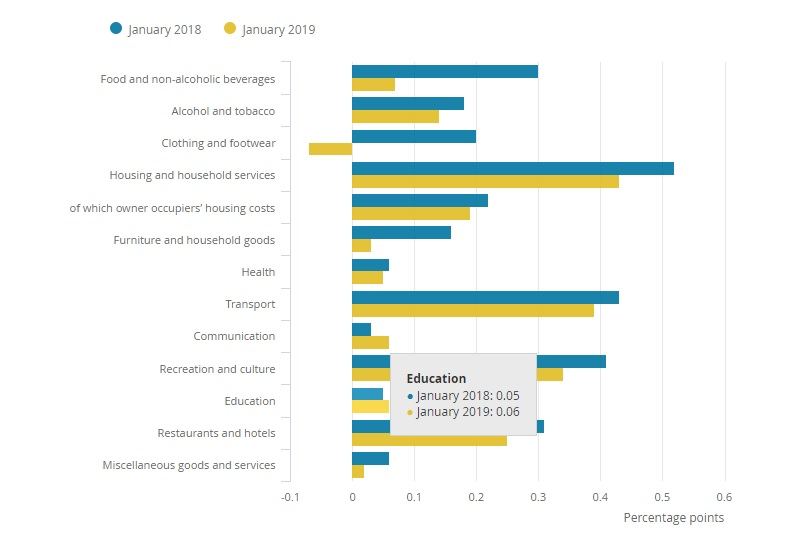
With oil prices falling in the final quarter of last year, also the UK inflation decelerated above expectations in January. The headline UK inflation decelerated to 1.8% over the year in January while core inflation remained stable at 1.9% y/y.
Related story
Contributions to headline UK inflation in January 2019
The monthly growth rate of the UK total retail sales rose 1.0% in January 2019, following a decline of 0.7% in December 2018 while the core retail sales stripping the consumer basket of motor fules sales increased 1.2% over the month in January after falling 1.0% in the previous month.
The UK total retail sales rose 4.1% over the year and core retail sales increased 4.2% y/y in January.
The fundamental news barely compensated the Brexit stalemate that persistently weighed on GBP/USD over the past two weeks that saw the currency pair slide from above 1.3200 level to 1.2770 last week’s low.
While the UK Prime Minister Theresa May struggles to gain support for her proposals in House of Commons, the European Union officials keep saying the current Brexit deal won’t be re-negotiated. Many commentators see the moves as part of UK Prime Minister’s strategy of putting the lawmakers in House of Commons into the corner in an effort to delay Brexit in the last minute vote. That may materialize on March 21-22 summit of the European Council.
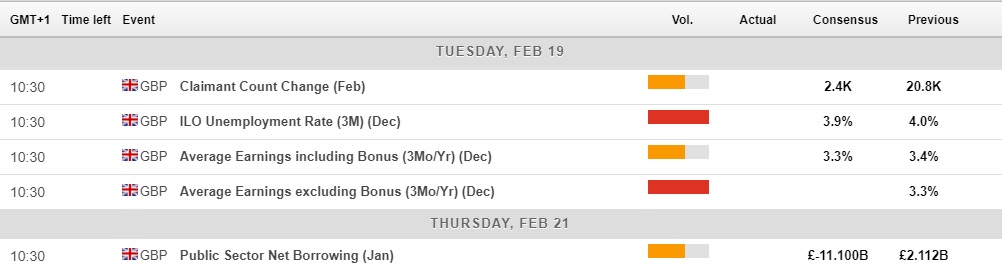
In the week ahead, the UK labor market report is due and it is expected to confirm the tight conditions with the unemployment rate dropping to a new for decade low of 3.9% and the wages rising 3.3% over the year.
Technically the GBP/USD is moving in a bearish trend and the technical indicators like Slow Stochastics are deeply in the Oversold territory indicating possible correction higher.
The Bank of England officials speaking last week
The Bank of England Governor Mark Carney was giving a public speech on global economic development in London on Tuesday warning of risks from China and de-globalization that are having a significant impact on the global economy with Brexit possible opening a new form of international cooperation and cross-border commerce.
The Bank of England external Monetary Policy Committee (MPC) member Gerttjan Vlieghe was more eloquent on Thursday, February 14 saying that if Brexit deal is done, around one quarter-point rate hike a year is a reasonable central case scenario for the Bank rate. “I would raise rates after a no-deal Brexit if needed, even if it is politically unpopular,” Vlieghe further said amending that an easing or extended pause in monetary policy more likely to be appropriate than tightening in case of a no-deal Brexit.
Summary of key quotes from Dr. Vlieghe:
- I consider the appropriate pace of monetary tightening is somewhat slower.
- If Brexit deal is done, around one quarter-point rate hike a year is a reasonable central case.
- The degree of future monetary tightening will in part depend on how large Sterling’s appreciation after a Brexit deal is.
- There is considerable uncertainty around my forecast for policy rate path.
- Signs of an economic slowdown in early 2019 means a lot needs to go right for this forecast to come to pass.
- I can probably wait for evidence of growth stabilizing, inflation pressure rising before considering a rate hike.
- In a no-deal Brexit scenario, an easing or extended pause in monetary policy more likely to be appropriate than tightening.
- There may be a further hit to consumption if households decide to raise the saving rate.
- I would raise rates after a no-deal Brexit if needed, even if it is politically unpopular.
- Other MPC members do not find it as useful to talk about interest paths as I do.
- I do not see a very big gap between my view on rates and that in BoE inflation report.
- I do not expect reduced immigration to lead to faster UK wage growth.
Technical Analysis
GBP/USD Daily chart
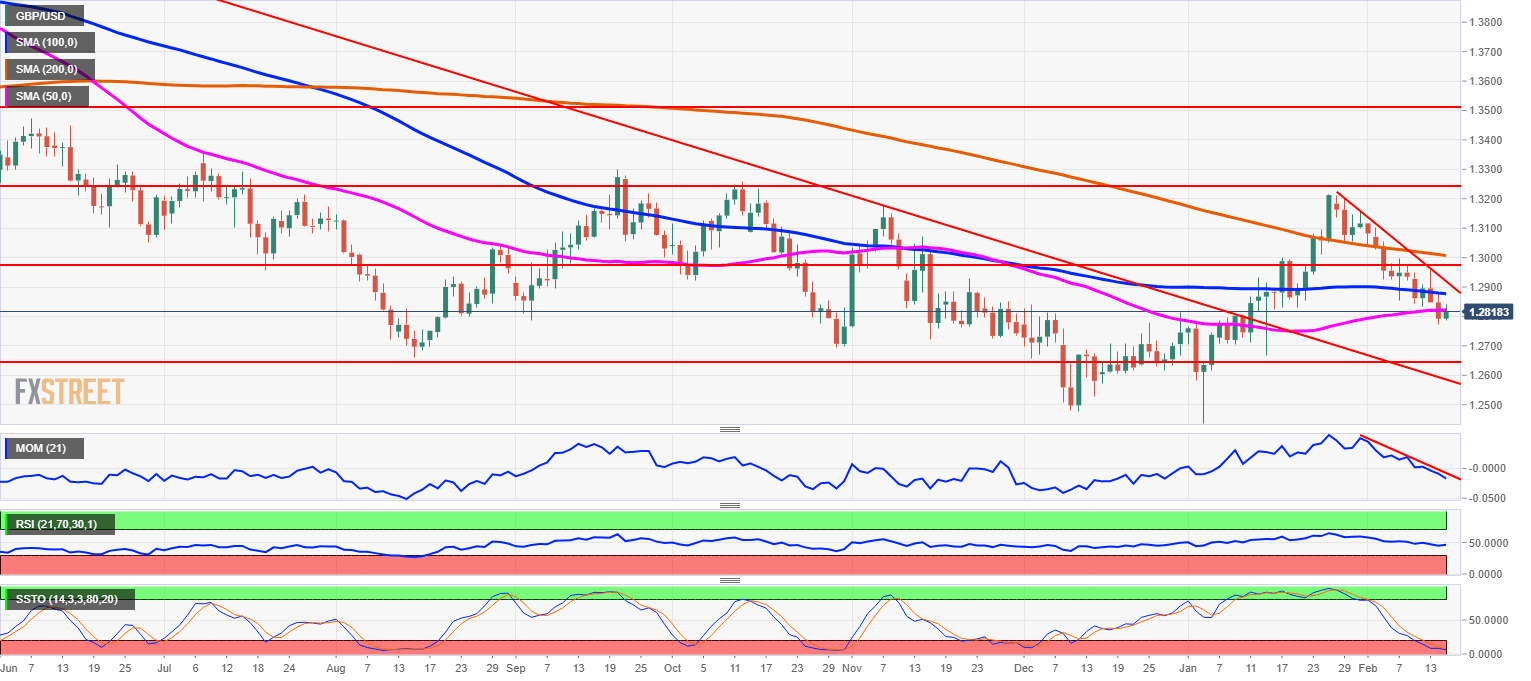
Technically the GBP/USD is moving within a corrective trend after breaking the psychologically important 1.3000 and 38.2% Fibonacci retracement line of 1.2970 last week.
The technical oscillators like the Relative Strength Index (RSI) is flat in the neutral territory while Momentum is trending lower and Slow Stochastics (SS) fell into the Oversold territory. The GBP/USD is sitting at around the 1.2800 level and with the UK retail sales coming out stronger than expected it is likely to re-gain 1.2822 representing a 50-DMA on a daily chart. The 1.2883 representing a 100-DMA is resistance on the upside.
The economic calendar for the week ahead
UK economic calendar for February 18-22
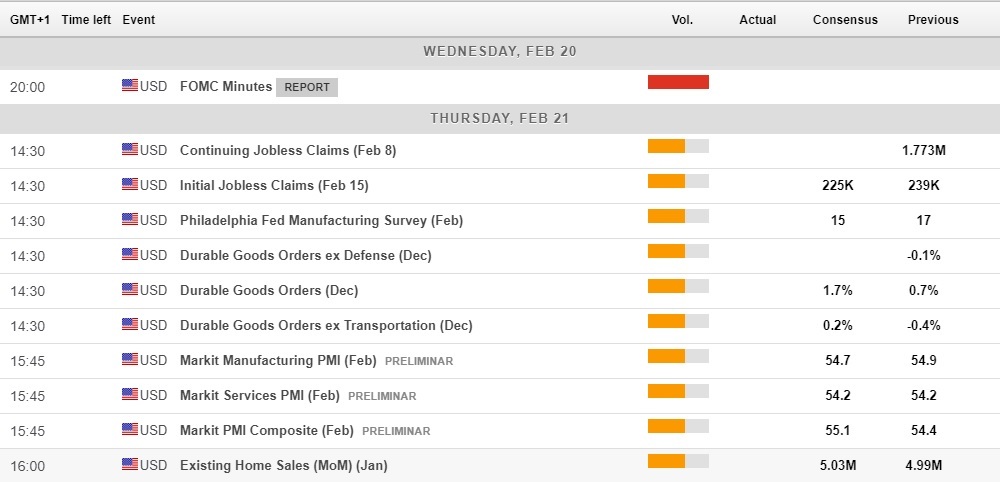
US economic calendar for February 18-22
The FX Street Forecast Poll
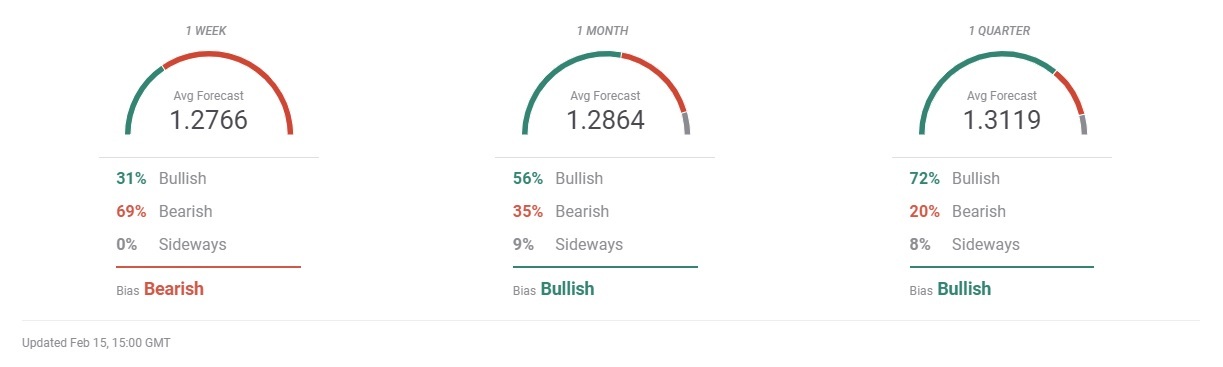
The FX Street Forecast Poll is expecting Sterling to appreciated to fall to 1.2766 for the week ahead, swinging down from 1.2995 predictions last week. The bullish-to-bearish ration changed to 31%-69% from 61%-39% last week.
While the 1-month forecast is bullish predicting 1.2864 FX rate in 1-month time from now, down from 1.2929 last week. Bullish-to-bearish forecast changed more bullish with 56%-35% distribution, up from 45-44% bullish-to-bearish forecasts last week.
The vast majority of the forecasters in the FX Street Forecast Poll is bullish over the 3-months horizon with GBP/USD prediction almost unchanged from last week at 1.3119 and with 72%-20% of bullish-to bearish forecasts, up from 61%-29% last week.
Author
Mario Blascak, PhD
Independent Analyst
Dr. Mário Blaščák worked in professional finance and banking for 15 years before moving to journalism. While working for Austrian and German banks, he specialized in covering markets and macroeconomics.