Could the rising popularity of ETFs dent Indian physical Gold demand?

Indians have a longstanding love affair with gold. Historically, they have preferred to hold physical metal. However, over the last two years, investment in Indian gold ETFs has exploded. Could surging investments into paper gold cut into physical demand?
Analysts at Metals Focus don’t think so, arguing that there won’t likely be a material decline in bar and coin demand because "a substantial base of investors continues to prefer physical gold, including those who value holding physical metal and purchases funded through unaccounted income.”
India ranks as the second-largest gold market in the world behind China. The country accounts for nearly 20 percent of global retail offtake. Demand climbed by 17 percent year-on-year in 2025, driven by heightened investor interest as gold repeatedly scaled new record highs.
Over the last decade, Indian investors have snapped up 1,800 tonnes of gold coins and bars, highlighting Indian passion for the yellow metal.
In 2015, the Indian government created a sovereign gold bond (SGB) program. Issued by the Reserve Bank of India, these government-backed securities were denominated in grams of gold. They paid 2.5 percent annually over 8 years and were redeemable based on the current gold price at maturity.
SGBs opened the door for Indian investors to gain exposure to gold in a low-risk way without holding the metal, and demand for SGBs accelerated sharply post-COVID, with nearly 80 percent of total inflows recorded after April 2020.
Gold ETFs became available in India in 2007, but weren’t very popular. However, when the government discontinued new issuances of SGBs in February 2024, ETF flows began to increase.
A gold ETF is backed by a trust company that holds metal owned and stored by the trust. In most cases, investing in an ETF does not entitle you to any amount of physical gold. You own a share of the ETF, not gold itself. ETFs are a convenient way for investors to play the gold market, but owning ETF shares is not the same as holding physical gold.
In December 2023, Indian ETF gold holdings stood at 42.3 tonnes. As of January 2026, Indian ETFs held 110.5 tonnes of gold. That's a 161 percent increase.
Indian ETFs charted their ninth straight month of gold inflows in January, totaling ₹240 billion ($2.5 billion). That drove assets under management (AUM) to a new high of ₹1.8 trillion. AUM by Indian-based gold funds has more than tripled on a year-over-year basis.
Investor participation has also grown by leaps and bounds. In January, Indian funds reported another 1.2 million accounts, pushing the total number of gold ETF folios to 11.4 million.
According to Metals Focus, several factors beyond surging gold demand generally have supported ETF growth.
“First, the discontinuation of SGBs redirected a portion of incremental flows toward ETPs. Second, the launch of several new multi-asset funds, which allowed for 15-20 percent allocations to gold, created an additional channel supporting ETP inflows. As a result, inflows into gold ETPs have surpassed equities for the first time in January 2026. More recently, the government’s decision to allow pension funds to allocate up to 1 percent of assets to gold could generate further incremental demand for ETPs. Structural features have also improved accessibility. With each ETP unit typically representing 0.01g of gold, investors allocating through systematic investment plans can deploy fixed amounts without worrying about minimum quantities, unlike physical gold where even 1g purchases require a higher ticket size. For instance, in February 2023, 1g gold cost around ₹6,000, which has now jumped to roughly ₹16,000.”
ETFs accounted for just 2 percent of annual investment inflows in 2023. That jumped to 6 percent in 2024 and then to 13 percent last year.
“If sustained, this trend would signal a structural shift in retail activity away from physical gold toward ETPs.”
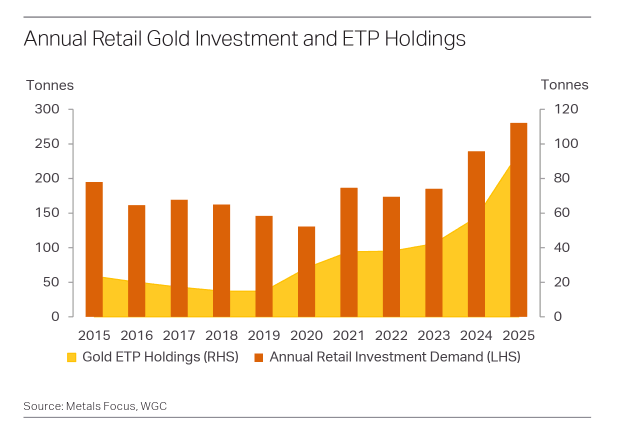
However, Metals Focus analysts don’t anticipate the rising popularity of ETFs to drive a decline in physical gold demand because there are plenty of Indians who prefer to hold bars, coins, and gold jewelry. Furthermore, a large percentage of the Indian population lives in rural areas that lack the technology infrastructure to support electronic investing. Around two-thirds of India’s gold demand comes from beyond the urban centers.
Instead of stealing from physical gold demand, it appears ETFs are merely adding to it.
To receive free commentary and analysis on the gold and silver markets, click here to be added to the Money Metals news service.
Author

Mike Maharrey
Money Metals Exchange
Mike Maharrey is a journalist and market analyst for MoneyMetals.com with over a decade of experience in precious metals. He holds a BS in accounting from the University of Kentucky and a BA in journalism from the University of South Florida.