GBP/USD Weekly Forecast: Pound struggles on persisting Dollar strength
- The BoE surprisingly keeps rates unchanged, adding pressure to the Pound.
- The US Dollar's trend remains firm after the FOMC, supported by US economic data.
- GBP/USD's upside potential comes only from a possible exhaustion of the downward momentum after several weeks of losses.

The GBP/USD pair posted its third consecutive weekly decline, continuing a bearish trend that began in mid-July. Since then, it has fallen from near 1.3100 to 1.2232, reaching the lowest level since March on Friday. The combination of a dovish Bank of England (BoE) and a hawkish pause from the Federal Reserve (Fed) has paved the way for further weakness in the pair.
UK economy gets a pause from the BoE
In a week full of central bank meetings, the Bank of England stole the headlines by not hiking interest rates. The central bank was expected to raise rates by 25 basis points (bps), but data released on Wednesday showed that UK inflation, as measured by the Consumer Price Index (CPI), fell to an annual rate of 6.7% in August, down from 6.8% in July, contrary to expectations of an increase to 7.2%. These numbers led to a change in the Monetary Policy Committee's decision. In a 5-4 vote against raising rates, the BoE kept borrowing costs unchanged, announced an acceleration in Quantitative Tightening, and kept the door open to further tightening.
Lower inflation and a central bank not raising rates further could be negative for the Pound in the short term but positive for the economy in the medium term. For such a scenario to benefit the Pound, encouraging activity data and improved confidence are needed.
Data released on Friday showed that the UK S&P Global/CIPS Manufacturing PMI rose from 43.0 to 44.2, surpassing expectations. However, the Services PMI declined more than expected to 47.2 from 49.5. The Manufacturing PMI reached the highest level in two months, while the Services PMI dropped to the lowest level in 32 months. Not the encouraging numbers investors were waiting for.
Fed pauses, keeps warning markets
The FOMC kept the Fed Funds rate unchanged as expected at the range of 5.25%-5.50%. In their projections, most members anticipate that further tightening may be appropriate before year-end. They also forecasted less easing for the next year compared to previous expectations.
Fed Chair Jerome Powell reiterated the message and tone of recent weeks, emphasizing that future rate hikes are still likely if inflation rebounds and the economy continues to perform well, particularly with a tight labor market.
The FOMC's projections led the market to interpret the meeting as hawkish, resulting in selling Treasury Bonds and buying the Dollar. While this didn't necessarily trigger a significant appreciation of the Greenback, it added fuel to the rally that has been occurring for over two months. Treasury 10-year yields reached their highest levels since 2007 on Thursday before retracing modestly.
Following the Fed meeting, data showed that the US labor market remains robust, with Initial and Continuing Jobless Claims reaching their lowest levels since January. On the negative side, housing data came in weaker than expected, and the Philly Fed Manufacturing index for September tumbled. However, these negative signs become less relevant when comparing US numbers to those of the UK.
A firm Dollar after central bank’s week
Fundamentally, the US Dollar continues to be favored as the US economy is in a stronger position than the UK’s. This week, the Pound's advantage with the BoE raising rates disappeared. The only factor at play within the current market conditions is how far the Dollar can go before it tires.
The US Dollar Index (DXY) is posting its tenth consecutive weekly gain, marking a record streak. While the length of the rally is noteworthy, its magnitude is not necessarily the most relevant aspect at this point. Although such a prolonged rise without a significant correction raises the possibility of a retracement, the fact that it has increased by just 5.80% during this period implies that the rally may still have further upside potential, or that any correction could be limited.
The week ahead
After a week filled with events and crucial economic data, the upcoming days are expected to be quieter. Market participants will continue to analyze the outcomes of the recent BoE and Fed meetings. The overall market sentiment will play a key role, particularly for the Pound, which could benefit from any improvement.
In the UK, the most relevant report will be the revised Q2 Gross Domestic Product (GDP) reading, which is scheduled for release on Friday. The preliminary reading in August showed a positive surprise, with market expectations of stagnation being surpassed by a 0.2% quarterly expansion. If the revision changes that number to negative, it could add further bearish pressure to the Pound.
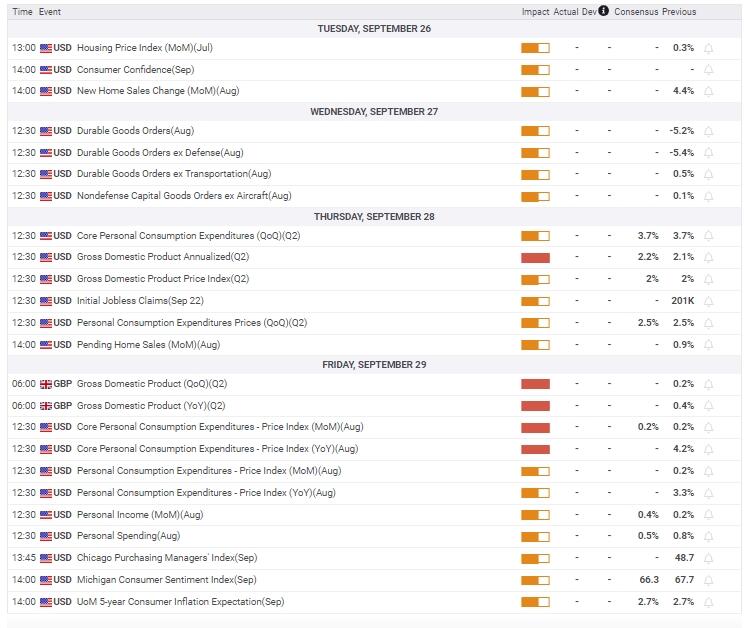
The US economic calendar for the next week includes the Chicago Fed National Activity Index for August on Monday, New Home Sales on Tuesday, Durable Goods Orders on Wednesday, Q2 GDP (third reading), Jobless Claims, and Pending Home Sales on Thursday, and Personal Income and Spending on Friday.
The crucial number to watch will be the Core Personal Consumption Expenditure (PCE) Price Index, which is the Fed's preferred consumer inflation measure and included in the Personal Income report. A monthly increase of 0.2% is expected in August. A reading hotter than expectations would likely trigger a rally in the US Dollar, as it would increase the likelihood of further tightening by the Fed. Conversely, a surprise below expectations could boost GBP/USD.
The US government is headed toward a potential shutdown in October. While this has happened before and does not imply a possible default on US debt, the longer it takes to return to normal, the more consequences it could have on the economy. A shutdown could also disrupt the release of US economic reports.
GBP/USD: Technical outlook
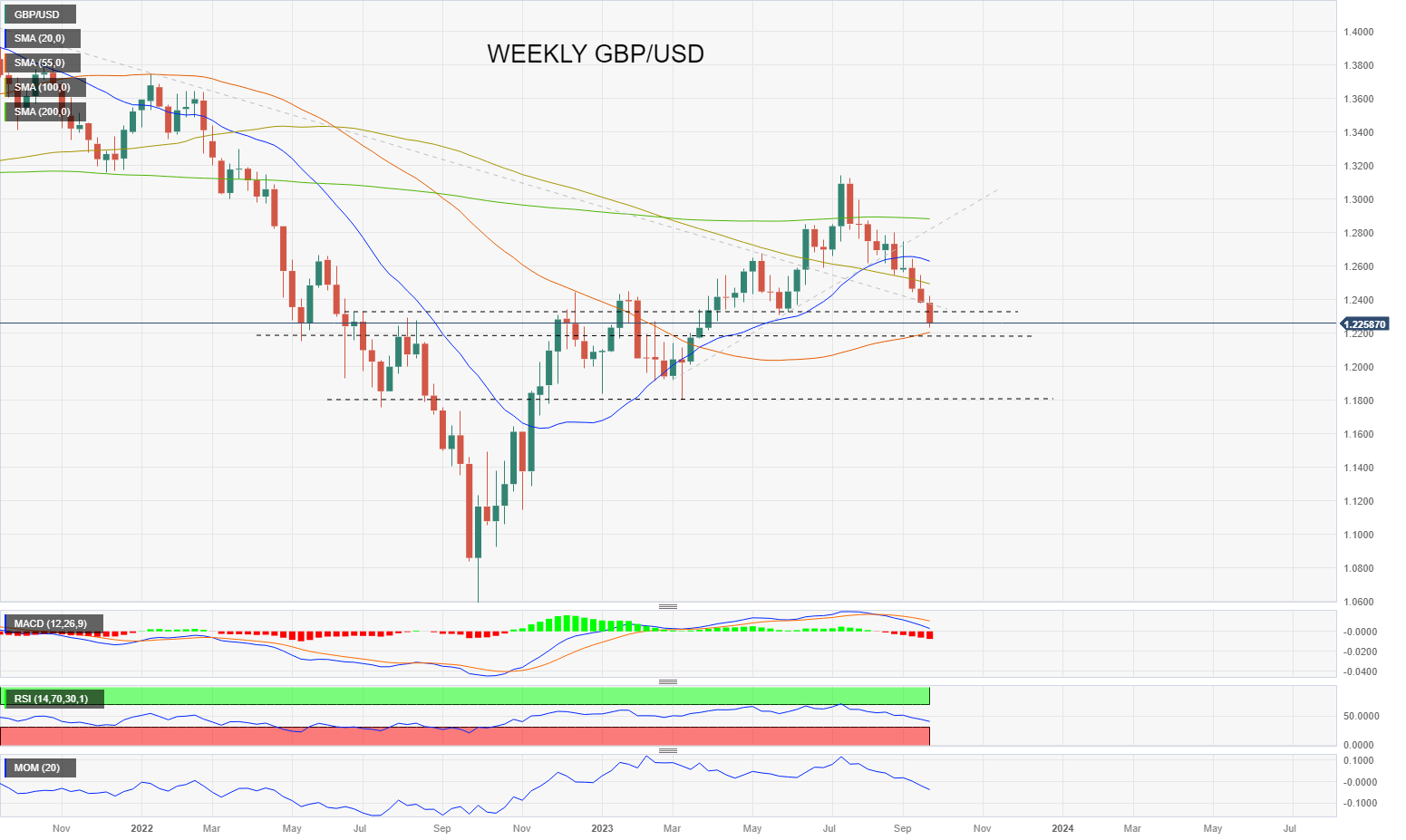
The GBP/USD pair approached the 200-day Simple Moving Average (SMA) twice during the week but resumed its downward movement. It broke below the 1.2350 support area and bottomed out at 1.2230, which is becoming a solid support level. However, the medium-term support is located around 1.2200, followed by 1.2130. Any upward moves in the coming days are likely to be seen as corrective.
For a potential shift in the bearish outlook to a neutral stance, a recovery above the 20-day SMA at 1.2490 and a trendline at 1.2520 would be needed.
On the weekly chart, GBP/USD is approaching the 1.2200 level, which aligns with the 55-week SMA. This convergence increases the odds of a rebound if that area is reached in the next sessions. However, it also warns of the potential for accelerated bearish momentum if the pair drops firmly below it. Technical indicators on the daily chart remain bearish, and even a modest recovery in the coming days is unlikely to change that configuration.
GBP/USD: Forecast poll
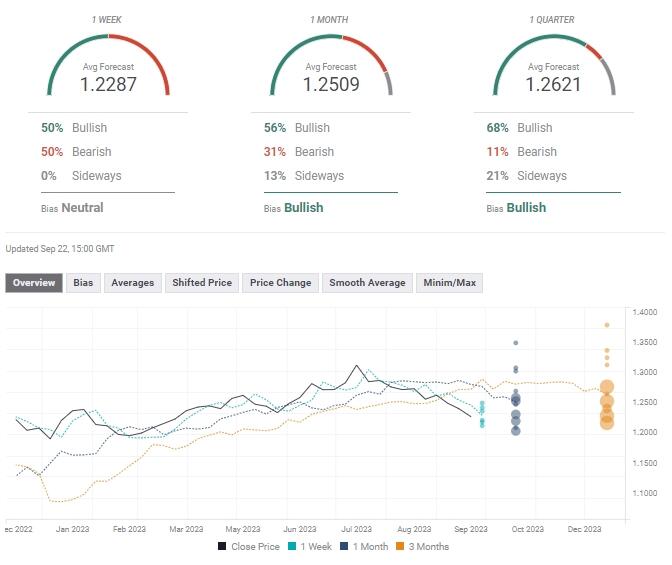
The FXStreet Forecast Poll suggests that experts anticipate the GBP/USD pair to be near a bottom and potentially undergo a recovery in the coming weeks. The one-week average is slightly below 1.2300. However, the recovery is expected to gather momentum, with predictions indicating that the pair may move above 1.2500 within a one-month timeframe. Looking ahead to the next quarter, the average forecast is bullish at 1.2620.
Author

Matías Salord
FXStreet
Matías started in financial markets in 2008, after graduating in Economics. He was trained in chart analysis and then became an educator. He also studied Journalism. He started writing analyses for specialized websites before joining FXStreet.