GBP/USD Weekly Forecast: Can UK data save the Pound?
- Key UK economic reports are due next week, including inflation and employment.
- The US will report Retail Sales, and the Fed will release the FOMC meeting minutes.
- GBP/USD risks are tilted to the downside, but a rebound seems likely if it holds above 1.2620.

The Pound dropped against the US Dollar for the fourth consecutive week, but it managed to hold above the lows seen in August and maintained the 1.2600 level. The GBP/USD was pushed lower by a stronger US Dollar. The UK GDP report presents optimism regarding next week's economic data, potentially supporting the Pound. In the US, following the release of inflation data, attention will shift towards the FOMC meeting minutes, Retail Sales, and Federal Reserve officials' comments.
Between US inflation and UK economic growth
The US Dollar was one of the top-performing currencies last week, benefiting from robust US fundamentals and cautious market sentiment. Wall Street and UK stock indices experienced limited movements during the week as they faced challenges surpassing their monthly highs.
The US economy appears to be the brighter spot among global powers. Data from China points to further weakening, while growth in Europe remains stagnant. This difference partially explains the positive momentum of the US Dollar.
Growth data from the United Kingdom showed that the economy avoided stagnation during the second quarter. The figures released on Friday exceeded expectations and provided a modest boost to the Pound. Gross Domestic Product (GDP) expanded by 0.2% during the second quarter, surpassing expectations of 0% and exceeding the 0.1% growth in the first quarter. June showed a growth rate of 0.5%, above the expected 0.2%, and recovered from the 0.1% contraction registered in May. The main contributor to June's GDP growth was Industrial Production, which expanded by 1.8%, surpassing the expected 0.1%.
The numbers align with the Bank of England (BoE) forecasts, indicating no recession ahead. However, economists warn that sustaining the rebound may become challenging amid rising headwinds. The market expects the BoE to raise rates by 25 basis points on September 21, with another hike seen in December.
Key numbers in the US were the inflation figures. The Consumer Price Index (CPI) rose 0.2% on a monthly basis in July, with the annual rate at 3.2%, above the previous month's 3% and slightly below market estimates of 3.3%. Despite showing the first acceleration in 13 months, the numbers did not raise concerns about an escalation in inflation, providing evidence that the disinflation process is still ongoing in the US. The US Producer Price Index (PPI) for July came in slightly higher than expected, with the index rising 0.3% on a monthly basis, and the annual rate rebounding from 0.2% to 0.8%, surpassing the market consensus of 0.7%.
The initial reaction to the US CPI numbers led to a temporary decline in the US Dollar. However, the Producer Price Index (PPI) supported the Greenback on Friday. The economy shows that if the Federal Reserve (Fed) wants to be even more aggressive in its monetary tightening, it can do so. Inflation figures support the view that the Fed will not raise interest rates further but did not weaken the US Dollar.
A key driver of the Dollar's strength was the rise in US Treasury yields during the week, with the 10-year yield increasing from under 4.00% to 4.15%. The Treasury concluded a busy auction week with decent demand. UK bond yields jumped on Friday after the release of UK GDP, with the 10-year Gilt rate reaching 4.50%, the highest level in almost a month.
Week ahead: FOMC minutes and UK inflation
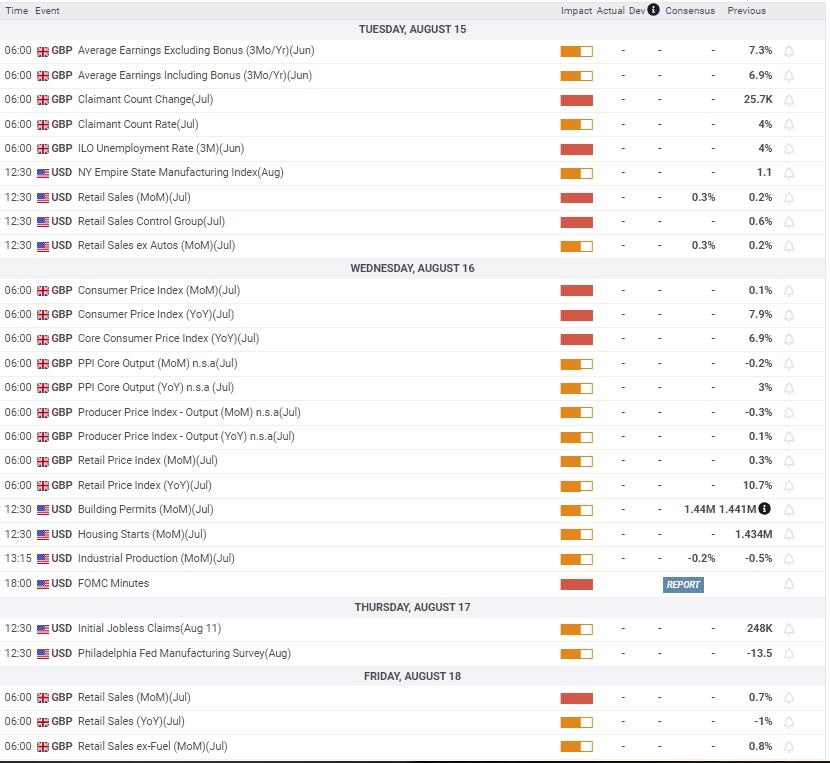
Next week in the UK, there are several relevant economic indicators that will be closely watched. On Tuesday, the UK will release the June employment report. Wage growth is expected to remain around 7% (year-over-year), and the Unemployment Rate is projected to be at 4%. A positive report in these areas would be supportive of the Pound.
On Wednesday, the UK will release the July inflation report, including the Consumer Price Index (CPI) and the Producer Price Index (PPI). The CPI is expected to show a significant decline in the annual rate from 7.9% to 7%, with the Core CPI rate falling marginally from 6.9% to 6.8%. Inflation figures will be closely scrutinized. An acceleration in inflation would be seen as a surprise and could boost the Pound. However, if the numbers come below expectations, it may not necessarily harm the Pound, as it could improve the economic outlook. Another important report in the UK will be the July Retail Sales, to be released on Friday.
Positive UK data has the potential to support the GBP/USD and end its weekly negative streak. Additionally, an increase in risk appetite could work in favor of the Pound. The market exhibits caution and mixed sentiment; an improvement could weaken the Greenback. Conversely, if sentiment deteriorates, the Pound will also suffer.
In the US, the data scheduled for release next week is not expected to impact Fed expectations significantly. The market sees that the Fed has reached its terminal rate, with underlying inflation showing signs of moderating and the labor market softening but not showing significant weakness. The most important will be the Federal Open Market Committee (FOMC) July meeting minutes when the Fed raised rates. It could have an impact, although the previous minutes did not provide new information. The debate among Fed members will be the focus. US Retail Sales, scheduled for Tuesday, will be relevant, and later in the week, the weekly Jobless Claims data will also be worth paying attention to. Market participants will listen carefully to comments from Fed officials ahead of the Jackson Hole symposium.
GBP/USD: Technical outlook
The weekly chart shows some positive signs despite presenting the fourth consecutive weekly decline. The pair remains above a trendline and the important 20-week Simple Moving Average (SMA) around 1.2620. However, technical indicators suggest that bearish risks are increasing, with the Relative Strength Index (RSI) heading south and Momentum about to drop below 100. The Pound needs to hold above the mentioned SMA to limit losses. If it fails to do so, it could trigger an acceleration to the downside. On the contrary, if the Pound holds above, it could stage a recovery with critical resistance seen at the 1.2860 – 1.2880 area.
On the daily chart, the GBP/USD maintains a bearish bias, although it has been consolidating around 1.2750 during the last week. The price remains well below a bearish 20-day Simple Moving Average, with the 100-day SMA waiting at 1.2615.
A decisive break above 1.2830 would set the Pound to a more robust rebound, potentially changing the short-term bias to bullish. To the downside, there is strong support around the 1.2600 area. A break below this level would open the door for a deeper slide, potentially targeting 1.2450 as the next medium-term support level.
-638273642204942245.png)
GBP/USD: Forecast poll
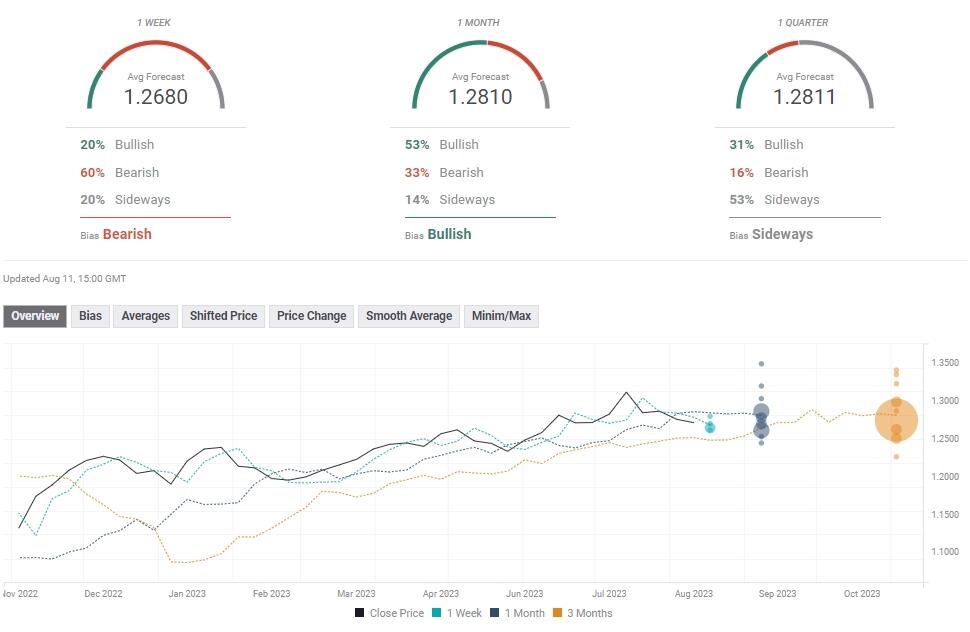
The FXStreet Forecast Poll indicates a mild bullish bias in the short term, as the one-week average target aligns slightly below 1.2800. The one-month outlook has shown improvement compared to last week, with several experts predicting the pair to move above 1.2800. The average forecast for the next quarter remains relatively neutral, with the average not deviating far from 1.2800.
Author

Matías Salord
FXStreet
Matías started in financial markets in 2008, after graduating in Economics. He was trained in chart analysis and then became an educator. He also studied Journalism. He started writing analyses for specialized websites before joining FXStreet.