GBP/USD Forecast: Recovery to remain limited unless 1.2000 resistance fails
- GBP/USD has regained its traction following Thursday's decline.
- The pair needs to flip 1.2000 into support to attract additional buyers.
- Eyes on Fedspeak and February ISM Services PMI data from the US.

GBP/USD has managed to stage an upward correction during the Asian trading hours on Friday and continued to edge higher toward 1.2000 in the early European morning. The pair needs to flip that level into support to attract buyers and extend its rebound.
After the data from the US revealed on Thursday that Unit Labor Costs rose by 3.2% in the fourth quarter, the benchmark 10-year US Treasury bond yield climbed to its highest level since early November above 4% and provided a boost to the US Dollar. In the late American session, however, Atlanta Fed President Raphael Bostic's cautious comments on policy tightening helped the market mood improve and limited the USD's upside, allowing GBP/USD to find support.
Bostic voiced his support for a 25 basis points (bps) rate hike in March and said that they could be in a position to pause the tightening cycle by mid-to-late summer. Bostic will speak again later in the day. Richmond Fed President Thomas Barkin and Fed Governor Michelle Bowman are also scheduled to deliver speeches. In case these policymakers push back against the idea of a 50 bps rate increase being on the table at the next policy meeting, the USD could stay on the back foot ahead of the weekend.
The US economic docket will feature the ISM Services PMI report. The Fed is concerned about wage growth feeding into high inflation in the service sector. Hence, market participants will be paying close attention to the inflation component of the survey, the Prices Paid sub-index.
In February, the Prices Paid Index is forecast to decline to 64.5 from 67.8 in January. Such a print would show that input inflation continued to rise, albeit at a slightly softer pace than it did in January. In case this component arrives near or above the January print, the USD could gather strength with the initial reaction and vice versa.
It's also worth noting that if the headline ISM Services PMI drops below unexpectedly, recession fears could dominate the market action and make it difficult for the USD to find demand.
Meanwhile, DUP leader Sir Jeffrey Donaldson said the decision on whether to support British Prime Minister Rishi Sunak's new Brexit agreement will be “collective”. Several news outlets reported that the DUP is likely to take around two weeks to present their opinion. The uncertainty surrounding the new Northern Ireland deal proposal could cause investors to refrain from betting on a persistent Pound Sterling strength.
GBP/USD Technical Analysis
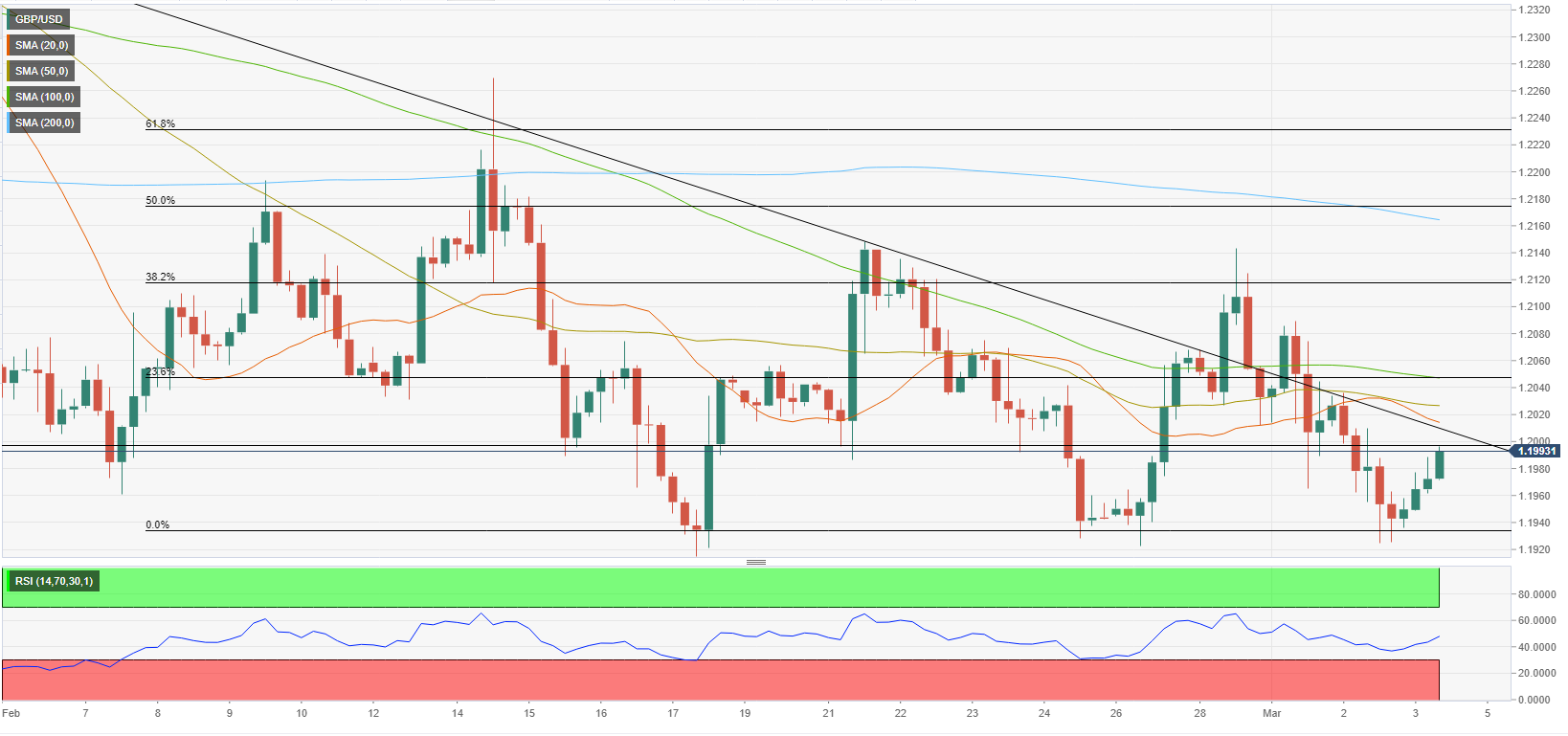
The descending trend line coming from early February, reinforced by the 20-period Simple Moving Average (SMA) on the four-hour chart, forms stiff resistance at around 1.2000. Once the pair stabilizes above that level, it could target 1.2050 (Fibonacci 23.6% retracement of the latest downtrend, 100-period SMA) and 1.2100 (psychological level, static level).
On the downside, 1.1960 (100-day SMA) aligns as key support before 1.1940 (end-point of the latest downtrend). A daily close below this level could attract sellers and trigger a leg lower toward 1.1900 (psychological level, static level) and 1.1840 (January 6 low).
Author

Eren Sengezer
FXStreet
As an economist at heart, Eren Sengezer specializes in the assessment of the short-term and long-term impacts of macroeconomic data, central bank policies and political developments on financial assets.