EUR/USD Price Forecast: Outlook remains positive above 1.1650
- EUR/USD struggles to regain convincing upside traction above 1.1800 on Monday.
- The US Dollar trims losses but remains on the defensive post-SCOTUS ruling.
- Germany’s Business Climate improved marginally in February, IFO said.

EUR/USD now seems to have moved into a consolidative phase following the pair’s inability to clear the February highs north of 1.1900 the figure, somewhat stabilising around or just below the 1.1800 region. As long as the key 200-day SMA near 1.1650 holds the downside, further gains should remain in the pipeline.
Monday’s late recovery in the US Dollar (USD) threatens the positive performance of EUR/USD and the rest of the risk complex.
Indeed, as market participants continue to digest Friday’s SCOTUS ruling against President Trump’s global tariffs, the Greenback seems to have been brought to life, trimming earlier losses and prompting EUR/USD to abandon the area of daily peaks in the 1.1840-1.1830 band and return to the sub-1.1800 zone.
In the current context, the US Dollar Index (DXY) trades with modest losses in the 97.60 region, building on Friday’s retracement although still flirting with the upper end of the monthly range.
Fed: steady hands, softer edges
The Federal Reserve (Fed) left the Fed Funds Target Range (FFTR) unchanged at 3.50% to 3.75% at its late January meeting. No surprises. Markets were fully positioned for a hold.
What shifted, subtly but meaningfully, was the tone.
Indeed, policymakers sounded more at ease with the current state of the economy. Growth is holding up better than many feared, and crucially, the Federal Open Market Committee (FOMC) no longer sees employment risks as deteriorating. Inflation is still described as somewhat elevated, but the urgency has clearly eased.
The vote passed 10 to 2, with two dissenters favouring a 25 quarter point cut. That split is important. It tells you that while the centre of gravity is steady, the internal debate has not disappeared.
At the press conference, Chair Jerome Powell struck a measured note. Policy, in his view, is in a good place. Decisions remain strictly meeting by meeting, with no preset path. He downplayed recent inflation surprises, attributing much of the overshoot to tariffs, and reiterated that services disinflation continues to make progress. Just as important, no one on the Committee is treating a rate hike as the base case.
The message was clear. Confidence has improved, but there is no rush.
The January Minutes reinforced that picture. Most participants backed holding steady. Several indicated that further easing would likely be appropriate if inflation declines as expected, while others warned that hikes could still be warranted if price pressures prove sticky. Inflation is seen drifting back toward 2%, but not in a straight line.
With growth solid and the labour market stabilising, the Fed remains firmly data dependent, not leaning decisively toward aggressive cuts.
ECB: calm, consistent, unhurried
The European Central Bank (ECB) also left its three key rates unchanged in a unanimous and widely expected decision.
The communication felt steady, almost rehearsed. The medium-term outlook still points to inflation returning to the 2% target, and recent data have not materially altered that view. Wage indicators appear to be stabilising, although services inflation remains under scrutiny. The ECB still anticipates a modest dip in consumer prices in 2026, reinforcing the argument for patience.
At her press conference, President Christine Lagarde described risks as broadly balanced. Policy remains agile and data dependent. The Governing Council acknowledged recent foreign exchange moves but judged them to be within historical norms, reiterating that there is no exchange rate target.
In short, the ECB is not on autopilot, but it is not in a hurry either.
Markets are pricing around 8 basis points of easing this year and broadly expect another hold at the March 19 meeting.
Euro positioning: conviction on both sides
Positioning in the Euro (EUR) is becoming more intense.
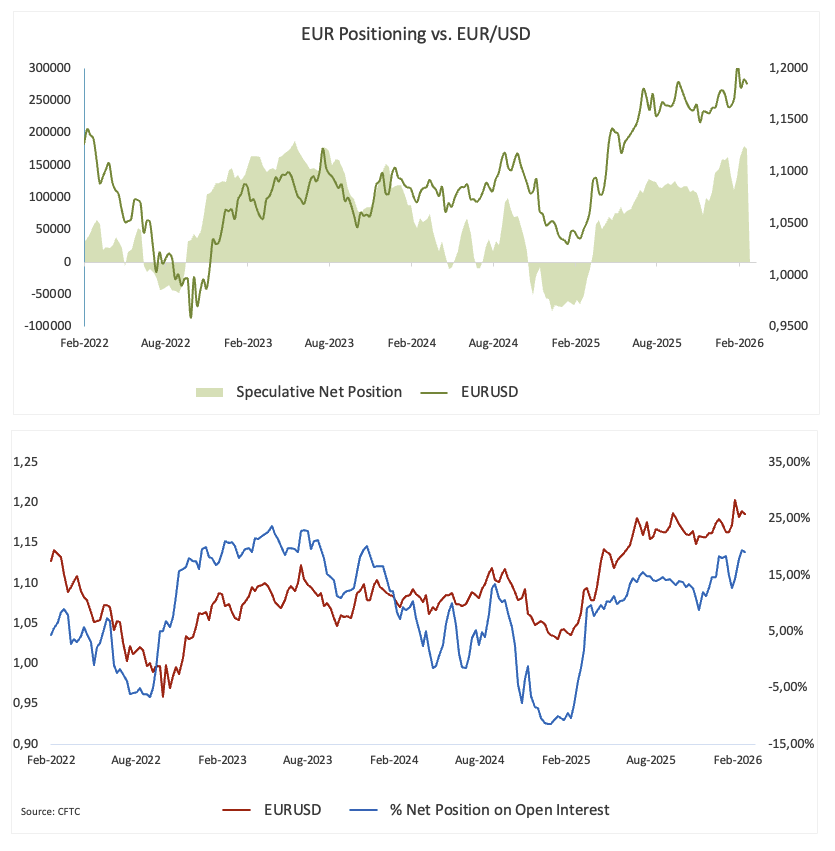
The latest Commodity Futures Trading Commission (CFTC) data show speculative net longs climbed to nearly 174.5K contracts in the week to February 17, the highest level since September 2020. On the surface, that looks like a strong vote of confidence in the single currency.
But the picture is more nuanced.
Hedge funds and other institutional accounts have also increased short exposure, pushing it to around 235.8K contracts, the highest since May 2023. When both longs and shorts rise together, it usually signals rising conviction on both sides, not a simple bullish extension.
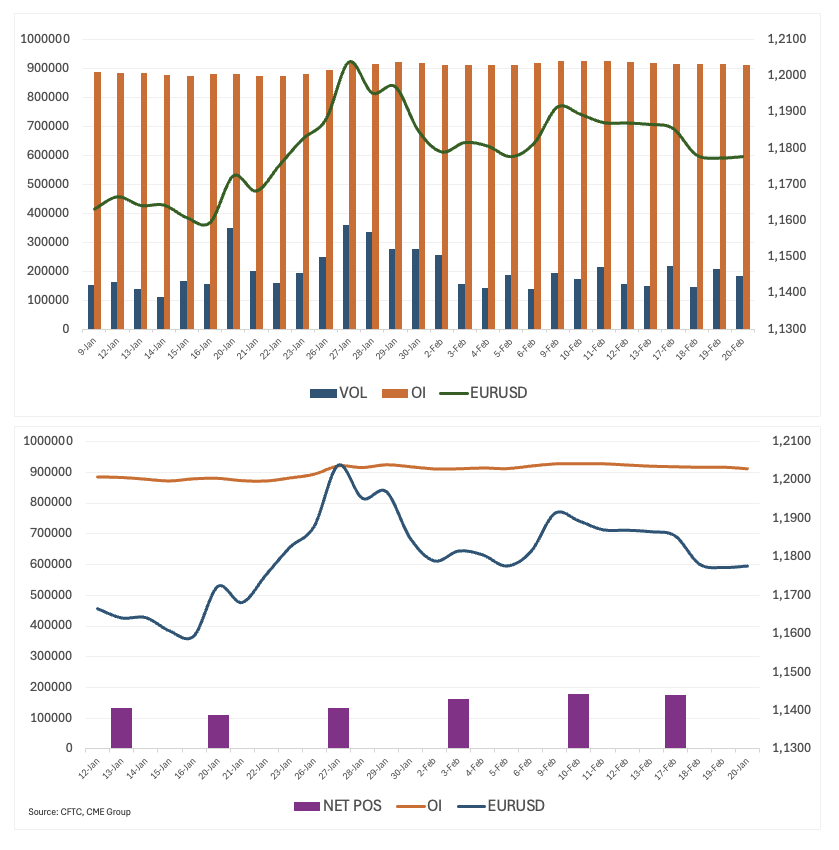
Open interest has eased slightly to roughly 916.8K contracts, just below previous record highs. That suggests this is not a thin or fragile move. It is a genuine tug of war. Bulls see structural upside. Bears see vulnerability.
In that kind of environment, moves can extend, but reversals can be sharp if the narrative shifts.
What it means for EUR/USD
Net positioning still favours the Euro (EUR), but the build up in opposing shorts makes the path higher more complicated. The trade is more crowded, more sensitive, and more reactive to incoming macro catalysts.
What’s next
Near term: the US Dollar remains the dominant driver. Labour market data, inflation releases and geopolitical headlines are likely to dictate the tempo. The immediate calendar is light, with the weekly US jobless claims in focus, though comments from Fed officials could easily steal attention.
Risks: a Fed that stays cautious for longer continues to underpin the Greenback, particularly against an ECB that is effectively in wait and see mode. From a technical perspective, a decisive break below the 200 day Simple Moving Average (SMA) would raise the probability of a deeper corrective phase.
Technical corner
In the daily chart, EUR/USD trades at 1.1797. The 55-day Simple Moving Average (SMA) advances above the 100- and 200-day SMAs, with all three sloping higher to reinforce a bullish bias. Price holds above these averages, keeping buyers in control in the near term. The Relative Strength Index (14) sits at 48.6 (neutral), edging higher and suggesting momentum is stabilising.
Immediate resistance aligns at 1.2082, followed by 1.2266. Support is seen at 1.1766, then at 1.1578. A topside clearance of the first barrier would open the path toward the next cap, while a close below initial support would risk a deeper pullback within the broader uptrend structure.
(The technical analysis of this story was written with the help of an AI tool.)
Bottom line
EUR/USD right now is being driven far more by the US narrative than by developments in the euro area.
With the Fed’s 2026 rate path still lacking clarity and the euro area yet to deliver a convincing cyclical rebound, upside progress is likely to remain gradual rather than morphing into a clean, sustained breakout.
For now, it is a Dollar story first, Euro story second.
Euro FAQs
The Euro is the currency for the 20 European Union countries that belong to the Eurozone. It is the second most heavily traded currency in the world behind the US Dollar. In 2022, it accounted for 31% of all foreign exchange transactions, with an average daily turnover of over $2.2 trillion a day. EUR/USD is the most heavily traded currency pair in the world, accounting for an estimated 30% off all transactions, followed by EUR/JPY (4%), EUR/GBP (3%) and EUR/AUD (2%).
The European Central Bank (ECB) in Frankfurt, Germany, is the reserve bank for the Eurozone. The ECB sets interest rates and manages monetary policy. The ECB’s primary mandate is to maintain price stability, which means either controlling inflation or stimulating growth. Its primary tool is the raising or lowering of interest rates. Relatively high interest rates – or the expectation of higher rates – will usually benefit the Euro and vice versa. The ECB Governing Council makes monetary policy decisions at meetings held eight times a year. Decisions are made by heads of the Eurozone national banks and six permanent members, including the President of the ECB, Christine Lagarde.
Eurozone inflation data, measured by the Harmonized Index of Consumer Prices (HICP), is an important econometric for the Euro. If inflation rises more than expected, especially if above the ECB’s 2% target, it obliges the ECB to raise interest rates to bring it back under control. Relatively high interest rates compared to its counterparts will usually benefit the Euro, as it makes the region more attractive as a place for global investors to park their money.
Data releases gauge the health of the economy and can impact on the Euro. Indicators such as GDP, Manufacturing and Services PMIs, employment, and consumer sentiment surveys can all influence the direction of the single currency. A strong economy is good for the Euro. Not only does it attract more foreign investment but it may encourage the ECB to put up interest rates, which will directly strengthen the Euro. Otherwise, if economic data is weak, the Euro is likely to fall. Economic data for the four largest economies in the euro area (Germany, France, Italy and Spain) are especially significant, as they account for 75% of the Eurozone’s economy.
Another significant data release for the Euro is the Trade Balance. This indicator measures the difference between what a country earns from its exports and what it spends on imports over a given period. If a country produces highly sought after exports then its currency will gain in value purely from the extra demand created from foreign buyers seeking to purchase these goods. Therefore, a positive net Trade Balance strengthens a currency and vice versa for a negative balance.
Author

Pablo Piovano
FXStreet
Born and bred in Argentina, Pablo has been carrying on with his passion for FX markets and trading since his first college years.

















