Indian Gold demand robust in india in January as prices scaled new highs


Investment continues to drive strong gold demand in India, driving prices to a premium in January.
India ranks as the second-largest gold market in the world.
The gold price continued to scale new highs in the new year. The yellow metal eclipsed all-time highs 12 times last month and topped $5,400 an ounce before sharply correcting in late January.
In rupee terms, gold set a record of ₹175,231 per 10 grams. The rising gold price, coupled with a weakening rupee, drove the local gold price up 24 percent as of the end of January.
Premiums grew as wide as $80 an ounce in January due to expectations of an import duty hike. When the tax didn’t materialize, premiums moderated.
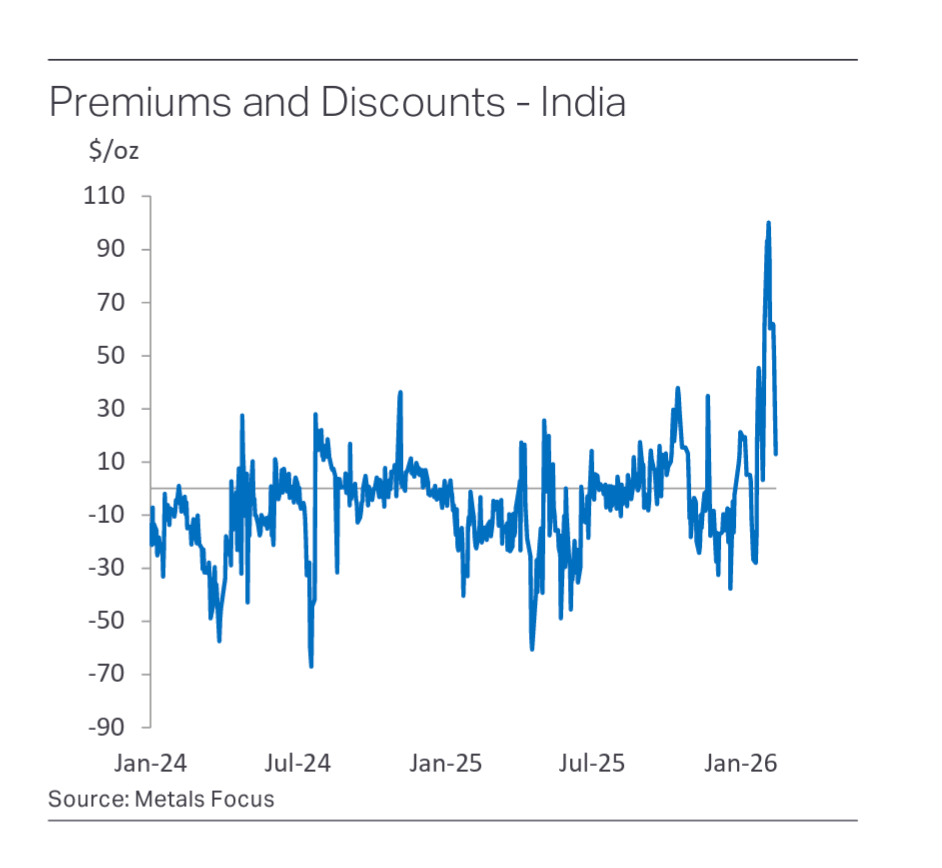
Prices cooled into early February, falling by around 7 percent with the correction and some strengthening of the Indian currency.
The premium also flipped to a discount on February 11 as it became clear there wasn’t going to be a significant rise in import duties, and local gold supplies increased.
Investment demand surging
Investment demand continues to lead the way in India, as the jewelry market struggles with headwinds due to higher prices.
Demand for gold ETFs continues to surge. India-based funds reported record gold inflows, holdings, assets under management (AUM), and investor participation.
Indian ETFs charted their ninth straight month of gold inflows, totaling ₹240 billion ($2.5 billion). That drove AUM to a new high of ₹1.8 trillion. AUM by Indian-based gold funds has more than tripled on a year-over-year basis.
In tonnage terms, Indian ETFs added another 15.5 tonnes in January, pushing cumulative gold holdings over 100 tonnes for the first time at 110 tonnes.
The World Gold Council estimates another 3 tonnes of gold flowed into Indian ETFs in the first 12 days of February.
Notably, inflows into gold ETFs eclipsed inflows into Indian equities for the first time. According to the World Gold Council, this could indicate “evolving preference in investor asset allocation.”
WGC analysts say gold ETFs now account for 2.3 percent of the total mutual fund industry AUM in India. That represents the highest share on record, up substantially from 0.8 percent just one year ago.
Investor participation also grew in January with gold ETFs reporting another 1.2 million accounts. That drove the total number of gold ETF folios to 11.4 million.
Indians have historically preferred physical gold, but interest in ETFs has swelled in the last year.
A gold ETF is backed by a trust company that holds metal owned and stored by the trust. In most cases, investing in an ETF does not entitle you to any amount of physical gold. You own a share of the ETF, not gold itself. ETFs are a convenient way for investors to play the gold market, but owning ETF shares is not the same as holding physical gold.
Anecdotal evidence suggests physical gold investment also remains robust. As the World Gold Council summed it up, “Feedback from physical market participants suggests that consumer demand has remained resilient following the inauspicious period (mid-December to mid-January), despite record-high gold prices and elevated volatility, with buying skewed towards investment products.”
World Gold Council analysts say price gains have reinforced bullish sentiment among Indian investors, and there are “limited expectations of meaningful correction.” It has also attracted new buyers “across age groups,” with price dips triggering buying.
“Investment demand for bars and coins continues to hold firm, with some participants indicating a potential shift in allocation from capital markets to gold. Meanwhile, liquidation activity remains limited, reflecting confidence among holders that prices are unlikely to see a sharp correction.”
Unlike Western markets, where selling has been robust, liquidation has been moderate in the Indian market, with investors holding onto their metal, expecting additional price gains.
Indian gold jewelry demand is described as “measured,” with consumers staggering accumulation instead of buying with lump-sum purchases. The World Gold Council estimates jewelry demand is down about 20 percent in volume. However, with the higher prices, the value of purchases is up 25 to 30 percent.
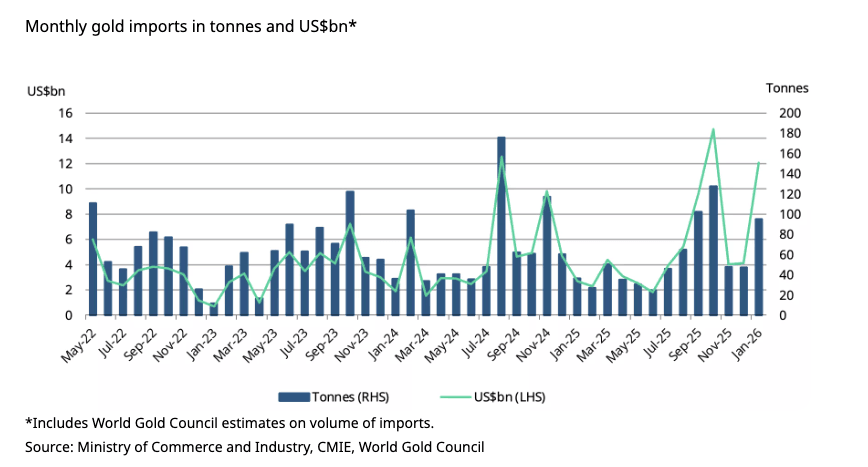
Gold imports last month reflected strong demand, rising to a 3-month high of 95 to 100 tonnes.
The surge in gold prices drove the import value up 192 percent month-on-month at $12.1 billion.
India's love affair with Gold
Indians love gold for both cultural and economic reasons.
The yellow metal is deeply interwoven into India’s marriage ceremonies, along with its religious and cultural rituals. Festival seasons typically boost gold demand.
Indians also value the yellow metal as a store of wealth, especially in poorer rural regions. Around two-thirds of India’s gold demand comes from beyond the urban centers, where large numbers of people operate outside the tax system. Many Indians use gold jewelry not only as an adornment but as a way to preserve wealth.
In the West, gold is generally viewed as a luxury item.
Not in India. Even poor Indians buy gold.
According to a 2018 ICE360 survey, one in every two households in India had purchased gold within the last five years. Overall, 87 percent of Indian households own some gold. Even households at the lowest income levels in India hold some of the yellow metal. According to the survey, more than 75 percent of families in the bottom 10 percent of income managed to buy some gold.
The yellow metal was a lifeline for Indians buffeted by the economic storm caused by the government's response to COVID-19. After the Indian government locked down the country, banks tightened credit to mitigate the default risk. Unable to secure traditional loans, Indians used gold to secure financing. As Indians endured a second wave of lockdowns, many Indians resorted to selling gold outright to make ends meet.
To receive free commentary and analysis on the gold and silver markets, click here to be added to the Money Metals news service.
Author
Mike Maharrey
Money Metals Exchange
Mike Maharrey is a journalist and market analyst for MoneyMetals.com with over a decade of experience in precious metals. He holds a BS in accounting from the University of Kentucky and a BA in journalism from the University of South Florida.