|

GBP/USD analysis: bears tested the key 1.3000 support

GBP/USD Current price: 1.3063

  • UK inflation remained steady at 2.4% in June, reducing chances of an August rate hike.
  • UK Retail Sales expected to have advanced modestly in June.
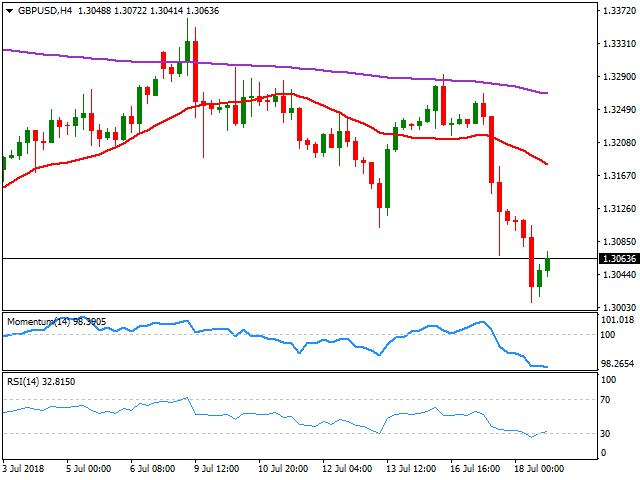
The GBP/USD pair fell to a new 2018 low of 1.3009, as broad dollar's strength coupled with steady UK inflation, which reduces chances of an interest rate hike in August. According to the official release, yearly inflation remained unchanged at 2.4% in June, with the core reading shrinking to 1.9% from the previous 2.1%, also below the expected 2.2%. The Retail Sales price index was up 0.3%, below the previous and the expected 0.4%. The UK will release June Retail Sales this Thursday, seen up 0.4% in the month, while the core reading is expected to post a modest 0.3% advance MoM. An easing dollar helped the pair bounce from the mentioned low, now at around 1.3060. Despite there were no fresh Brexit-related headlines, the negative sentiment triggered by the political woes that shaken the kingdom these days, continue to undermine the Pound. The 4 hours chart for the pair shows that it's currently oversold, with the Momentum maintaining its bearish strength but the RSI aiming to recover ground at 32, anyway indicating that selling interest remains strong. The 20 SMA in the mentioned chart gains downward strength well above the current level, and below an also bearish 200 EMA, which also favor the downside. The 1.3000 level is a major psychological support and won't be easy to break, yet if it finally gives up,  the pair could easily lose another 100 pips.

Support levels: 1.3035 1.3000 1.2970

Resistance levels: 1.3080 1.3120 1.3155    

View Live Chart for the GBP/USD

Author

Valeria Bednarik

Valeria Bednarik was born and lives in Buenos Aires, Argentina. Her passion for math and numbers pushed her into studying economics in her younger years.


More from Valeria Bednarik
Share:

Editor's Picks

AUD/USD stuck as the RBA talks tough into a slowdown

The Australian Dollar is going nowhere in a hurry, and the contradiction at its core explains why. The Reserve Bank of Australia keeps dangling the prospect of another hike, yet the economy it governs just expanded 0.3% in the first quarter, a clear step down from the prior pace. A central bank threatening to tighten into a visible slowdown is not a recipe for conviction in either direction, and the tape shows it.

USD/JPY: Japanese Yen coiled at the line, leaning on everyone but Japan

The Yen is doing very little, and that stasis is the whole story. USD/JPY sits glued near 160.00 not because Japan has found new strength, but because two outside forces are fighting to a draw over it: a US rate complex that keeps the dollar bid, and a Ministry of Finance that refuses to let the line break.

Gold declines below $4,500 on stalled US-Iran ceasefire talks, US NFP data looms

Gold price edges lower to near $4,470 during the early Asian session on Friday. The precious metal remains volatile amid ongoing geopolitical turmoil. Traders will closely monitor the developments surrounding the US-Iran peace deal and the US May employment report later on Friday. 


DeFi hack losses drop 80% from 2022 peak as security defenses improve — Immunefi

Losses from decentralized finance exploits have fallen by 80% since reaching a record high in 2022, according to a report released by Immunefi. The report, which analyzed exploit-driven losses across major blockchain ecosystems between 2020 and 2025, found that DeFi protocol losses declined from $2.62 billion in 2022 to $534 million in 2024.

Nonfarm payrolls: Testing the limits of Fed policy patience

The upcoming nonfarm payrolls report for May will provide the final update on the US labor market before Kevin Warsh attends his first policy meeting as the new Fed Chair later this month.

Recession on paper: What really moves the Canadian Loonie now?

Statistics Canada handed the headline writers a gift and the analysts a headache. Real GDP shrank 0.1% on an annualized basis in the first quarter, and with the fourth quarter of 2025 revised down to a 1.0% contraction, that is two negative quarters in a row, the textbook definition of a technical recession and Canada's first since the pandemic.















