|

GBP/USD analysis: agreement on softer Brexit pushed the Pound higher

GBP/USD Current price: 1.3286

  • UK Cabinet came to an agreement on a softer Brexit strategy on future trade relationship.
  • USD weakness added to GBP/USD short-term bullish case, 1.3310 region now key.
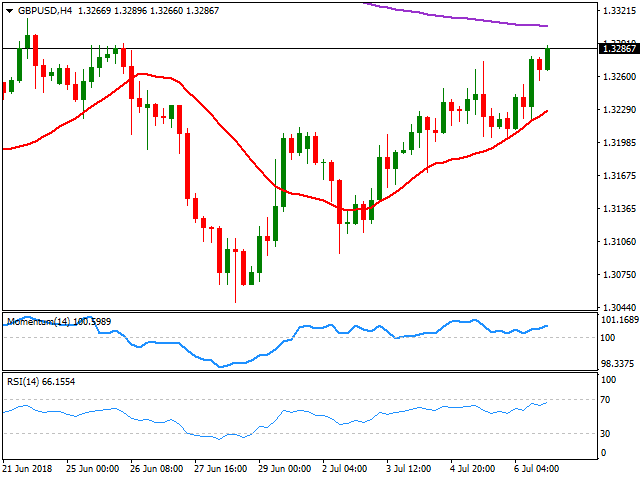
The GBP/USD pair closed the week with gains at 1.3286, just a handful of pips below the previous week's high, with the Pound finding demand on the back of better-than-expected UK data released through the week and a softer dollar, dumped on fears that the trade war will end up hurting US economic growth. Late Friday, news indicated that the UK Cabinet agreed with PM May's plan about the future trade relationship with the EU, an agreement that contemplates creating a free trade area for industrial and agricultural goods, "regulatory flexibility" for trade in services, and a "mobility framework" which will ensure citizens from both regions can continue to travel to each other's territories and apply for study and work. Boris Johnson strongly disagreed with the plan, saying that it would leave the UK as a "vassal state," among other strong comments. Indeed, the proposal from Mrs. May points for a softer-Brexit that needs yet the approval of the EU officers. The pair has been unable to clearly advance beyond 1.3300 for the last three weeks, and bulls could feel encouraged on a break above the level, although the pair should sustain gains beyond 1.3450 to actually enter bullish territory. Readings in the daily chart favor additional gains, as the pair ended well above a mild bearish 20 SMA, while technical indicators head north within positive territory, at their highest since last April. In the 4 hours chart, a bullish 20 SMA keeps leading the way higher, attracting buyers on intraday pullbacks, while technical indicators also maintain their bullish slopes, but below this month highs. The 200 EMA in this last time frame comes at 1.3310, while a relevant high is located at 1.3314, making of the 1.3310 an immediate and strong resistance.

Support levels: 1.3250 1.3210 1.3170

Resistance levels:  1.3315 1.3350 1.3390

View Live Chart for the GBP/USD

Author

Valeria Bednarik

Valeria Bednarik was born and lives in Buenos Aires, Argentina. Her passion for math and numbers pushed her into studying economics in her younger years.


More from Valeria Bednarik
Share:

Editor's Picks

AUD/USD looks weaker, focus is back to 0.7100

AUD/USD reverses Tuesday’s gains and retreats markedly toward four-day troughs in the low 0.7100s ahead of the opening bell in Asia. The firmer tone in the Greenback weighs on the risk complex amid unabated tensions on the US-Iran front, prompting the Aussie to shed part of recent gains and refocus on the downside. Moving forward, Australian trade balance results should entertain investors early on Thursday.

Japanese Yen bounces up from lows after Japan PM Takaichi’s intervention warnings

The Japanese Yen bounced up from five-week lows against the US Dollar, turning positive on the daily chart, as Japan’s Prime Minister Sanae Takaichi warned that Tokyo is ready to take action against Yen weakness. The USD/JPY pair has pulled back from the 160.00 level, considered a line in the sand for Japanese authorities, to hit session lows at 159.55.

Gold slumps to near $4,450 as strong US jobs data reinforce higher-rate bets

Gold price falls to around $4,450 during the early Asian session on Thursday. The precious metal attracts some sellers amid rising expectations that the US Federal Reserve will raise interest rates this year.


Grayscale launches Hyperliquid staking ETF, undercutting rival fees

Grayscale announced the launch of its Hyperliquid Staking ETF on Wednesday, now trading on Nasdaq. The fund offers investors direct exposure to HYPE and incorporates staking rewards, which the company claims have historically ranged from 2.2% to 2.3% annually. "HYPG represents an opportunity to provide efficient exposure to HYPE in an ETP wrapper," Grayscale noted on its website.

The upside-down math of debt
In 2010, Professors Carmen Reinhart and Kenneth Rogoff published a paper, Growth in a Time of Debt, which instantly went viral. The main thesis of the paper was that once a government's debt-to-GDP ratio crosses above 90%, a financial crisis and default are around the corner.
Recession on paper: What really moves the Canadian Loonie now?

Statistics Canada handed the headline writers a gift and the analysts a headache. Real GDP shrank 0.1% on an annualized basis in the first quarter, and with the fourth quarter of 2025 revised down to a 1.0% contraction, that is two negative quarters in a row, the textbook definition of a technical recession and Canada's first since the pandemic.