G7 energy pact: The new map of strategic reserves

The Group of Seven has quietly redrawn the global energy map. In the late-October ministerial meeting, the G7 advanced a coordinated plan to strengthen oil and gas reserves, reduce exposure to Russian supply chains, and reinforce transatlantic cooperation. Behind the careful phrasing sits a structural shift: strategic energy management is back at the core of Western policy.
From market logic to security logic
The joint statement dated 29 ottobre 2025 speaks of shared resilience built through infrastructure and stockpiling, yet the meaning goes deeper. Energy security is no longer left to price signals alone, it is being engineered. Storage capacity, swap lines, and flexible logistics are treated as policy tools, not just costs on a balance sheet.
The West is rebuilding a safety net that in the 1970s answered producer embargoes, now adapted to a fragmented world. Instead of one dominant cartel, policymakers face multiple shocks: Middle East flare-ups, Arctic shipping risks, Indo-Pacific chokepoints, climate variability. The G7’s answer is to smooth those shocks before they propagate into inflation and growth.
The transatlantic triangle
At the centre stands the transatlantic triangle: United States, European Union, United Kingdom. Priorities differ, conclusions converge. Washington wants export flexibility and protection from gasoline pressure at home, Europe seeks diversification after the abrupt detachment from Russian gas, London leverages its role as financial and trading hub. The common thread is simple: energy must remain a controlled variable.
The United States, now above 13,4 milioni di barili al giorno, acts as global balancer in crude and LNG. Despite export strength, it still relies on imported grades for refining mix and remains politically sensitive to retail fuel above 3,50 $ per gallone. That duality explains why Washington supports coordinated storage, emergency swap lines, and adaptable LNG scheduling.
Europe has turned emergency assets into a backbone. Floating regas units from Spain to Poland, extra cavern storage in Germany and the Netherlands, north–south and east–west pipeline reversals: what began as crisis improvisation is being consolidated into a permanent reserve network. Brussels aims to turn this patchwork into a structured system with inventory targets, shared access rules, and transparent release protocols.
The United Kingdom positions itself between physical barrels and financial pricing. Clearing houses, brokers, and trading desks provide liquidity, while access to continental and US reserves adds a physical anchor. In a world where credibility matters as much as flow, that combination is valuable.
A new geography of influence
Control is no longer measured only by barrels pumped, but by the ability to store, move, and release them on command. Influence comes from managing stability rather than creating scarcity. Energy policy begins to resemble monetary policy: reserves, signalling, and timing shape expectations as much as actual supply.
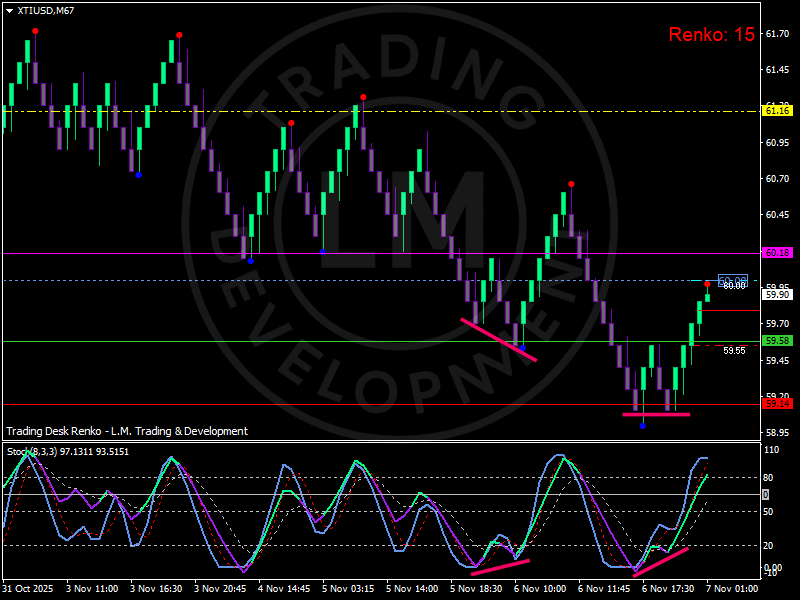
Prices reflect this discipline. WTI trades around 59,90 $, inside a corridor that mirrors strategic balance rather than panic. Each dip attracts controlled buying, each rally meets quiet profit-taking. Volatility itself is being treated as a policy variable, managed by coordination, messaging, and when needed small calibrated releases.
Technical picture and price rhythm
On the Renko chart, the pattern is consistent with that narrative. The latest recovery from 59,20 $ follows a double bullish divergence on the stochastic oscillator, with higher lows confirming demand near the lower boundary. Resistance sits at 60,10–61,20 $, while support remains defined at 59,00–59,20 $. The sequence of white bricks is measured, not euphoric, typical of institutional repositioning rather than speculative spikes.
For traders, this alignment between technical rhythm and policy rhythm matters. Structure tells you where conviction breaks, policy tells you when it may be tested. When ministers pre-commit to coordination, the market infers a soft ceiling on volatility, and positioning adapts. Energy begins to trade less like a raw commodity and more like a macro asset with a managed risk premium.
Policy and market implications
Supply insurance replaces cheap supply as the priority. Carry costs rise, but the political cost of disorder is higher. Infrastructure becomes policy: LNG terminals, storage caverns, and pipeline interconnectors are treated as strategic utilities that extend diplomacy by other means. Communication becomes a tool: regular updates on inventory, shipping, and capacity keep expectations anchored.
Coordination is not friction-free. Fiscal differences inside the G7 create uneven ability to finance storage, subsidies, or capacity additions. Domestic politics can intrude, particularly if US priorities shift in 2026. Europe must balance market integration with national control over critical assets. The UK mediates between physical and financial worlds while adapting to post-Brexit regulatory settings. The credibility of the pact will depend on transparency, equitable access, and predictable triggers for releases.
Global repercussions
Emerging economies will feel the ripple effects. India, Brazil, and Southeast Asia previously benefited from discounted barrels and flexible Russian or Middle Eastern flows. As G7 stockpiles absorb part of future imbalances, benchmarks may become firmer in tight episodes. Hedging costs could rise during stress, while optionality in physical procurement becomes more valuable. This is not a return to closed blocs, it is the segmentation of a once uniform market into zones of managed resilience.
Energy transition and portfolio view
The initiative reframes the energy transition. Renewables and electrification remain the goal, yet their integration depends on fossil stability during the build-out. Batteries, hydrogen, and grids cannot scale on schedule if fuel markets are erratic. By coordinating oil and gas reserves, the G7 is in effect buying time for the transition to mature, smoothing the path rather than abandoning it.
For portfolio construction, the message is clear. Oil trades with a lower tail risk when reserves are credible, but with a firmer floor when demand shocks hit. Gas behaves as a regional asset with global backstops, where storage and shipping set the cadence of seasonal swings. Energy equities may see lower beta to headlines and higher sensitivity to infrastructure cash flows. Macro assets linked to inflation carry, such as break-evens, could react more to policy signals than to one-off supply scares.
The broader takeaway
The G7 is formalising a model of managed energy capitalism. Open markets continue, but under a canopy of coordinated control. The aim is not to fix prices, it is to reduce the amplitude of shocks that bleed into inflation, confidence, and growth. In that environment, traders adapt: they pay more attention to storage data, LNG scheduling, shipping routes, and ministerial calendars, because those inputs now carry as much signal as weekly inventories.
Energy has returned to its role as a cornerstone of confidence. It is no longer just a set of contracts, it is part of the architecture that holds together policy, markets, and growth. The October statement made that architecture explicit. The price action since then has treated it as credible.
On the chart, the rhythm is slow and deliberate, like the policy behind it. Brick by brick, the market is learning to price stability, not just scarcity. And for once, the technicals and the geopolitics are telling the same story: energy will be managed, because predictability is now the most valuable fuel.
Author
Luca Mattei
LM Trading & Development
Luca Mattei is a market analyst focusing on FX, metals, and macroeconomic trends. He develops trading tools for retail and professional traders, coding indicators and EAs for MT4/MT5 and strategies in Pine Script for TradingView.