Fed Preview: Is the bar higher for hiking? Powell's may down the dollar, three things to watch
- The Federal Reserve is set to leave interest rates unchanged in its last meeting of the year.
- Hints about policy in 2020 via the dot plot and other tools are set to moves.
- Comments about the bank will react to incoming data are also of importance.

The Federal Reserve is bracing for a quiet Christmas – but markets are set to rock even if the world's most powerful central bank sits on its hands.
After cutting rates in the past three meetings, the Fed is set to leave them unchanged in its last meeting of the year. It signaled a pause, and Jerome Powell, Chairman of the Federal Reserve, recently said he sees the economy as "more than a glass-half-full."
His comments may have been based on a bounce in investment – as reflected by the recent Durable Goods Orders report. That has been one of the worrying signs. Powell is probably pleased with the upturn of the housing market – which has benefited from the Fed's looser policy. Sales of new homes and prices are rising at a satisfactory pace.
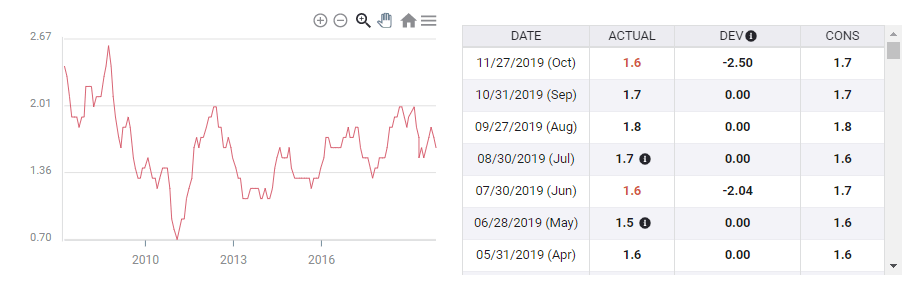
However, since he made those remarks, ISM's forward-looking Purchasing Managers' Indexes have missed expectations, pointing to slower growth in the services sector – and an ongoing contraction in the manufacturing one. Moreover, the rise in inflation has reversed course, with the Core Personal Consumption Expenditure (Core PCE) – the Fed's preferred gauge – slipping to 1.6% annually. The bank's target is 2%.
Core PCE has last exceeded 2% in 2008:
And while the labor market – the bank's second mandate alongside inflation – is creating jobs at a healthy clip, wage growth has stagnated.
Markets will likely look beyond the "on hold" decision, which is fully priced in, and gauge the Fed's policy in 2020. Bond markets are pricing in a rate cut in the second half of 2020, and these projections might be brought forward or pushed back – impacting the dollar.
The greenback will take its cue from these three things:
1) New forecasts
The bank publishes new forecasts for growth, employment, inflation, and, most importantly – interest rates. Minor changes are likely – but any tweak may result in outsized market moves.
The Fed's so-called "dot-plot" provides guidance, even if the Washington-based institution tries to play down its importance. A minor downgrade in rate projections, taking the October cut into account, is probably priced in. A deeper cut in expectations may send the greenback down, while leaving 2020 expectations unchanged may send it higher.
Here are the most recent projections, from September 2019:
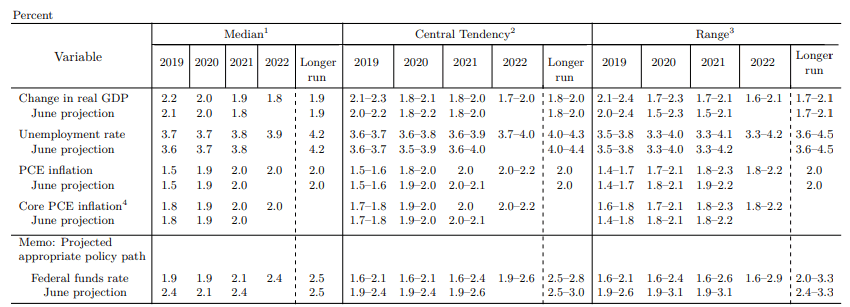
Source: Federal Reserve
Throughout the year, markets were ahead of the Fed in forecasting rate cuts, and they may extend this trend now.
2) Economic assessment
Comments about the inflation and employment – the Fed's dual mandate – are of interest. Also, the Fed's opinion about trade – that will be probably be left out of the statement but in Powell's comments may also stir markets.
Investors will initially compare December's statement with the one released in October. Small semantic changes, such as replacing "modest" to "moderate" or "strong" to "solid" concerning the economy, labor market, and inflation, may all make waves.
Later on, Powell's description of the current situation – whether using his glass metaphor or another one – will also have its say in affecting currencies.
3) Reaction function
Perhaps the most critical point is how Powell describes the bank's reaction function – how it will shift from sitting on its hands to changing interest rates. All central banks say they are data-dependent, but they tend to respond differently to incoming information.
Back in October, the Fed Chair said that a material reassessment of the outlook would trigger a rate cut. However, for the Fed to raise rates, a change in future projections is insufficient to raise prices. Powell said that only after inflation rises substantially, will he consider raising rates.
That means the bar for cutting rates is lower than for hiking them.
If he confirms this notion, the dollar may suffer as markets may begin pricing a rate cut more aggressively. However, if Powell dismisses it as a misunderstanding, the greenback has room to rise.
Conclusion
While the Fed likely to leave rates unchanged in its December 2019 meeting, clues about future moves, coming from the dot plot, the description of the economy, and the reaction function are set to rock markets.
More US recession? Not so fast, a calm look at the economy and currencies ahead of the NFP
Author

Yohay Elam
FXStreet
Yohay is in Forex since 2008 when he founded Forex Crunch, a blog crafted in his free time that turned into a fully-fledged currency website later sold to Finixio.