All eyes on US employment: Why today's jobs data could move markets


In what is traditionally a quiet period in the financial markets, we have a barrage of event risk to sink our teeth into this week, largely kicking off with today’s US November jobs report.
Markets in review: A cautious prelude
Monday's trading session concluded with major US equity benchmarks settling modestly lower, as market participants adopted a watchful stance ahead of today's jobs report. The S&P 500 shed 0.2% to 6,816, with the Dow Jones Industrial Average down 0.1% to 48,416, and the Nasdaq 100 falling 0.5% to 25,067.
In terms of US Treasuries, we were relatively stable across the curve yesterday, though the USD Index concluded the session on the back foot, with technicals suggesting further underperformance to 97.72-ish.
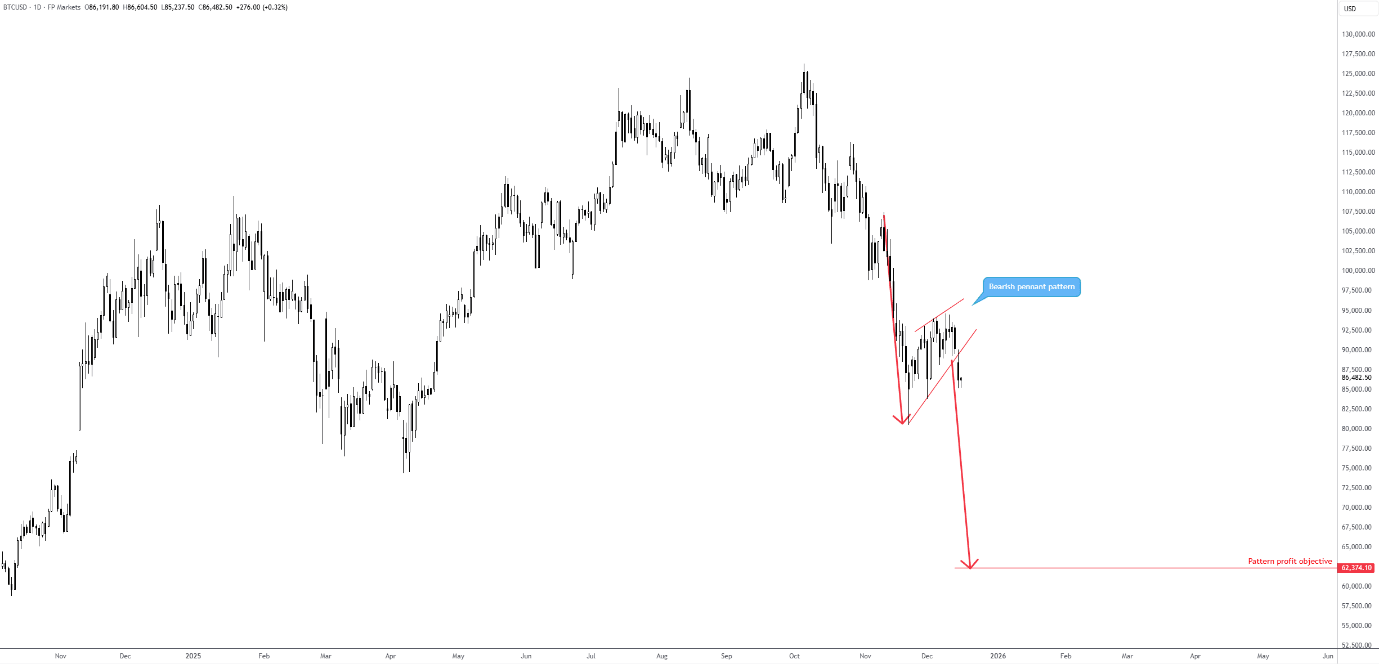
In the Crypto space, further underperformance was also seen. The last couple of months have been quite incredible for Cryptocurrencies. Think back to just October when BTC/USD was above US$125,000 – we are now down more than 30% to around US$86,000 amid liquidity concerns and softening risk sentiment. The FP Markets research team noted that daily price action on BTC/USD recently broke below the lower boundary of a bearish pennant pattern, extending from the high (low) of US$93,050 (US$80,540). Chart pattern enthusiasts will now likely look to aim at the formation’s profit objective of US$62,374.
US jobs report day: What's at stake?
The record-long US government shutdown that concluded in November caused several delays in official data, resulting in today’s jobs report combining October and November figures. The estimate range is broad, from 150,000 to -20,000 – suggesting analysts are unsure – with the median at around 50,000 jobs, down from 119,000 in September.
Interestingly, the distribution of estimates (LSEG) shows only a couple of economists expecting a negative print, leaving the door open to a possible – tradeable – surprise. As a result, a negative number today would likely lead to lower yields and a sell-off in the USD.
If unemployment ticks higher than expected – the median value suggests unemployment to remain unchanged at 4.4% – this would likely add weight to USD downside. The Fed’s latest SEP projected unemployment at 4.5%, with a gradual decline to 4.4% next year. Consequently, anything north of 4.5% today would be considered a surprise!
In the week-ahead post, I noted that the question for many now is the pace of Fed easing next year. If the jobs data comes in lower than expected, investors could increase Fed rate-cut bets for March (currently 50/50 [-13 bps]), with April then fully priced for a -25 bp reduction. All of this, of course, would be USD negative.
Author
Aaron Hill
FP Markets
After completing his Bachelor’s degree in English and Creative Writing in the UK, and subsequently spending a handful of years teaching English as a foreign language teacher around Asia, Aaron was introduced to financial trading,