EURUSD Weekly Forecast: Nonfarm Payrolls report triggers dramatic market reaction in the Fed aftermath
- The US Federal Reserve surprised financial markets by sticking to the aggressive monetary policy path.
- The US employment sector proved resilience, and optimism triggered a US Dollar sell-off.
- EURUSD regained the 0.9900 level and hints at a tough battle around parity coming next.

The EURUSD pair plummeted to 0.9729 on Thursday, finishing the week marginally lower above the 0.9900 threshold. The United States Federal Reserve (Fed) unexpectedly boosted the US Dollar mid-week by surprising market players with a hawkish monetary policy stance. Fed Chair Jerome Powell cooled expectations of a slowing pace of tightening and reaffirmed the aggressive path the central bank has adopted this year.
US Federal Reserve not near to giving up
The Federal Reserve policymakers lifted rates by 75 bps, although the statement suggested they may start slowing the pace of quantitative tightening. “In determining the pace of future increases in the target range, the Federal Open Market Committee (FOMC) will take into account the cumulative tightening of monetary policy, the lags with which monetary policy affects economic activity and inflation, and economic and financial developments.” EURUSD rallied on the news as market players rushed to sell the US Dollar.
However, Chair Jerome Powell came out with quite a hawkish speech and signaled that rate hikes are here to stay. “We are nowhere near a pause,” he said within the press conference, triggering a dramatic U-turn in financial markets. The American Dollar soared to fresh weekly highs while Wall Street plunged. At the same time, US Treasury yields soared to fresh multi-year highs, particularly those at the shorter end of the curve.
European recession being ignored
European Central Bank (ECB) President Christine Lagarde, on the other hand, maintained a more conservative stance. Speaking at different events, she mentioned possible additional action to prevent inflation from becoming entrenched and noted that a recession would not be sufficient to stem prices. Christine Lagarde added that inflation expectations are broadly anchored at the moment, though. Finally, she said that European policymakers have to “be attentive to spill-overs from the Fed policy.”
Mrs Lagarde seems to be ignoring the European Union is in a recessive spiral that keeps accelerating and maintaining the Euro below parity vs the US Dollar. Nevertheless, EU and German macroeconomic figures keep indicating that the economic contraction steepens month after month. Just as a reference, the EU Gross Domestic Product (GDP) posted a measly 0.2% quarterly growth rate in the third quarter of the year.
Dramatic reaction to Nonfarm Payrolls
EURUSD changed course once again on Friday following the release of the US Nonfarm Payrolls (NFP) report. The country added 261,000 new jobs in October, while the September figure was upwardly revised to 315,000. At the same time, the Unemployment Rate increased to 3.7% from 3.5%, while the Labor Force Participation Rate inched lower to 62.2% from 62.3%. Finally, Average Hourly Earnings declined to 4.7%, as anticipated. The generally encouraging figures boosted demand for high-yielding assets, with Wall Street further recovering after Wednesday’s collapse and backing the Euro. EURUSD trimmed most of its weekly losses and hovers around the 0.9920 area.
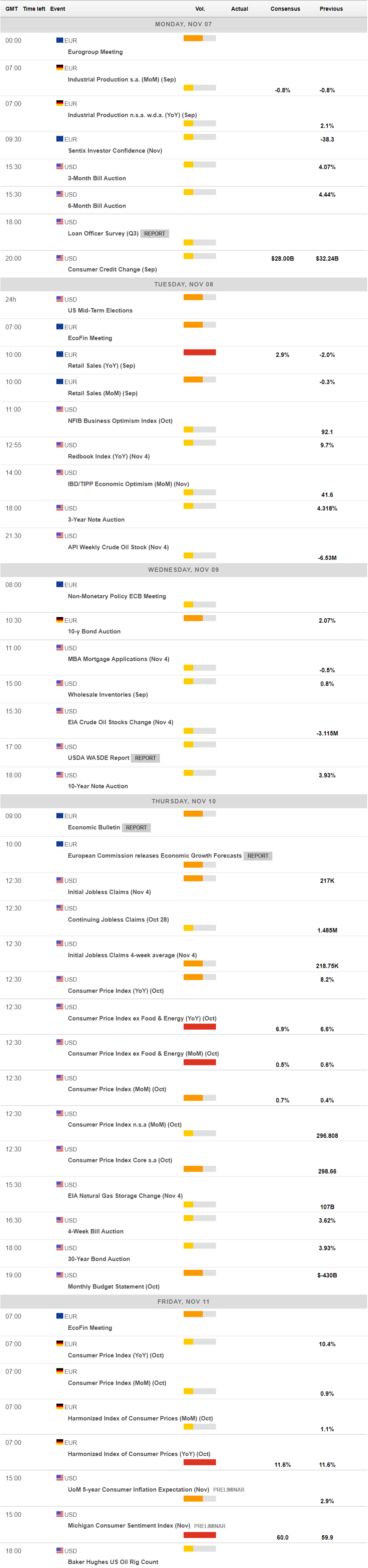
The upcoming week will be lighter regarding data releases, with some interesting figures coming from the European Union. The region will publish September Retail Sales, while the European Commission will publish its Economic Growth Forecasts. By the end of the week, Germany will publish the final readings of its October Harmonized Index of Consumer Prices.
The United States will publish on Thursday the October Consumer Price Index (CPI), with the core reading expected to have accelerated to 6.9% from 6.6%. The country will later release the preliminary estimate of the November Michigan Consumer Sentiment Index, foreseen ticking higher from the current 59.9 to 60.
EURUSD technical outlook
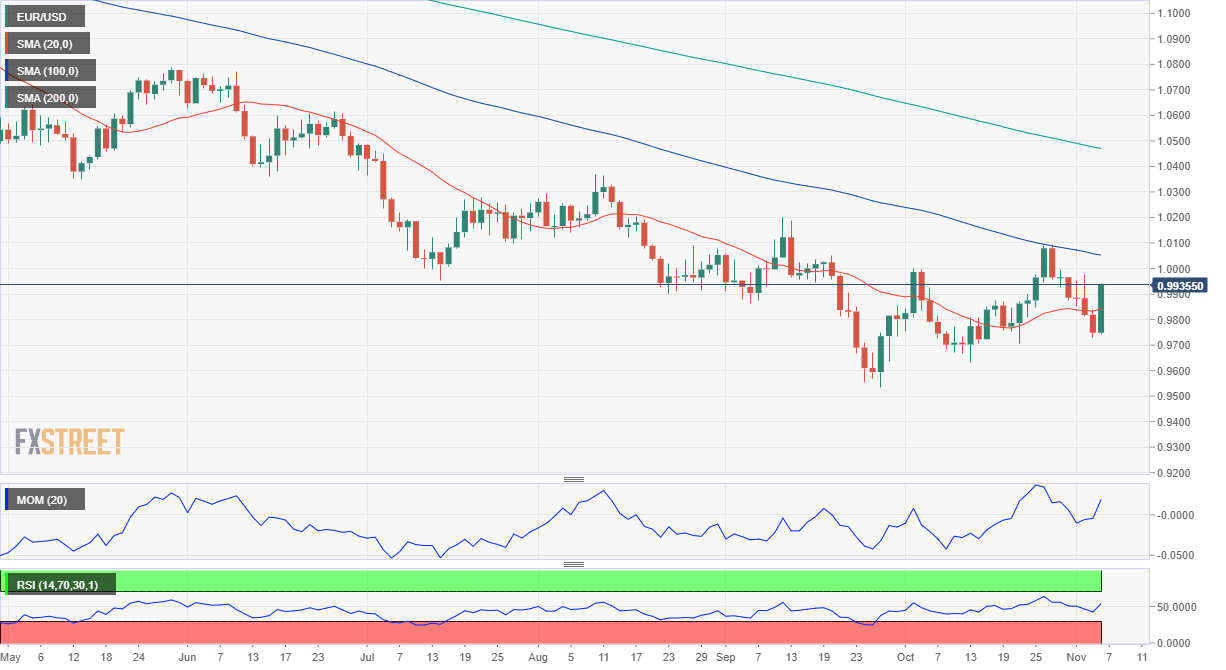
The EURUSD pair has spent the week below parity and posted a lower low and a lower high, a sign that bears are back. Profit-taking ahead of the weekend helped the pair to bounce on Friday, but the dominant bearish trend remains firmly in place.
The weekly chart shows that the pair keeps trading below a firmly bearish 20 Simple Moving Average (SMA), which remains way below the longer ones. At the same time, the 100 SMA is crossing below the 200 SMA, both at around 1.1270. Finally, technical indicators have resumed their declines within negative levels, skewing the risk to the downside.
In the daily chart, on the other hand, a bearish continuation is in doubt. The EURUSD pair recovered above a directionless 20 SMA, which provides immediate support at around 0.9830, and seems poised to extend its recovery towards the next relevant dynamic resistance level, a bearish 100 SMA currently at around 1.0050. Meanwhile, the Momentum indicator is turning marginally higher within neutral levels, while the Relative Strength Index (RSI) has picked up upward momentum and hovers around 53.
Strong resistance comes at parity first, followed by the mentioned daily 100 SMA, currently at around 1.0050. The next level to watch is 1.0088, October's monthly high. The first support level is 0.9870, followed by the 0.9790 price zone. Below the latter, EURUSD can extend its decline towards the 0.9700/20 price zone.
EURUSD sentiment poll
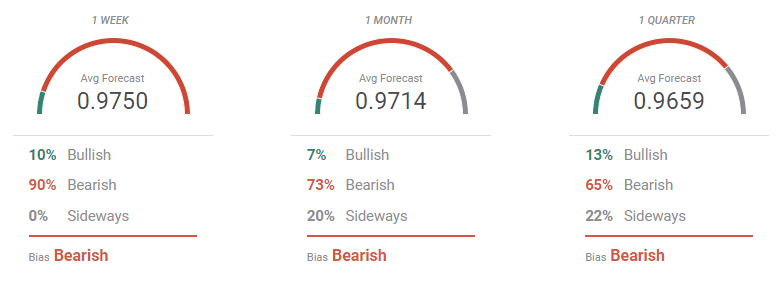
According to the FXStreet Forecast Poll, the EURUSD pair is set to keep falling, as the Nonfarm Payroll report dollar’s sell-off left bets kilter. In the weekly chart, 90% of the polled experts are looking for a lower-than-current level. Bears maintain the lead in the monthly and quarterly views but decrease to 73% and 65%, respectively. On average, the pair is seen at 0.9659 at the longer end of the range.
The Overview chart shows that most potential targets are between 0.9400 and 0.9900 in the three time-frame under study. Moving averages offer neutral-to-bearish slopes, suggesting that selling interest remains high. Looking into the distribution, a corrective advance seems more likely in a month, while the bearish trend resumes in the longer view. About the latter, some polled experts are looking for advances beyond parity, but the majority concentrates on the year’s low.
Author

Valeria Bednarik
FXStreet
Valeria Bednarik was born and lives in Buenos Aires, Argentina. Her passion for math and numbers pushed her into studying economics in her younger years.
















