Eurozone inflation preview: Highest core CPI since 2013 may send EUR/USD higher
- Preliminary inflation figures for December 2019 are set to show healthy price development.
- A 0.1% increase in core inflation would send it to the highest in over six years.
- EUR/USD bias is to the upside leading into the event.

Mario may be like Moses – former European Central Bank President Mario Draghi fought to raise inflation but may see it from afar – just like the biblical character's journey to the promised land.
Nevertheless, EUR/USD trading goes on without the bank's previous leader, and bulls may have a chance.
Economists expect preliminary eurozone Consumer Price Index for December to accelerate from 1% to 1.3% yearly – mostly driven by higher energy prices. While the ECB officially targets headline inflation, the focus has been shifting toward Core CPI in recent years.
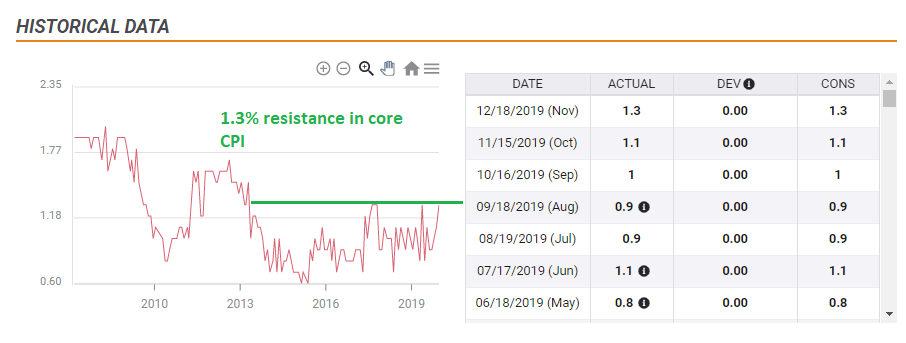
And with underlying inflation, expectations are modest – maintaining 1.3% annually – but there are chances for an upside surprise. French CPI beat expectations with 0.4% monthly, and German CPI surpassed estimates with 0.5%. While these figures refer to headline inflation, underlying prices may have picked up as well.
November 2019's 1.3% annual increase in Core CPI matched that seen in May last year. However, an acceleration to 1.4% would already send price action to the highest level since March 2013 – over six years ago. And that could already boost the euro.
Christine Lagarde, Draghi's successor at the helm of the ECB, left the bank's policy unchanged in her first rate decision and announced a strategic review. While the Frankfurt-based institution is looking for a new direction, an increase in prices may encourage it to opt for a more hawkish policy. A change – even if only in tone – from the extremely dovish sentiment that Draghi led, would also lead to unleashing EUR/USD potential.
EUR/USD positioning and three scenarios
EUR/USD is well-positioned into the January 7 release. The final Services Purchasing Managers' Indexes from the old continent beat expectations while the US ISM Manufacturing PMI missed estimates – hitting the lowest levels since 2009.
Moreover, the dollar has been unable to hold onto its safe-haven flows following the killing of top Iranian general Qassem Suleimani. After an initial demand, the greenback gave back its ground. Overall, the bias is bullish for EUR/USD.
Here are three scenarios:
1) Upside surprise: While some market participants have noted the beat in German and French figures, hitting the highest core inflation levels since 2013 with 1.4% or 1.5% would still be substantial. Adding the bullish bias, and EUR/USD could gain substantial ground. The probability is high.
2) No surprises: An "as expected" 1.3% scenario is unlikely to trigger an immediate response, and markets may refocus on other developments. However, given the positive trend, the currency pair may gradually extend its gains. The probability is medium.
3) Downside surprise, EUR/USD: If core inflation slips to 1.2% or 1.1% despite the early data, euro/dollar will likely react adversely to the disappointment. Nevertheless, the reaction could be somewhat muted. The probability is low.
Conclusion
The initial inflation read for the eurozone for December may beat expectations and trigger an upside move, extending the positive trend. If core CPI hits expectations at 1.3%, there is more for minor advance, while the unlikely disappointment could send it lower.
Author

Yohay Elam
FXStreet
Yohay is in Forex since 2008 when he founded Forex Crunch, a blog crafted in his free time that turned into a fully-fledged currency website later sold to Finixio.















