EUR/USD Weekly Forecast: US Gross Domestic Product and the ECB taking center stage
- The European Central Bank will announce its monetary policy decision next Thursday.
- Fresh US and German Gross Domestic Products coming up hint at a volatile week for EUR/USD.
- EUR/USD’s bearish stance hinting at fresh multi-year lows below 0.9500.


The EUR/USD pair extended its consolidative phase for a third consecutive week, settling at around 0.9790 on Friday. As usual, it was all about the American Dollar and whether speculative interest decided to buy or sell the USD.
A sense of optimism maintained the greenback under selling pressure on Monday, helping EUR/USD to reach a weekly high of 0.9875. Wall Street rallied amid confidence the United State economy will maintain its resilience to the global crisis, while government bond yields -usually reflecting growth and inflation concerns- remained stable.
Skyrocketing Consumer Price Index
Things began changing on Wednesday when the United Kingdom, the European Union and Canada posted updates on inflation. The figures were pretty discouraging as the Consumer Price Index in most major economies held at multi-year highs, despite the aggressive measures taken by central banks. The EU Consumer Price Index was confirmed at 9.9% YoY in September, while the core reading held at 4.8%, as previously estimated. Monetary policy tightening around the world has bolstered the chances of a global recession while doing little to tame stubbornly high inflation.
Record CPIs mean central banks, and particularly the US Federal Reserve, would keep raising interest rates until inflation comes down to more comfortable levels. Hence, market players rushed to price in an economic setback. Stocks plunged, while US Treasury bond yields soared to levels that were last seen in 2008. The monetary policy-sensitive 2-year note gave as much as 4.63%, while the 10-year note yield peaked at 4.29%. The curve has been inverted for over three months, reflecting investors’ concerns about economic growth
The American dollar soared with the news, putting pressure on EUR/USD which trimmed early weekly gains. The risk-off mood will likely extend into the upcoming days, as there are no signs the current macro picture will improve anytime soon.
Europe is facing more trouble than the US
Meanwhile, the Euro zone keeps battling with energy prices. The war started by Russia has put EU leaders on their toes ahead of the winter. The European Council had another meeting on Friday, but once again, they were unable to find a consensus on capping gas prices. Nevertheless, European Commission President Ursula von der Leyen said they were able to establish a "solid roadmap to keep on working on the topic of energy prices."
Data-wise, the macroeconomic calendar was light. Nevertheless, the deterioration of business confidence is notorious. The German ZEW Survey showed that Business Confidence plummeted in the country while remaining subdued in the whole Union. Also, the EU Consumer Confidence collapsed to -30 in October, according to preliminary estimates.
The last week of October will start with S&P Global publishing the preliminary estimates of its October Purchasing Managers’ Indexes. Manufacturing activity is expected to remain within contraction levels in Germany and the EU, while services output is expected to contract even further. In the US, the focus will be on the Services PMI and whether it was able to recover into expansion territory.
The US will publish October CB Consumer Confidence on Tuesday, expected to have eased to 105.6 from 108 in September, while Germany will unveil the IFO survey on Business Climate for the same month.
ECB decision and Gross Domestic Products coming up
On Thursday, the European Central Bank will announce its decision on monetary policy. Market players have priced in a 75 bps rate hike, with the ECB deposit facility rate foreseen at 1.5% and the rate on main refinancing operations expected at 2%. Market players, however, will be looking for clues on future monetary policy actions for direction. Still, the ECB is two steps behind of the US Fed. On equal economic conditions, holding dollars is much better than holding euros at the time being. Rates differential is a critical factor in terms of EUR/USD trend.
At the same time, the US will publish the preliminary estimate of the Q3 Gross Domestic Product. The economy is expected to have grown by 2% in the three months to September, reverting the negative trend that saw growth contracting for two consecutive quarters. The country will also release September Durable Goods Orders.
Finally on Friday, Germany will publish the preliminary estimate of the Q3 GDP, seen up by 0.4%, and the first estimate of the Consumer Price Index for the same month. Inflation is expected to have risen by 11.5% YoY in October, a new record high. On the other hand, the US will publish the September core Personal Consumption Expenditures Price Index, the Fed’s favorite inflation measure, previously at 4.9% YoY.

EUR/USD technical outlook
From a technical perspective, there seems to be no hope for the EUR. The long upward wick in the latest weekly candles suggests that sellers are more than happy to add at higher levels. Bears are aligned just ahead of a descending trend line coming from February’s monthly high at 1.1494, currently providing resistance at around 0.9970.
The weekly chart shows that the 20 SMA runs alongside the aforementioned trend line, a handful of pips above it. Meanwhile, the 100 SMA is nearing the 200 SMA, both over 1200 pips above the current price, an early hint towards a trend change. Finally, the Momentum indicator keeps advancing within negative levels, partially losing its upward strength, while the RSI indicator consolidates at around 29, all of which skew the risk to the downside.
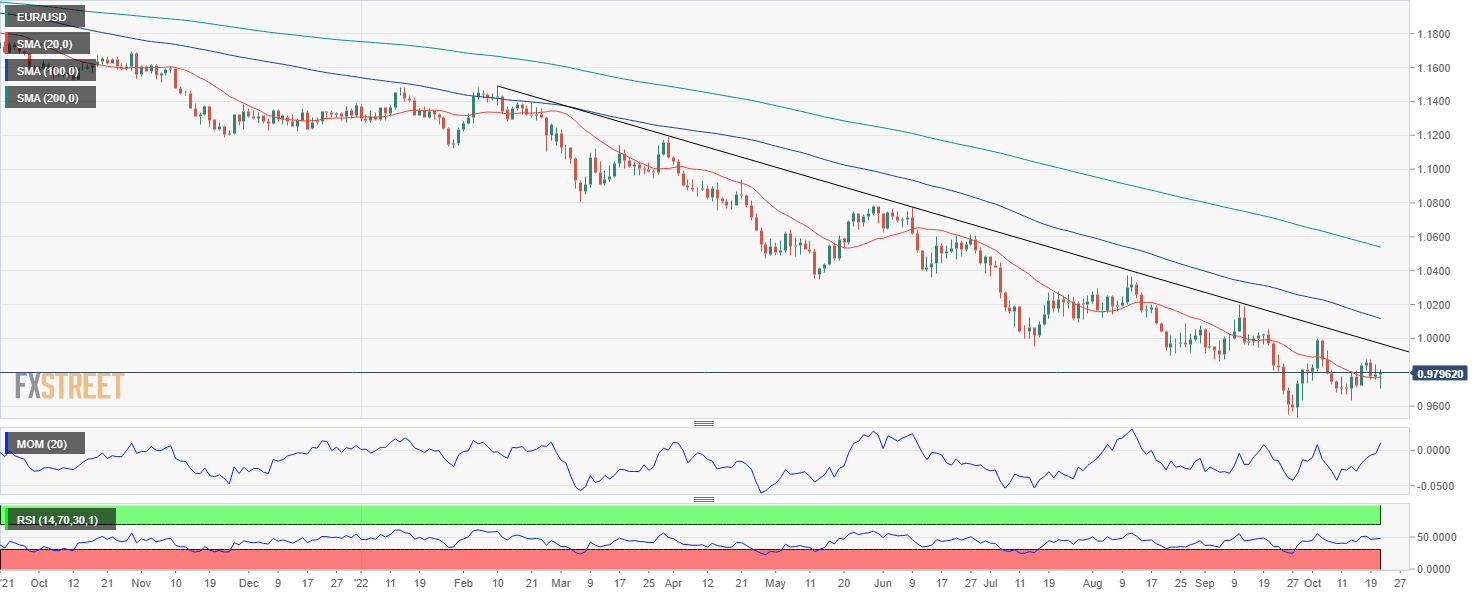
The daily chart supports a bearish extension as the pair develops below bearish moving averages, with the longer ones retaining their firmly downward slopes far above the current level. The Momentum indicator heads firmly south within negative levels, while the RSI turned lower and is currently at around 43, also anticipating further slides.
The immediate support level is 0.9630, where the pair bottomed on October 13, following the multi-decade low posted late in September at 0.9535. Once below the latter, the slide will likely continue toward the 0.9400 threshold. On the other hand, resistance can be found at 0.9840, the 0.9910 price zone, and the aforementioned trend line at 0.9970.
EUR/USD sentiment poll
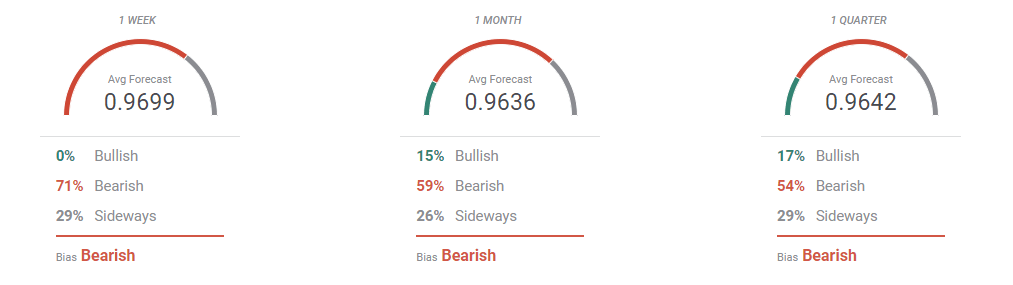
The EUR/USD FXStreet Forecast Poll shows that bears took full control of the pair. 71% of the polled experts are betting for lower lows in the near term, while the number of sellers remains above 50% in the monthly and quarterly perspectives. The pair is seen on average below the 0.9700 mark, which increases the risk of a bearish breakout toward fresh multi-year lows below the 0.9535 level.
The Overview chart shows that the near-term moving average is mildly bearish, with most potential targets just below the current level. On the other hand, the longer moving averages head firmly lower, in line with bears’ dominance. It is worth noting than in the monthly view, most targets accumulate between 0.9500 and 1.000, hinting at a potential bullish correction. Nevertheless, the quarterly perspective shows a large accumulation between 0.9100 and 0.9600, supporting the case for a lower low.
Premium
You have reached your limit of 3 free articles for this month.
Start your subscription and get access to all our original articles.
Author
Valeria Bednarik
FXStreet
Valeria Bednarik was born and lives in Buenos Aires, Argentina. Her passion for math and numbers pushed her into studying economics in her younger years.