EUR/USD Weekly Forecast: Could the ECB come to the rescue of the EUR?
- The European Central Bank meets to decide on monetary policy next week.
- The American economy hinted at resilience, despite the global downturn.
- EUR/USD holds around parity with modest signs of easing selling interest.

The EUR/USD pair seesawed around parity for a second consecutive week, volatile but unable to find direction. The American dollar dominated the FX board, although the shared currency was the most resilient, as EUR/USD refused to pierce the multi-year low at 0.9898 and settled around 1.0000.
Reality check for European policymakers
The EUR found support in comments from European Central Bank policymakers during the Jackson Home Economic Symposium, as they hinted at a more aggressive monetary tightening. French central bank head Francois Villeroy said on Saturday that the ECB needs a “significant” rate hike in September to push the main rate to neutral. ECB board member Isabel Schnabel also supported the case for a tighter monetary policy as she noted that “the cost of current high inflation becoming entrenched in expectations are uncomfortably high,” which means central banks “need to act forcefully.”
Market players rushed to lift odds for an ECB September hike to 75 bps, currently at around 67%, from roughly 25% before Jackson Hole. Sensitive government bond yields soared with the news, with bond prices plunging throughout Europe.
The European Union faces maybe the worst crisis since its formation, compliments to Russia. The Ukraine war has led to sanctions on Moscow which retaliated by cutting off energy supplies to the EU. Gas shortages across the Old Continent are pushing energy prices to record highs, which only fuel overheated inflation. The European Commission is studying an emergency intervention to cap prices, but as winter approaches, concerns mount, as there are no signs the crisis will be solved anytime soon.
Meanwhile, in the EU, official figures showed inflation surged by 9.1% YoY in August, and according to preliminary estimates, a new record high. The German Consumer Price Index was up by 7.9% in the same period, worsening from 7.5%.
Powell powerful message
In the US, macroeconomic hints showed that economic progress continues, despite being slower, somehow taking part of the burden of the Federal Reserve. Nevertheless, the central bank acknowledged that the current macroeconomic policy harms households and businesses but also reaffirmed it will maintain the focus on taming inflation. Speaking of which, there are some encouraging signs on the matter. The August ISM Manufacturing PMI sub-component Prices Paid shrank sharply in the month from 60 to 52.5. The official manufacturing index remained steady at 52.8, better than the 52 expected.
Furthermore, the Nonfarm Payroll report released on Friday showed that average hourly earnings rose by less-than-anticipated in August, while the country added 315K new job positions, slightly above forecast. On a negative note, the unemployment rate jumped to 3.7% as the participation rate increased to 62.4%.
Beyond the developments in the two major economies, it is worth noting that China put the city of Chengdu under lockdown, which is home to some 21 million people. Such actions in the world’s second-largest economy have taken their toll on global economic progress and pretty much triggered the latest setback. Beware of the potential effects such a decision may have in the upcoming months.
ECB comes next
The week ahead will bring some answers that could trigger plenty of volatility. The European Central Bank will have its monetary policy meeting on Thursday, September 8, and market players will finally know if the ECB has leaned towards taming inflation instead of preserving fragile growth. Should EU policymakers confirm a 75 bps rate hike, the shared currency may be able to recover further, potentially confirming an interim bottom in EUR/USD.
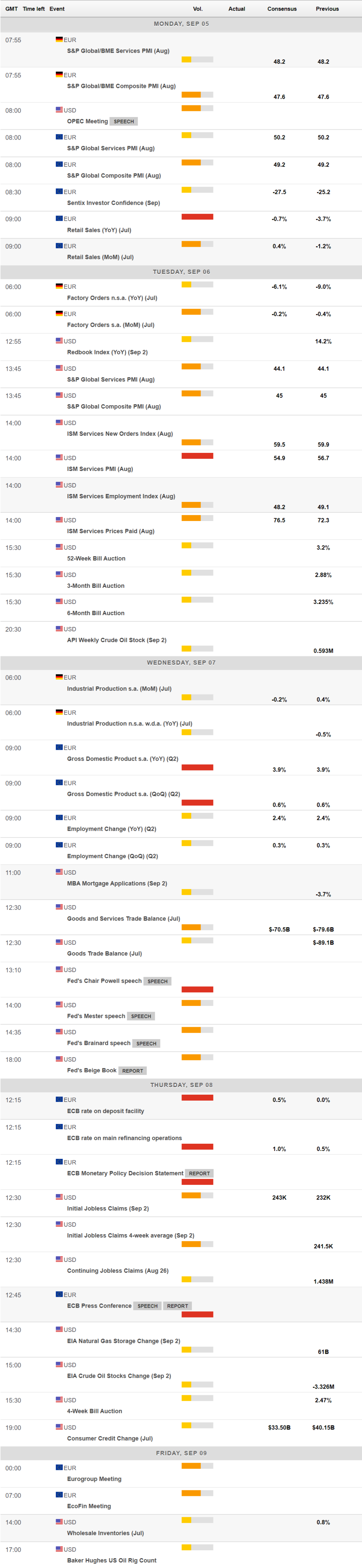
Ahead of the event, market participants will be cautious. Nevertheless, the macroeconomic calendar will include EU July Retail Sales and the US August ISM Services PMI. Also, the EU will publish the final estimate of the Q2 Gross Domestic Product, foreseen unchanged at 3.9%, while US Federal Reserve Chair Jerome Powell will be on the wires.
EUR/USD technical outlook
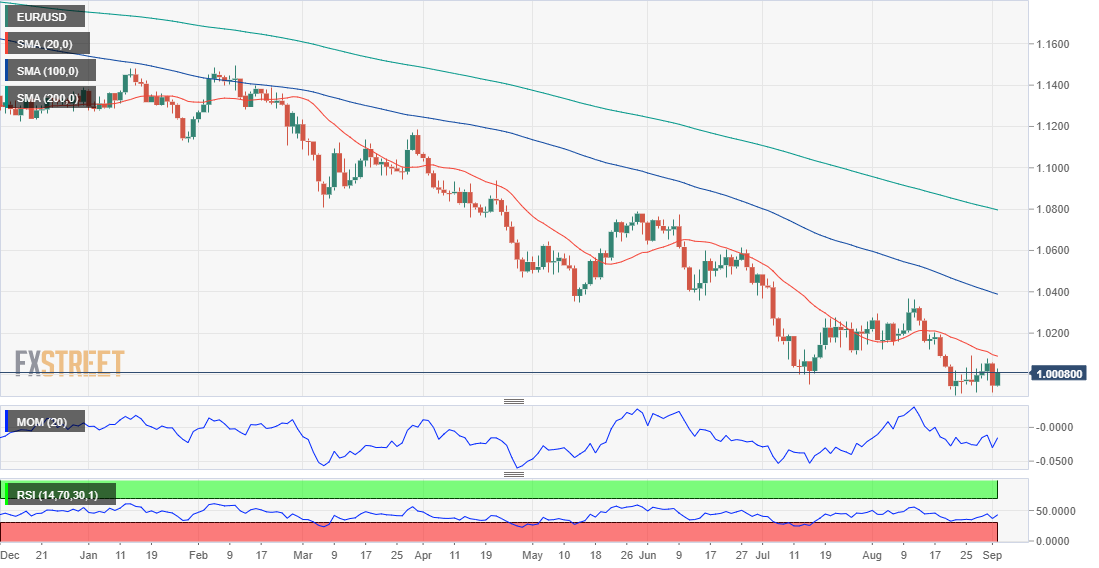
The long-term technical picture for EUR/USD is bearish. In the weekly chart, the Momentum indicator maintains its firmly bearish slope well below its midline, while the RSI indicator is currently consolidating at around 30, without signs of downward exhaustion. At the same time, the pair is developing well below a daily descendant trend line coming from this year’s high at 1.1490, which falls at around 1.0220 next week. Finally, the 20 SMA maintains its bearish strength above the trend line, while the longer moving averages are slowly turning south over 1,000 pips above the current level.
The daily chart shows that the pair has spent the last two weeks ranging around parity, without defining an upcoming direction. Technical indicators have bounced from oversold readings but remain within negative levels and far from suggesting additional gains ahead. Meanwhile, the 20 SMA heads south above the current level, providing an immediate dynamic resistance at around 1.0090.
The pair topped for a second consecutive week in the 1.0080/90 region, which means a clear break above the area should be read as a sign of easing selling interest. Beyond that level, the aforementioned trend line at 1.0220 is the next level to break to anticipate a firmer recovery towards the 1.0340 price zone.
An intermediate support level is 0.9950, followed by the yearly low at 0.9898. A break below the latter could open the door for a steeper decline towards the 0.9800/20 price zone.
EUR/USD sentiment poll
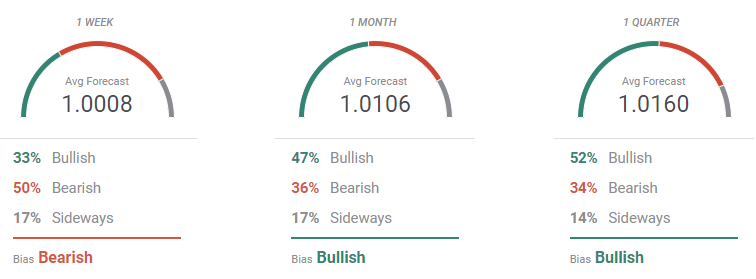
The FXStreet Forecast Poll hints at EUR/USD holding near the lower end of the year range in the near term, as bears dominate the weekly perspective, keeping the pair on average around parity. However, bulls dominate the monthly and quarterly perspectives as bears start giving up. Bulls stand at 47% and 52%, respectively, with the pair then seen on average above 1.0100.
The Overview chart shows that the near-term moving average has turned flat, with some higher highs surging. The monthly and quarterly perspectives maintain modest bearish slopes, although is notable the wider spread of potential targets, showing bears are starting to hesitate.
Author

Valeria Bednarik
FXStreet
Valeria Bednarik was born and lives in Buenos Aires, Argentina. Her passion for math and numbers pushed her into studying economics in her younger years.