February employment preview: Back to payroll reality

Summary
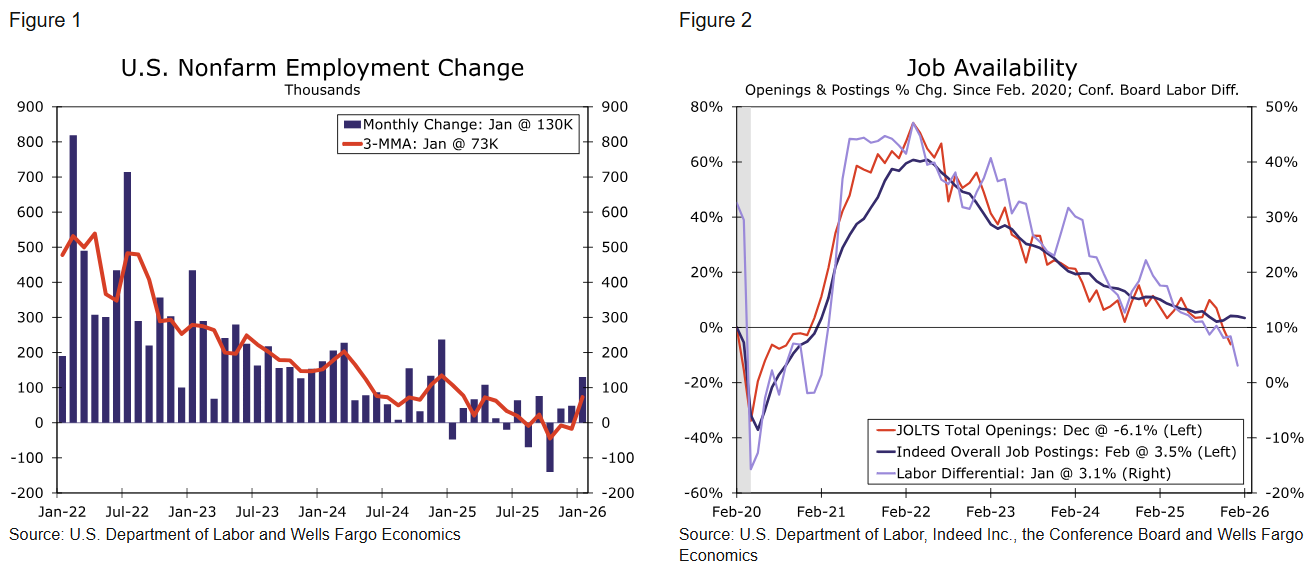
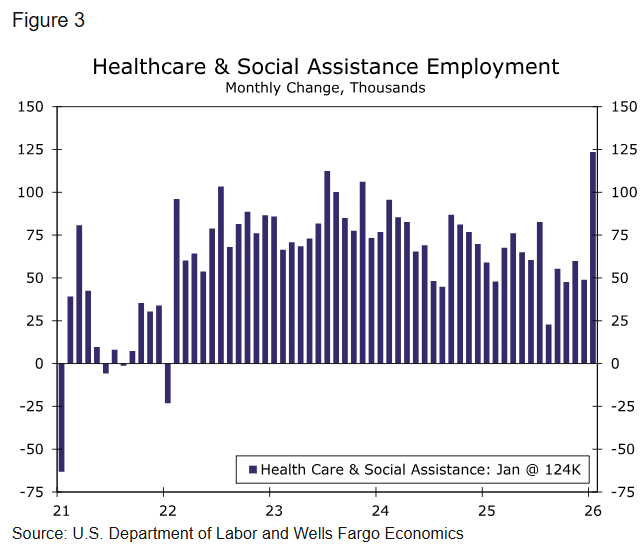
We expect the February employment report to show that January’s robust pace of job growth overstated underlying momentum in the labor market. We look for nonfarm payrolls to rise 45K in February, moderating from its current three-month average pace of 73K (Figure 1). While some stabilization in labor demand is evident, a range of indicators, including JOLTS and consumers' perception of job availability, continue to point to a gradual loosening in labor market conditions rather than a renewed acceleration in hiring (Figure 2).
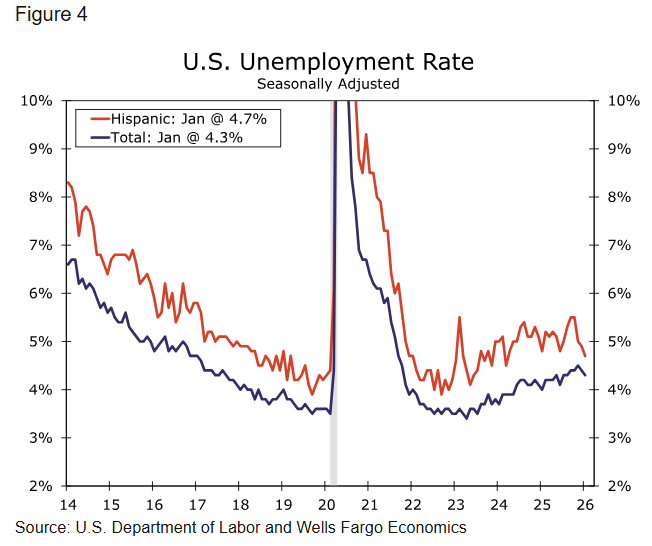
Looking across industries, last month's outsized gain in healthcare & social assistance is unlikely to be repeated (Figure 3). We expect either a downward revision to January and/or some payback with a sub‑trend reading in February for this sector. Although recent winter storms largely missed the payroll survey weeks, poor conditions throughout the month likely restrained hiring activity in weather‑sensitive sectors, such as leisure & hospitality and construction. By contrast, federal government job cuts should be starting to lose steam, which should help to lessen the drag on employment from the public sector. Netting out our expectation for a roughly 10K decline in government employment, we look for private sector payrolls to rise 55K in February.
The upcoming jobs report will incorporate the delayed annual population control to the household survey. The adjustment will revise the civilian non-institutional population in January 2026 to better align with the latest Census Bureau estimates. Historical data prior to 2026 will not be revised, leading to a step-change in the January levels. Accordingly, the levels of employment, unemployment, the labor force, etc. will not be directly comparable on a year-ago basis. Ratios such as the unemployment rate and labor force participation rate should be less impacted, although they too may not be entirely immune if the adjustments reveal a meaningful change in the composition of the population.
We look for the unemployment rate to hold at 4.3% in February, but we would hasten to add there are a number of cross currents this month that generate quite a lot of two-sided risk. The population control adjustments pose some downside risk, in our view, given the immigration shifts we have seen this year (Figure 4). At the same time, the household survey's measure of employment growth has been running well ahead of its trend the past two months, leaving some scope for payback in February that could push the jobless rate up to 4.4%. But in the end, we think these cross currents will net out to keep the u-rate steady.
After a stronger‑than‑expected gain in January, we expect average hourly earnings growth to return to a trend-like increase of 0.3% month-over-month in February. If realized, AHE would hold steady at 3.7% year-over-year.
Author

Wells Fargo Research Team
Wells Fargo