EUR/USD Weekly Forecast: Battle around 1.1000 to be decided by sentiment
- Federal Reserve chief Powell turned even more aggressive on monetary policy.
- The Russia-Ukraine crisis keeps escalating, affecting global economic developments.
- EUR/USD is hovering around 1.1000, with the risk increasingly skewed to the downside.


The EUR/USD pair hovers around the 1.1000 mark, unable to attract speculative interest throughout the week. Volatility has been limited, partially due to a scarce macroeconomic calendar, but also amid increasing uncertainty over the war. Russia escalated its attacks on neighbor Ukraine, while a diplomatic solution is slipping further away.
Occidental leaders keep piling up sanctions on Moscow. NATO announced it would enhance its presence of troops in the eastern and south-eastern parts of its territory, with soldiers from the US, Canada, Germany and the UK.
Eastern nations respond to Russia
US President Joe Biden met on Thursday with European leaders, G-7 partners and NATO allies, offering a press conference in the White House afterwards. Among other things, Biden said he would support expelling Russia from the G-20, adding that he understands sanctions will not deter Russia but will ultimately lead to the country stopping the invasion. Finally, he noted that allies are ready to respond if the Kremlin decides to use weapons of mass destruction, although he was reluctant to confirm the US will deploy soldiers in Ukraine.
The Eastern-European conflict is already weighing on global growth prospects and skyrocketing inflation. Central bankers are no longer worried about acting too soon on tightening monetary policies, but on the contrary, think it may be too late in this new global scenario.
Tighter monetary policies coming
The American dollar appreciated on Monday, as US Federal Reserve Chair Jerome Powell became even more aggressive. Speaking about the economic outlook at the National Association for Business Economics Annual Economic Policy Conference, he said “inflation is much too high” and that the central bank will respond accordingly. Powell joined the 50 bps hike club, as several Fed members have noted they would support such a move as soon as May. He noted that their plans to reduce the balance sheet would likely be completed by the next meeting, although he did not clarify when they would start shrinking it.
Powell’s words triggered a government bonds sell-off, which sent yields to their highest since May 2019. Yields retreated as days went by but finished the week higher.
In Europe, the European Central Bank keeps slowly dropping its patient stance. After President Christine Lagarde surprised with some hawkish comments in the last meeting, several ECB members have hinted at a possible rate hike in the EU before year-end. The central bank has already announced it will stop its bond purchases earlier than previously planned, now meant for the third quarter of the year.
The US Federal Reserve’s goal is to reach maximum employment and price stability, while the ECB’s commitment is focused only on price stability. Inflation in the US and the EU stands at multi-decade highs and is on the rise, as economies slowly recover from the massive lockdowns that hit the world at the beginning of the pandemic.
Speaking of which, a new wave of coronavirus is quickly spreading in Europe. A new strain, called Omicron BA.2, is triggering record contagions in Germany, but cases are also on the rise in the UK, France, Italy, Austria, among other countries. So far, governments have refrained from deciding on new restrictions, but chances are increasing. Nevertheless, it seems unlikely that countries will return to lockdowns unless health systems start to collapse.
Growth stable, but for how long?
On the data front, Markit published the flash estimates of the March PMIs. EU readings surprised to the upside, hinting at continued economic progress despite the war. It’s worth noting that April figures may be a great disappointment. The German IFO survey showed that the Business Climate deteriorated to 90.8, worse than anticipated.
US figures were mixed. February Durable Goods Orders were down 2.2%, much worse than the -0.5% expected. The preliminary Markit estimates of the US March PMIs were upbeat, while Initial Jobless Claims for the week ended March 18 shrank to 187K, beating expectations. Finally, the March Michigan Consumer Sentiment Index was confirmed at 59.4-
The next week will be a bit busier, as it will include the final readings of the German and EU March Consumer Price Index and the final reading of the US Q4 Gross Domestic Product. Finally, the US will release monthly employment figures on Friday. The Nonfarm Payroll Report is expected to show that the country added 450K new jobs in March, while the Unemployment Rate is expected to print 3.7%. Additionally, the country will release the March ISM Manufacturing PMI.

EUR/USD technical outlook
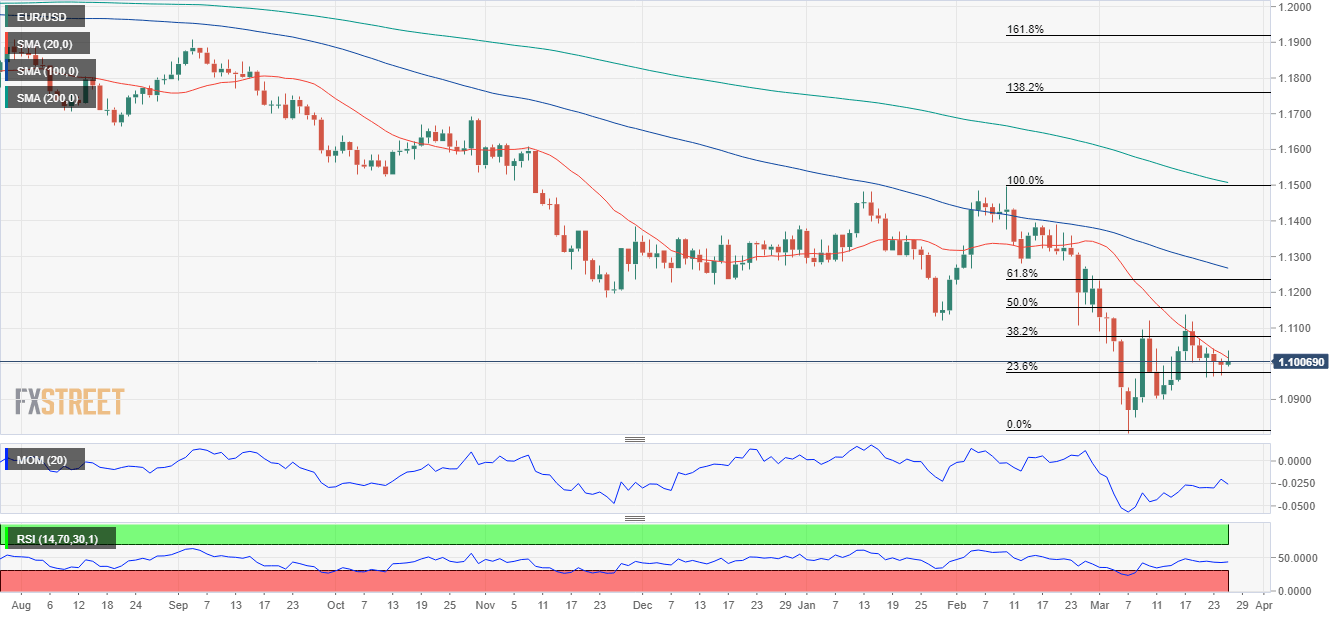
The EUR/USD pair is bearish, according to the weekly chart, as it shows that the price remains far below all of its moving averages. The 20 SMA heads firmly lower, now a handful of pips above the 61.8% retracement of this year’s slide. Technical indicators, in the meantime, remain directionless within negative levels.
The 23.6% retracement of the same rally provided weekly support in the 1.0960 price zone, the main area for bears to beat. Once below the latter, the pair could retest the year’s low at 1.0805.
The daily chart shows that the bearish 20 SMA which rejected bulls throughout the week, is now maintaining its downward slope at around 1.1015. The Momentum indicator advances within positive levels, diverging from the RSI indicator which is heading lower at around 43. Bulls may have better chances if the pair recovers beyond 1.1070, the 38.2% retracement of the aforementioned decline, with room then to extend gains towards the 1.1150 price zone.
EUR/USD sentiment poll
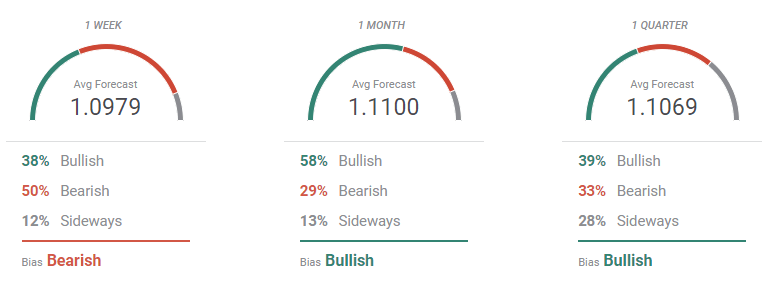
According to the FXStreet Forecast Poll, the EUR/USD pair will remain under pressure in the near term but could recover some ground afterwards. Bears stand for 50% of the polled experts in the nearest perspective, with an average target of 1.0979. Bulls are a majority of 58% in the monthly view, aiming to reach the 1.1100 price zone. Finally, the quarterly view suggests the pair will remain within the 1.09/1.11 price zone, with bulls barely overcoming bears.
The Overview chart indicates that bears hold the grip. The three moving averages under study head lower, with uneven strength. More relevantly, the same chart shows that the number of those betting for possible targets sub 1.1000 continues to increase and that the pair has the chance of reaching fresh 2022 lows.
Premium
You have reached your limit of 3 free articles for this month.
Start your subscription and get access to all our original articles.
Author
Valeria Bednarik
FXStreet
Valeria Bednarik was born and lives in Buenos Aires, Argentina. Her passion for math and numbers pushed her into studying economics in her younger years.