EUR/USD Forecast: On hold ahead of the US Federal Reserve


EUR/USD Current price: 1.1735
- The US Federal Reserve will likely leave its monetary policy unchanged.
- Market participants expect clearer clues on tapering timing.
- EUR/USD is neutral-to-bearish in the near term, could resume its decline once below 1.1700.
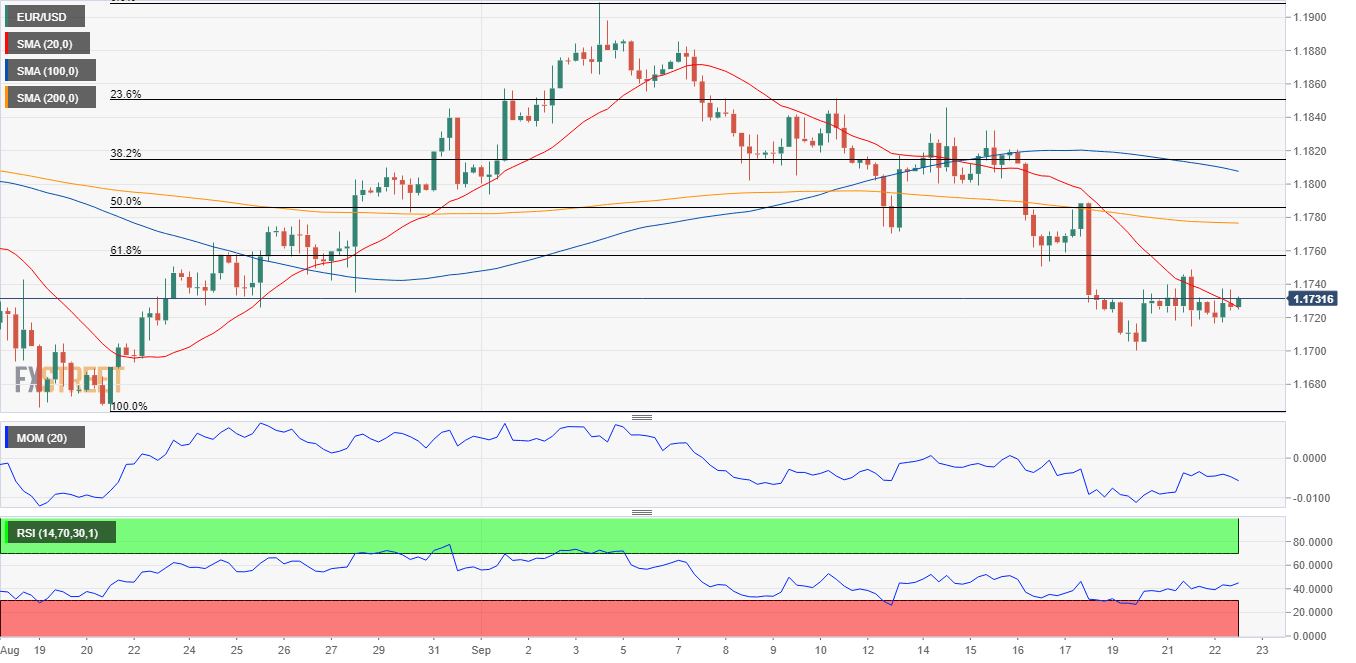
The EUR/USD pair quietly consolidates a handful of pips above the 1.1700 figure, with financial markets in wait-and-see mode ahead of the US Federal Reserve monetary policy decision. The central bank is widely anticipated to maintain its monetary policy on hold, as macroeconomic figures accompany the dovish tilt seen in August. Inflation has receded from its highs, somehow in line with policymakers temporary concept, while employment growth remains sluggish. Additionally, concerns related to the spread of the Delta variant put a hold on policymakers.
Nevertheless, the US economy is improving, as the second quarter Gross Domestic Product was confirmed at 6.6% QoQ. Hence, the Fed can’t avoid the tapering discussion. The most policymakers can do, is delay it towards 2022, which will likely be a nice boost to equities to the detriment of the greenback.
Ahead of the event, the US will release August Existing Home Sales while the EU will unveil the preliminary estimate of September Consumer Confidence, foreseen at -5 from -5.3 previously.
EUR/USD short-term technical outlook
The EUR/USD pair trades around 1.1730, below the 61.8% retracement of its latest daily advance at 1.1755, the immediate resistance level. The near-term perspective is neutral-to-bearish, as the pair is currently hovering around a bearish 20 SMA, which keeps heading lower below the longer ones. The Momentum indicator managed to cross into positive territory but lacks strength, while the RSI indicator consolidates around 43. Bears will likely add on a break below 1.1700.
Support levels: 1.1700 1.1660 1.1620
Resistance levels: 1.1755 1.1780 1.1820
Premium
You have reached your limit of 3 free articles for this month.
Start your subscription and get access to all our original articles.
Author
Valeria Bednarik
FXStreet
Valeria Bednarik was born and lives in Buenos Aires, Argentina. Her passion for math and numbers pushed her into studying economics in her younger years.