EUR/USD Forecast: Fearful of the Fed and Trump's tariffs after setting a lower high
- EUR/USD has been edging lower amid growing trade uncertainty.
- The Federal Reserve's decision may boost the dollar.
- Wednesday's four-hour chart is worsening for the currency pair.

To tariff or not to tariff? That is the question on President Donald Trump's agenda – and for markets – four days ahead of the December 15 deadline. White House advisors Larry Kudlow and Peter Navarro have both said that the president is yet to make a decision – adding to market tensions, which support the safe-haven US dollar.
On the other hand, officials on both sides of the Pacific are working together on a potential delay in the new levies, providing some calm. Trump will meet his trade negotiators on Thursday and perhaps announce a decision.
Fed in focus
The Federal Reserve is in the spotlight today. The world's most powerful central bank is set to leave interest rates unchanged after cutting them three times in a row. Investors will examine the statement as well as the Fed's new interest rate projections – the "dot-plot" to gauge the next moves. Bond prices are reflecting another rate reduction in the second half of 2020.
Jerome Powell, Chairman of the Federal Reserve, will hold a press conference after the decision and may reveal details about the bank's reaction function.
See
- Federal Reserve Preview: Watching for the Projection Materials
- Fed Preview: Is the bar higher for hiking? Powell's may down the dollar, three things to watch
Ahead of the Fed, the US will publish Consumer Price Index figures for November. Economists expect the core CPI to remain at 2.3%, and any deviation may move the dollar and also shape expectations for the central bank's decision.
See US CPI Preview: Inflation nostalgia
The European Central Bank will announce its decision on Thursday, the first one under Christine Lagarde as president. Lagarde will likely call for unity after her predecessor Mario Draghi's controversial new stimulus package.
Recent euro-zone figures have been encouraging. The German ZEW Economic Sentiment beat expectations with 10.7 points in December.
See ECB Preview: How Lagarde's debut December decision may drive EUR/USD higher, three scenarios.
Overall, trade headlines and the Fed decision top the agenda, but many other moving parts are eyed.
EUR/USD Technical Analysis
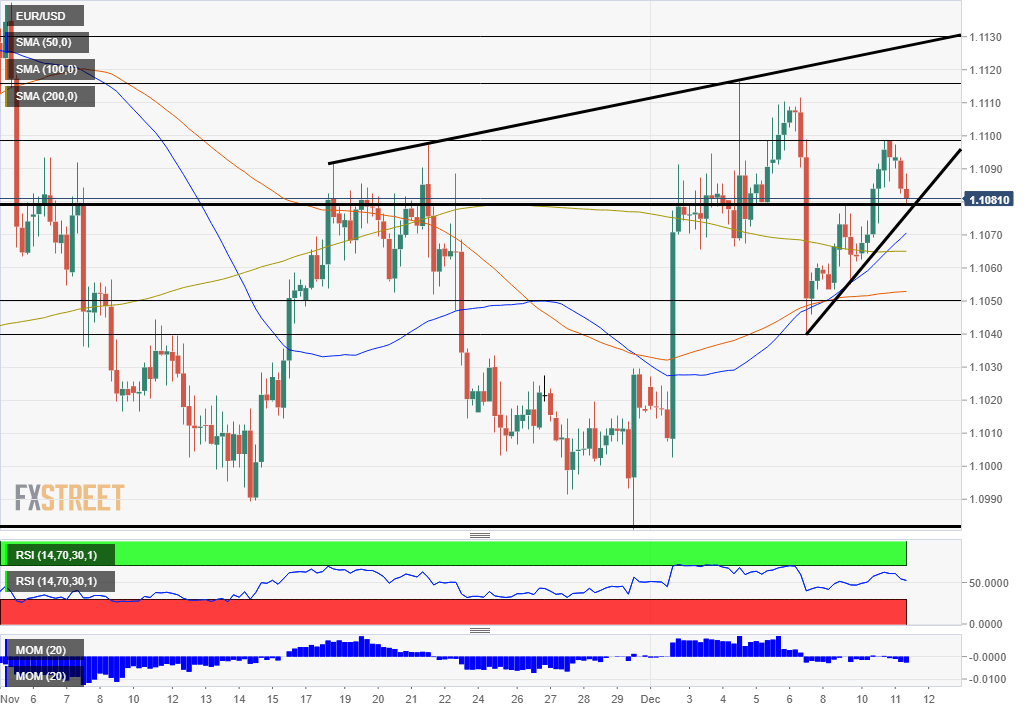
By failing to recapture 1.11 and retreating, euro/dollar has set a lower high – a bearish sign. Moreover, momentum on the four-hour chart remains to the downside.
On the other hand, the currency pair is clinging to uptrend support, which converges with the former resistance line of 1.1080. This level is now critical. The currency pair continues trading above the 50, 100, and 200 Simple Moving Averages.
Support awaits at 1.1050, which provided support in late November and is also where the 100 SMA meets the price. It is closely followed by 1.1040, Friday's low. The next cushion is only at 1.0980, which was the low point in November, followed by 1.0940.
Resistance awaits at 1.11, followed by 1.1115, which is December's high. Next, we find 1.1130 and 1.1180.
Author

Yohay Elam
FXStreet
Yohay is in Forex since 2008 when he founded Forex Crunch, a blog crafted in his free time that turned into a fully-fledged currency website later sold to Finixio.

















