Central banks take centre stage as markets navigate messy US data


US equity benchmarks fell on Wednesday, led by declines in tech (2.2%), industrials (1.6%), and consumer discretionary (1.2%). The Nasdaq 100 shed nearly 500 points, down 1.9% to 24,647; the S&P 500 dropped 78 points (1.2%) to 6,721, and the Dow Jones Industrial Average was down 228 points (0.5%) to 47,885.
In the FX space, the USD Index caught a bid yesterday, though the move was capped by daily resistance around 98.58. Longer-dated US yields increased moderately, while shorter-dated maturities were largely unchanged. Meanwhile, in the commodities complex, it was another positive day for Gold and Silver. The former is now on the doorstep of record highs at US$4,381, while the latter refreshed all-time pinnacles at US$66.89, up a whopping 130% YTD.
As European cash markets prepare to open, traders are looking to a packed docket today, dominated by the November US CPI data and updates from the BoE and the ECB.
US CPI data on deck
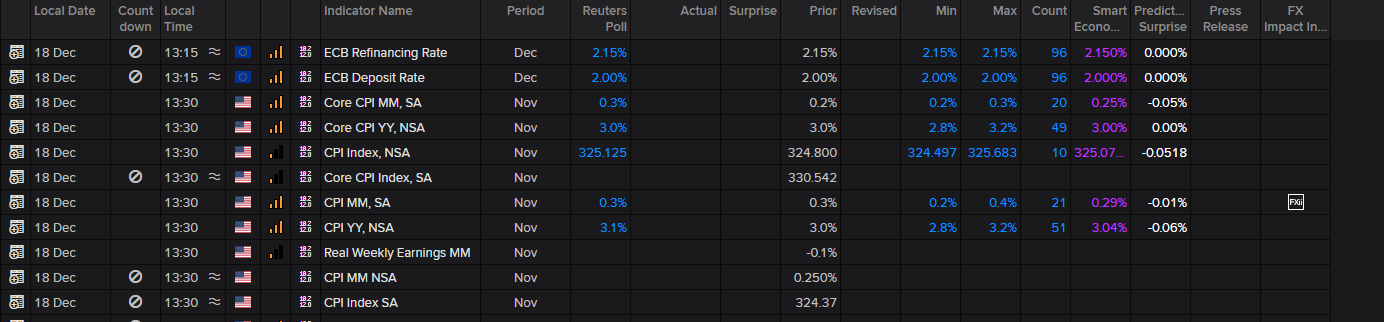
Today’s November US CPI inflation report will make the airwaves at 1:30 pm GMT, though this could prove to be a messy print. The US government shutdown prevented data collection in October, so today’s report will reflect a blend of October and November figures. As shown in the LSEG calendar below, median values for the YY headline data suggest a slight uptick to 3.1% from 3.0% in September, while YY core numbers are expected to remain unchanged at 3.0%.
Despite price pressures remaining north of the Fed’s 2.0% inflation target, the central bank is clearly concerned about the labour market. Investors have assigned about a 25% chance that the Fed will cut rates in January next year (-7 bps), with about a 50/50 chance at the March meeting (-15 bps).
Although today’s release shows data-collection complications, if inflation eases or we see an in-line print, this could boost expectations for Fed rate cuts and weigh on US yields and the USD. If you look at the forecast distribution for the YY headline figure, only 2% of polled economists call for 2.8%; therefore, a 2.8% or lower reading today would likely be USD negative and could be something to consider trading out of. A higher-than-expected number (>3.2%) would, of course, have the opposite effect, albeit a USD bid will likely be short-lived.
BoE rate announcement: Counting doves
This afternoon also welcomes an announcement from the BoE at midday GMT. Money markets have fully priced in a 25-bp rate cut, lowering the bank rate to 3.75% from 4.00%. Although odds were already heavily in favour of a rate cut, investors increased bets following the October jobs data and the November inflation print earlier this week.
The key focus at today’s meeting will be the MPC vote split. Like the markets, I do believe that this week’s inflation data – which came in much lower than expected on both the headline and core YY fronts – will be enough to nudge BoE Governor Andrew Bailey to side with the doves.
However, given that markets now fully expect a rate cut, I think it will come down to the central bank’s forward guidance and whether more MPC members shift dovish. Remember, on 6 November, a clear division was evident among policymakers. Members Breeden, Dhingra, Ramsden, and Taylor voted to cut the bank rate and are expected to do so again, while members Greene, Lombardelli, Mann, and Pill are anticipated to vote to keep rates unchanged. With Bailey expected to vote to cut rates, if there is a further dovish shift in the MPC vote – for example, a 6-3 in favour of a cut – this will weigh considerably on GILT yields and the GBP. Similarly, if the BoE’s language becomes more dovish, it could also have a marked impact across UK markets.
To be frank, I feel the BoE announcement will be far more interesting and potentially market-moving than the ECB at 1:15 pm.
ECB decision: When standing pat is the play
In terms of the ECB, markets are fully pricing in a no-change decision, leaving the deposit rate at 2.00% and the main refinancing rate at 2.15%. With eurozone GDP growth recently revised higher, unemployment at historic lows, and headline inflation hovering around 2.0%, the central bank does not need to cut rates. In fact, rate cuts have all been priced out, with a small chance of a hike implied in the latter part of 2026. My base case is that the ECB keeps rates where they are next year, but if markets lean more heavily in favour of hikes, this would, of course, benefit the EUR.
As I noted in previous posts, for today’s meeting, I expect ECB President Christine Lagarde to reiterate her usual ‘policy is in a good place’ and that the central bank is not ‘pre-committing to a particular rate path’. Most analysts, however, noted that they expect the ECB to raise its growth forecasts.
Author
Aaron Hill
FP Markets
After completing his Bachelor’s degree in English and Creative Writing in the UK, and subsequently spending a handful of years teaching English as a foreign language teacher around Asia, Aaron was introduced to financial trading,